

Georges Auric
1899–1983
Life
Georges Auric was born on 15 February 1899 in Lodève in the Hérault department and grew up in Montpellier. As a teenager he was already composing eagerly, and in 1913 the family moved to Paris, where he studied at the Conservatoire. He then took lessons with Vincent d'Indy at the Schola Cantorum.
Through the composer Erik Satie and the poet Jean Cocteau, Auric became part of the postwar Parisian avant-garde. In 1920 the critic Henri Collet counted him among Les Six, which also included Darius Milhaud, Arthur Honegger and Francis Poulenc. Alongside composing, Auric wrote music criticism and later took on management roles: from 1962 to 1968 he was artistic director associated with the Paris Opéra and the Opéra-Comique.
Works and Style
Auric is regarded as a composer with an ironic tone, who combines folk-like melodies with refined harmony. In doing so he deliberately distanced himself from the shimmering, chromatic sound world of Debussy. His early pieces are energetic and angular; in the 1930s he turned to a more accessible, popular idiom. His classical training is clearly audible in his craftsmanship, especially in his lean scores, often scored for only a few instruments.
Well-known Works
Auric made his name with the ballet Les Matelots (1925), and further stage works were written for the Ballets Russes. His career as a film composer began in 1930 with Cocteau's Le Sang d'un poète. Scores followed for René Clair's À nous la liberté, Cocteau's La Belle et la Bête (1946) and Moulin Rouge (1952), whose song became a great success. For the stage, in 1924 he wrote the incidental music to Marcel Achard's comedy Malborough s'en va-t-en guerre!, staged in Paris under the direction of Louis Jouvet. This piece is among the works that appear in concert life today.
In Concert Life Today
Today Auric is present above all through programmes of wind and chamber music that place his music alongside works by his contemporaries. At the Staatsoper Hannover in January 2027, a line-up of oboe, clarinet and bassoon can be heard, performing Auric together with Ibert, Tomasi, Decruck and Françaix. In March 2027 he is heard at the Staatsgalerie Stuttgart in a song recital with baritone and piano, alongside Poulenc, Satie and Dessau. In June 2027 the Oldenburgisches Staatstheater presents Malborough s'en va-t-en guerre! in a programme by a chamber ensemble with clarinet, trumpet, bassoon, violin, cello and piano, supplemented by Martinů. In November 2026 Auric was heard at the Pavillon der National-Bank in Essen in an evening of woodwind music that brought together French composers such as Milhaud, Tansman and Ibert. In this way his output remains alive in Germany, above all in the context of French wind and chamber music.
Upcoming concerts featuring works by Georges Auric
Monday 18 January
20:00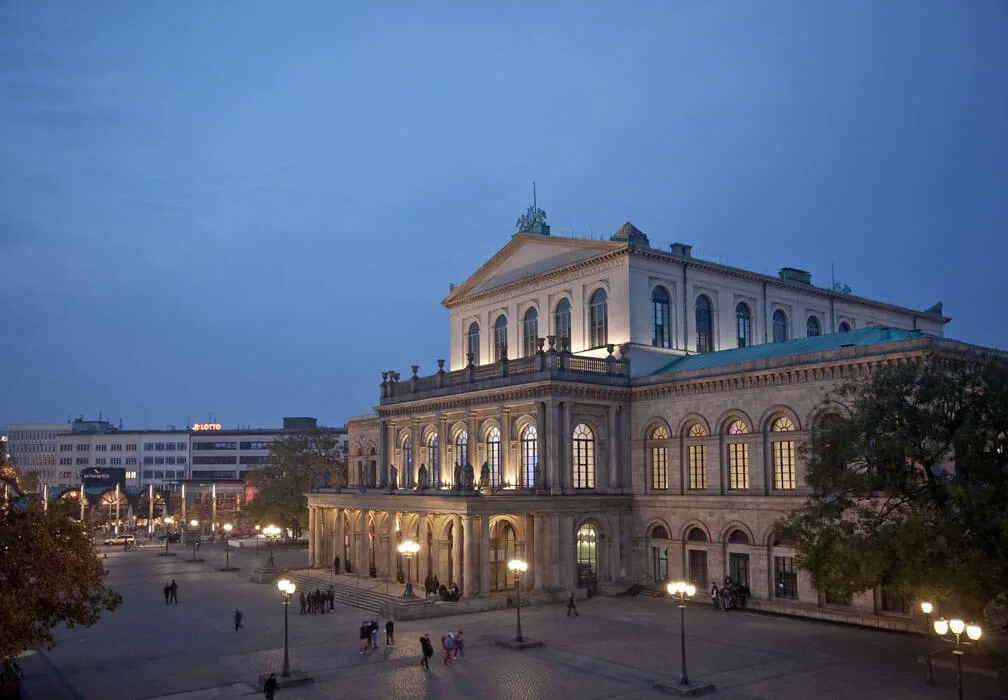 Anke-Christiane Beyer (oboe), Katharina Arend (clarinet), Lisanne Traub (bassoon)Anke-Christiane Beyer (Oboe) Katharina Arend (Klarinette) Lisanne Traub (Fagott)Staatsoper Hannover, Hannover, Telefon: 9999 00
Thursday 18 March
19:30Holger Falk (baritone), Steffen Schleiermacher (piano)Holger Falk (Bariton) Steffen Schleiermacher (Klavier)Staatsgalerie Stuttgart, StuttgartSunday 6 June
11:15 Kai Bröckerhoff (clarinet), Matthias Elsaeßer (trumpet), Jens Pfaff (bassoon), Elija La-Bonté (violin), Friederike Seeßelberg (cello), Eric Staiger (piano)Kai Bröckerhoff (Klarinette) Matthias Elsaeßer (Trompete) Jens Pfaff (Fagott) Elija La-Bonté (Violine) Friederike Seeßelberg (Violoncello) Eric Staiger (Klavier)Oldenburgisches Staatstheater, Oldenburg