

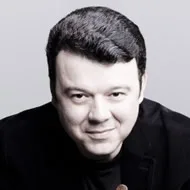
« Instruments are living, breathing beings with soul, feelings, moods and opinions. »
Vadim Gluzman's extraordinary artistry lies in continuing the great violin tradition of the 19th and 20th centuries, which he revitalises with the freshness and dynamism of the present day. His broad repertoire includes, in particular, contemporary music, which he champions and loves. He is a sought-after soloist worldwide; live recordings as well as award-winning albums, which he has recorded exclusively for the BIS label, complement his extensive concert activity.
Classicpoint.net: As a child you deceived your parents into thinking you had been practising a lot. When did that change, and did you enjoy practising?
I believe the real reason I started playing the violin was a case of childish jealousy. My father is a conductor and my mother a musicologist. Both teach, and I wanted to receive just as much attention from them as they gave their students. So I wanted to be taught by them too. However, they had the wisdom not to teach me themselves, but instead enrolled me at a school for musically gifted children in the Soviet Union. At that time I was living in Riga, the capital of Latvia. At the end of the auditions they said that I had a very strong sound and that I had passed. Then the jury wanted to see my hands. I was absolutely convinced that they wanted to check whether my fingernails were clean. The next day they posted the list of accepted students. I was on the list, and next to my name stood "Skripka" - violin. There was no discussion and no negotiation. I was told that I was a violinist, and that was that. I had to come to terms with it.
In Russian the violin is feminine and the piano masculine. My father had explained to me that the piano is the king of instruments and the violin the queen. What do you think a six-year-old boy would want to play, a queen? Of course not, he wants to play the king! I resolved that on my next visit to Riga I would ask people how they assess the hands of six-year-olds. How do they foresee development, how can they judge whether these will become good violinist's hands? Because in fact my hands are good for the violin, but they are not suited to the piano at all. My first teacher still teaches at that school; he is now almost 80 years old.
When we emigrated to Jerusalem after the collapse of the Soviet Union, it was a cultural shock for me. Personally, musically, artistically, in every way: there was a completely different attitude towards everything. What appealed to me most was my newly gained self-determination, the fact that I was now able to make decisions independently. Freedom is a gift given by God, and it had been taken from us in the Soviet Union. Arriving in a place where democracy is lived was like realising that I had never before truly breathed. Until I was 16 I was not allowed to breathe, and I was not even aware that I was not breathing. But suddenly I had access to oxygen, to this freedom, and it completely changed my perspective.
From childhood I was told: "You are a violinist." The mere idea that I could question this statement was unimaginable. But once I was allowed to question my world, I began to doubt it. Was I really a violinist? There was a time when I believed that I was not. Had it not been for Isaac Stern and Arkady Fomin (my first teacher in Dallas, when I went to America to study), I would probably have given up. They were guiding figures; they dissuaded me from doubting my future and instead encouraged me to shape it.
You were taught according to the Russian School model. What do you think of this type of teaching today?
That is not entirely correct. I studied in the former Soviet Union, but my first teacher in Riga (Romans) taught according to the German school and tradition of violin playing. My only real contact with the Russian school was the one year of study with Zakhar Bron in Novosibirsk. So I cannot be described as a representative violinist of the Russian school. Nevertheless, I am very familiar with it. There are many positive aspects, such as a very high level of professionalism from an early age and a solid basic technique. But there are also many aspects I dislike. The focus is placed too strongly on the virtuoso repertoire, there are not enough genuine performance opportunities, and little early chamber music experience. This results in a very one-sided education. The teaching is usually very authoritarian and based on the one "correct" interpretation of the teacher, rather than encouraging students to find and develop their own opinions, their own taste and their own musical direction.
Please tell us how it came about that you were taught by Isaac Stern? What did you learn from him?
I was 16 years old and had only just arrived in Jerusalem two weeks earlier when I learned that Isaac Stern was auditioning children at the Music Centre. Everyone else had probably arranged an audition two years in advance, but I simply went there, introduced myself and said that I wanted to play for Isaac Stern. Eventually he came into the room, the receptionist explained to him that a boy from Latvia had turned up, and he was kind enough to listen to me. A few hours later I left the Music Centre with a new violin, a place at school, a scholarship and the awareness that I knew absolutely nothing about music, let alone about violin playing itself.
My close relationship with Isaac Stern helped me enormously, although it was anything but easy. He had an incredible energy within him, like a machine that never lets him stop. Nothing was good enough, and I mean that in the most positive sense. He was only interested in what could be improved. It was pointless to waste time concentrating on strengths when one could instead perfect weaknesses.
Your teacher was also Zakhar Bron. You studied in the same class as Maxim Vengerov, Vadim Repin and others. What was that like?
Looking back, it was an extremely exciting time. Of course, at the time I could not really enjoy it; I was a teenager, but what an environment, growing up together with all of them. Basically, it was a daily competition. Not only Maxim and Vadim were there, but also Natalia Prischepenko, who was for a long time first violinist of the Artemis Quartet. … It was truly an incredibly fertile environment, and Zakhar Bron was, of course, a wonderful source of inspiration. He knew how to inspire us in the most varied ways, either by playing for us or by shouting at us, and each of us received truly individualised treatment.
Do you have any tips on how to deal with nerves?
Nerves: that is quite simple, I just don't concern myself with them. Of course I become nervous like everyone else, and of course it affects my playing. The only remedy I have found over all these years is to get on stage, again and again. Experience is the best recipe. Go on stage as often as possible. There is absolutely no other way. At the beginning one is anxious, that is quite clear. Even when you are standing in front of just 10 people, you are almost too nervous to speak. That is normal. But normal is good; I see nothing wrong with it. Frankly, once you know how to handle nerves, they only improve the performance. Now and then I manage to channel what is called "nerves" and turn it into creative inspiration. It will not diminish your performance once you have learnt to deal with it. And you learn this by doing it. You can learn to make your nerves your friend. Keep your friends close, and your enemies closer. And perhaps one day you will recognise, truly recognise, that we only produce sound, hopefully beautiful sound. We do not operate, we do not build buildings, we do not manufacture products. What we do does no harm to anyone, even when we do it badly. If you truly love what you do, if you cannot live without music, the day will come when accumulated experience compensates for the nerves. I tell everyone who asks me this question: find every possible opportunity to perform, and do not think about money, at least not in that moment. A care home, a church, a synagogue or any other performance opportunity. And then simply play.
You travel a great deal around the world to give concerts. Is there a funny story you could tell us?
My favourite funny moments always happen during rehearsals or sometimes during concerts, when musicians play tricks on each other. Unfortunately, these stories cannot be retold; one has to experience them oneself. But one funny moment comes to mind. A few years ago I got the start time of a concert at the festival in Colorado wrong. I had barely any time to open the violin case, tune the violin and walk onto the stage. I had already played half of Prokofiev's Sonata No. 2 when I noticed that I had forgotten to change my shoes and was wearing white running shoes with bright yellow stripes. It was incredibly hard not to laugh, and I am sure that many audience members wondered about my sense of style.
You play the legendary 1690 ex-Leopold Auer Stradivari. Can you tell us something about this wonderful instrument?
The ex-Leopold Auer violin was made by Antonio Stradivari in 1690. The instrument was named after its former owner, a Hungarian-Jewish violinist who was one of the most important violin teachers of the 19th century. Among his students were legends such as Heifetz, Elman and Gorski. Auer lived from 1845 to 1930. He lived for half a century in Russia and served as imperial court violinist to three tsars.
Mary Galvin and Geoff Fushi, the founders of the Stradivari Society, heard my recital debut at the Ravinia Festival. They must have liked what they heard, because when I returned home from a tour a month later, there was a message on my answering machine inviting me to Chicago to collect a violin that had just become available. I travelled there the very next day. When the violin was handed to me and I began to tune it, I had a distinct feeling that someone was watching me from behind. I turned around and saw a huge portrait of Leopold Auer gazing at me from the wall of the Bein & Fushi shop!
I realised that I found the Russian connection incredibly inspiring. I was trained in the Russian tradition, and this tradition was founded with this instrument. Yes, I love the historical link that this violin offers me. But I think that while I close this circle, I can at the same time begin something new. I very strongly believe that instruments are living, breathing beings with soul, feelings, moods and opinions. A relationship with an instrument is in many respects comparable to human relationships. As in every relationship, one influences the other and leaves parts of one's soul in the other. We certainly leave our stamp on the instrument. Whoever played this violin before me since Auer, Leonidas Kavakos and Dylana Jensen, all of them left a part of their soul in the instrument.
The violin is a part of my body. Words cannot describe how beautiful this instrument is. Through it I can run 15 times faster, dive 15 times deeper. When I first held this violin in my hands and produced sounds with my bow, I understood that my life had changed.
This violin possesses all conceivable and sometimes even unimaginable shades of colour and intensity, from the darkest, deepest, most intense colours to the brightest, featherlight, most heavenly sounds! To have such a vast range at one's disposal is the greatest gift for an artist. It constantly inspires me to seek new sounds and interpretations.
You recently recorded Brahms with the Lucerne Symphony Orchestra. What is your connection to the composer Brahms and to the works you have recorded?
It is important to remember that it was a modern piece when Joseph Joachim played it. Thanks to his curiosity, his forward-looking outlook and his trust in composers such as Brahms, we have this repertoire. Of course I am not saying that Brahms could not have written this concerto without Joachim, but without his influence it would have become a different piece. Many years ago, when I first played this concerto with orchestra, I walked onto the stage and the orchestra played the opening tutti. I remember that I suddenly had this question in my mind: "Who gives me the right to play this music?" This had never happened to me before, neither while practising nor during rehearsals. Only when I stood in front of the audience was I struck by this thought like a cold shower. But I realised that I cannot carry the weight of all the great interpreters who have played this piece on my shoulders. That would be paralysing in a certain way. All I can do is convey how I feel about this piece, as honestly as I can.
By now I have played almost everything Brahms wrote for violin, and I have also dared to record some of the works. It goes without saying that he is one of the greatest composers humanity has ever produced. Every single work is a masterpiece without exception. Every time I play the Brahms Violin Concerto, for example, I feel as if I have come into possession of a perfect palace with extraordinary exterior and interior architecture. My task is then to furnish it with furniture and decorations in such a way that the beauty of the palace is highlighted, while at the same time making it unmistakably my own. It is a delicate balancing act, a great challenge, but it brings incredible inspiration and satisfaction.
The sonata moves me as deeply as hardly any other work by Brahms could. There is something incredibly intimate and deeply moving in it that cannot be put into words. It is one of Brahms's most introverted works, and that makes it all the more powerful and impressive emotionally. Internal bleeding is the most painful kind, and that is how this work feels to me.
What interests you apart from music?
I love reading; I always have three or four books in my suitcase. So far I do not read electronically. My tastes are wide-ranging: from biographies, historical books and novellas to crime novels, I read pretty much everything.
Interview by Florian Schär | Classicpoint.net | 3.10.2017
© Photo: Marco Gorggreve
More interviews
All interviews →


