

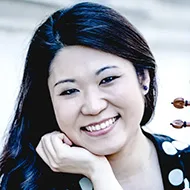
«Without analytical experience, my intuition would not exist.»

Born and raised in Beijing, Tianwa Yang recorded Niccolò Paganini's 24 Caprices on CD at the age of 13, becoming the youngest performer ever to do so, and was regarded in her homeland as the "Pride of China". At 16, she came to Germany on a DAAD special scholarship, laying the foundation for her career in Europe. Her artistic development was accompanied and profoundly shaped by Lin Yaoji, Jörg-Wolfgang Jahn and Anner Bylsma. In 2014 she was awarded an ECHO Klassik as "Young Artist of the Year" as well as the annual prize of the German Record Critics' Award. In 2015 she received another ECHO Klassik, this time as "Instrumentalist of the Year".
She is a sought-after soloist and teaches as a professor at the Hochschule für Musik in Würzburg.
Do you see yourself today more as a "global" musician, or do your cultural roots continue to play a central role for you?
I feel more like a European musician, because my musical roots come from Bach, Beethoven or Brahms; I grew up with their music.
How do you approach a work that you are adding to your repertoire for the first time – more analytically or intuitively?
I would say there is no clear separation between "analytical" and "intuitive". For me, intuition can only arise from experience, just as I cannot have an intuition for a foreign language that I don't speak at all.
My intuition for music or for a new piece is therefore based on countless experiences with other pieces of music that I have studied, thought through and worked out analytically. Without these analytical experiences, my intuition would not exist, or would be very different.
Classical music business is often performance-oriented and demanding. How do you deal with pressure and high expectations?
For me – and probably for many of my fellow musicians in the industry as well – the greatest pressure or the highest expectations come from myself. The pressure often shows itself in everyday life; especially nowadays, as a soloist you are also occupied and confronted with many other things besides making music. Simply playing chamber music with wonderful musicians and dear friends is for me the most beautiful balance. Enjoying the beauty of music – the very thing we all drive ourselves crazy for!
What helps you to remain artistically curious and open?
The love of music, staying self-critical, and continuing to educate myself, not only in music but also in many other areas, whether artistic or scientific.
How did your training in China and later in Europe shape your musical thinking?
In my youth, discipline and diligence were the most important elements of my training. Later, through the musical personalities who strongly influenced me, I learned that constantly questioning and staying curious are among the most important elements of musical work.
What role does silence play in your musical work – in practice, in concert, in everyday life?
Silence is very important in music! Every rest, unless it is at the end of a piece, is almost more exciting than a sounding note. Of course, silence is also very important in practice and in concert, so that we can truly feel the tension within that silence. For example, I love practising at night, of course only when it does not rob anyone else of their sleep.
What are your passions besides music?
Reading, hiking in the mountains, drinking coffee in cafés!
Interview by Florian Schär | Classicpoint.net | 1 April 2026
Image copyright: Andrej Crilc