

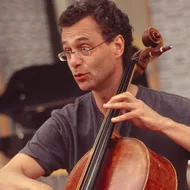
«An international career depends on many factors.»
«An international career depends on many factors.»
As an internationally renowned soloist, composer and teacher, Thomas Demenga is one of the most outstanding cellists and musical personalities of our time. Since 1980 he has led a training and soloist class at the Musikhochschule Basel. Since 2011 he has been artistic director of the Camerata Zürich.
You studied with Antonio Janigro and Mstislav Rostropovich, among others. How did you experience these great cellists, and what did you learn from them?
From Antonio Janigro, a style of playing marked by nobility and great musicality, and the fact that music and cello technique are linked – so cello technique should be acquired through musical processes and not on its own. From Rostropovich, his tremendous energy and the will to express something. Always coupled with visions or images, sometimes with very everyday comparisons. Being able to experience Rostropovich's phenomenal qualities at close quarters was a formative experience for me.
You also studied with Leonard Rose and lived in New York during that time. To what extent did that period shape you?
Above all the city of New York itself, with its incredibly rich cultural offering and the city as such, its bustling life. Not so much the Juilliard School or Leonard Rose (who was very rarely there...). I played more frisbee with Nigel Kennedy in the corridors of the Juilliard School than I practised the cello... And we played duets together on the streets of Manhattan and earned quite good money doing so.
You are particularly engaged with contemporary music and often seek to juxtapose it with other musical eras. Such juxtapositions are familiar from concert programmes. How did you come to apply this concept to CD recordings as well, for example the Bach suites?
At that time I was one of the first to perform such solo programmes – the step to a CD recording was then a small one – but it also required the right label. In 1980 I was fortunate enough to record an improvisation album for ECM: Cellorganics. Shortly afterwards I asked Manfred Eicher whether he would not one day venture into the classical field. Gidon Kremer and I were then among the first classical musicians to record for ECM New Series – and we have remained so to this day.
You are also active as a composer. How does a new composition come about for you?
I carry thoughts around with me for weeks before I even think of placing a blank sheet of music on my desk. When the time is ripe and I finally begin, things sometimes move quite quickly – but composing nevertheless remains very time-consuming, and it occupies me for months at a time.
Since 1980 you have led a training and soloist class at the Musikhochschule Basel. What is important to you when teaching?
Helping students to become independent musical personalities as well as good cellists.
The Musikhochschule Basel is considered one of the strongholds of cello teaching in Europe. Sol Gabetta, for example, studied here and launched her career. Who do you believe will be the next to have an international career?
For example my student Sayaka Selina Studer. But an international career depends on very many factors. It is not enough to be a superb instrumentalist. That is only the prerequisite for having a chance at all. An iron will, perseverance and daily intensive work on the instrument are just some of them. Ultimately luck also plays a major role, and last but not least the needs of the music market.
Do you work with the Schola Cantorum, which is also affiliated with the Musikhochschule?
No, but I am happy to be inspired by it.
Your brother Patrick Demenga has also had a major career as a cellist. You often play together and have also made joint CD recordings. Was it equally harmonious in your youth, or were there sometimes problems?
Any musical work involves disagreements – I don't think it matters who they are with. The more intensively one works, the greater the possibility of not agreeing straight away. This is a quality – it leads to a more interesting interpretation than if one is of one mind from the start. In the end, what counts is the result that is presented publicly – only that is important.
Did you both decide to become cellists at the same time?
No, I am eight years older than my brother.
You are currently artistic director of the Camerata Zürich. What are your visions for this ensemble?
I want to bring the Camerata Zürich out of the shadow of the Zürcher Kammerorchester – to give more concerts with the orchestra and to devise witty, colourful programmes that also attract young people.
Interview by Florian Schär | Classicpoint.ch | 04.06.2012