

«The digital experience plays an important role.»

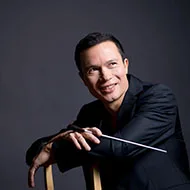
Stanley Dodds is Chief Conductor of the Sinfonie Orchester Berlin, which he has led since 2014 in ten consistently sold-out concerts at the Berliner Philharmonie, including the annual New Year's Concert with Beethoven's Ninth Symphony. Each season he chooses a thematic focus for the series. After Brahms's music was in the spotlight in 2018/19 and Russian Romantic symphonic music in 2019/20, the 2020/21 season would have been devoted entirely to the anniversary composer Beethoven. Due to the Corona pandemic, however, all of the orchestra's concerts were cancelled until the end of the year, apart from one concert in September 2020.
In February 2020, Stanley Dodds made his debut with the Vancouver Symphony Orchestra. Despite the restrictions imposed by the pandemic, he was able to accept an invitation from the Staatskapelle Halle in October 2020 and conduct works by Beethoven in three symphony concerts on the River Saale. In Berlin he was also heard as part of the Musikfest, where he conducted musicians of the Berlin Philharmonic in a programme dedicated to Wolfgang Rihm, with Tabea Zimmermann, Christian Gerhaher, Jörg Widmann and Tamara Stefanovich as soloists. Because the repetition of the programme in the Musica Viva series at the Prinzregententheater in Munich could not take place before an audience due to the pandemic, Stanley Dodds instead conducted the musicians of the Symphonieorchester des Bayerischen Rundfunks in a live-streamed concert and a radio production.
You were born in Canada, grew up in Australia, studied in Austria and Switzerland, and now work in Germany. Where do you feel at home?
I have now been living in Berlin for almost 30 years, and it is the place I call my home. My children have all grown up here. It is a true capital of the arts, and the Philharmonie is the centre of my artistic activities. Today I cannot imagine living anywhere else. During this time the city has changed dramatically and continues to develop, which makes it a very exciting place to live. As you can see, I love Berlin!
You were taken on by the Berlin Philharmonic directly after your studies. Did you never think of starting a solo career?
I studied at the Lucerne University of Music for over five years. During this time I had wonderful experiences performing around the world, including as a soloist, with the Festival Strings Lucerne. (My brother Daniel Dodds is today the artistic director of the Festival Strings.) After my studies in Lucerne I looked to Germany to continue my training. I was made aware of the Karajan Academy of the Berlin Philharmonic, where I auditioned and was given a place. It seemed to me the ideal place to continue my studies, with weekly lessons from the orchestra's principals, a focus on chamber music and regular work with the orchestra. When I completed my studies, I did not yet have much experience with professional symphony orchestras and was not yet fully aware of the wonderful universe I was about to enter.
At the Berlin Philharmonic you are also responsible for media rights and the development of digital platforms. What are your current projects there?
I am a member of the board of the Stiftung Berliner Philharmoniker, which is responsible for managing the orchestra and the Philharmonie. Within the board, I serve as Media Director and am in particular responsible for administering the orchestra's media rights for all forms of communication and exploitation. The orchestra has a decades-long tradition of managing these rights itself. I have witnessed the shift in emphasis from physical media in the 1990s to today's streaming services, a change that meant the implosion of the existing business model and a complete transformation of the entire industry. The Berlin Philharmonic recognised these developments early on and, as one of the pioneers of live-event streaming, began building a high-quality digital streaming platform. Our platform, the Digital Concert Hall, is already in its third generation, streams in 4K HDR with many additional state-of-the-art features, and holds an archive of the last 13 years with hundreds of hours of performances. In addition, the orchestra has also founded its own label, Berliner Philharmoniker Recordings. Current projects include planning new releases with our Chief Conductor Kirill Petrenko and the technical further development of the streaming platform.
Where do you see the future?
Although the closure of concert halls was a catastrophe for the arts, I am grateful for the clear and profound conviction it has left me with about how important live musical performances are. The phenomenon of bringing players and audience together in a first-class concert hall is unique and irreplaceable, no matter how sophisticated the technology may be. This is both a relief and a challenge, because I also believe that the digital dissemination of our art must play an extremely important role. Above all for those who have no direct access to the live experience, but also as a complement for those who want to delve deeper and pursue their curiosity about live performance. The digital sphere is irreplaceable when it comes to staying in contact with like-minded people around the world who are passionate about music.
You also work as a conductor, on the one hand with various ensembles of the Berlin Philharmonic, but also as Chief Conductor of the Sinfonie Orchester Berlin. How well can all of this be combined?
As I said, the Philharmonie is indeed the centre of my artistic activity. The Sinfonie Orchester Berlin has performed exclusively in the Philharmonie for over 60 years, so there can be no overlap of concert dates. It is a great privilege and a great relief that I can pursue such a varied activity in an iconic building. Alongside my guest appearances with other orchestras, working with young musicians is also very important to me. It is always a great joy to work with the current scholarship holders of the Karajan Academy, and for 10 years I have been leading the Youth Orchestra of Mecklenburg-Western Pomerania.
What is important to you as a conductor?
I came to conducting by playing in an orchestra. From within the orchestra I observed the conductor and what was happening around me, asked myself many questions about how and why things work or don't, and sometimes wondered whether it could not be done differently. These experiences still shape me today when I stand in front of an orchestra, and through years of alternating between the two roles I have also learned the fundamental differences. I see my role as a conductor as bringing the orchestra to its best possible performance in the time available, by drawing on my experience as a player and conductor, the craft I have acquired over the years and my understanding of orchestras in general.
What is important to you as a violinist?
For me it is important to remain an active player. As much as conducting challenges me and gives me great pleasure, there is no substitute for the immediate and sensual satisfaction of producing the sound oneself. As a player one stays honest and correspondingly humble. Everyone can hear what one plays, whereas conducting is a mysterious and often misunderstood profession. Basically, it is a paradox – a musician who makes no sound!
Is it more difficult or easier to conduct your colleagues at the Berlin Philharmonic than a "foreign orchestra"?
Conducting my colleagues is both familiar and strange to me. Musically we find each other very quickly, but it may be something unusual for them to be conducted by a fellow player, and I am sensitive to that. In the relationship between conductor and players a certain personal distance is always required, which is mainly due to the hierarchy of the situation. The players are rather used to being primus inter pares, and I try to take this into account in our work together. By contrast, every new orchestra needs a phase in which we get to know each other, and this does not always go smoothly. But that is the daily bread of a conductor. The profession rarely brings the advantage of being loved by everyone.
You regularly lead concert projects with children, young people and amateurs. Why is this particularly close to your heart?
I believe that young musicians and amateurs are a very important part of our audience, on whom we as professionals depend. Amateurs appreciate what we do from the perspective of being active musicians themselves. Their unclouded love of music probably also passes on to the next generation, because it is often their children who learn a musical instrument. And besides, I love being regularly inspired by their boundless enthusiasm.
What are your passions besides music?
I love the sea and the mountains. My only criticism of Berlin would be that it is too far from the Alps, for skiing in winter and hiking in summer. I am also a passionate sailor and always dream of the next cruise.
Interview by Florian Schär | Classicpoint.net | 1.9.2021
More interviews
All interviews →


