

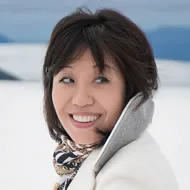
« One has to understand life in order to say something through music. »
SoRyang began playing the piano at the age of five and was already winning numerous regional awards at eleven. At 16 she left her hometown of Seoul, Korea, and completed a piano degree in the master class of Professor Detlef Kraus at the FOLKWANG University of the Arts in Essen, graduating as a concert pianist. She received the First Folkwang Prize and the first special prize at the International Brahms Competition in Hamburg. She then went to Vienna for postgraduate studies, where she graduated with a Magister at the University of Music and Performing Arts. Since then SoRyang has performed piano recitals around the world; her performances at the Carnegie Hall in New York, in the Golden Hall of the Vienna Musikverein and at the Vienna Konzerthaus attracted considerable attention. As a well-known Mozart interpreter, she regularly presents Mozart piano works, including at Schloss Mirabell in Salzburg and at the Mozarthaus Vienna. She has also given recitals in New York, Los Angeles, Dallas, Hong Kong, Shanghai, Barcelona, London, Rome, Hamburg, Vienna, Salzburg, Dresden and Berlin, among other places.
Classicpoint.net: When you came from Korea to Essen at the age of 16 to study, didn't you feel homesick?
As a teenager with musical talent being allowed to study in Germany was a great honour for me. I did not want to disappoint anyone and put all my strength and energy into my studies. The joy of finally learning truly authentic music made me happy, so that the „old“ life had no place left in me.
By contrast, many other Korean women were not enthusiastic about studying in Germany. They were really homesick and wanted to return home quickly.
You come from Korea, studied in Germany and now live in Vienna. Where do you see the greatest cultural differences?
In Korea, practising was always about accuracy and speed. When it came to music, one imitated other world-famous pianists. But in Germany I learned how to let the music speak. A funny example of cultural differences is, for instance, that one must not play the many notes in the bass register loudly. Otherwise it sounds as if potatoes were rolling down the cellar stairs. But in Asia we have neither such cellar stairs nor do we store potatoes at home. So this image alone was something entirely new to me. My professor valued my talent and supported me, among other things, by helping me get some wonderful concerts very early on.
At that time, the world of music was all there was for me, and I practised like one possessed. When I then came to Vienna, I got to know the easygoing life. Alongside my studies I often went out strawanzen with Austrian friends. If I say that I explored many different districts on foot, visited Heurigen in the countryside and watched many old films in ancient cinemas, one might wonder why I no longer spent the whole day dutifully practising the piano as before. But that is exactly what makes music what it is. If one does not understand life, what do I have to tell the audience through music? It is not my goal to demonstrate to my listeners through brilliant piano playing everything I can do and they cannot. I want to reach them, be at one with them and build a connection.
Which adjustment or adaptation was the most difficult for you?
I grew up in a very good environment – like a princess – but in Europe many people treated me rather condescendingly because I look Asian. I can cope with that today.
Could you tell us a little about upbringing and the role of women in Korea?
Upbringing is very harsh; it is purely geared towards success, and children grow up in an unfeeling society. It is a constant competition over who has achieved more. Piano playing is often a means to an end. Almost all of my female friends who studied piano gave it up as soon as they got a university post or married well. That is a great pity. In Korea one is a small part of a highly structured society. Therefore there is hardly any room left for individual artistic freedom.
Do you see yourself as a role model for Korean women? Do people in Korea follow your career?
Indeed, my schoolmates from my music secondary school believe that I am living their dream in paradise. But they do not want to practise the piano so much again. They hated it. I, on the other hand, love practising the piano, and it is an important and firm part of my life.
Do you also give masterclasses in your homeland, or do you plan to move back to your homeland at some point?
So far I have made little effort to maintain contacts with Korea, even though there are so many warm-hearted people there. But living in Korea is unthinkable for me. In the meantime I have developed in a different direction from Koreans. I now feel more Austrian, or rather European. I would therefore certainly feel that I had taken a huge step backwards. With so much enforced restraint and many often senseless obligations, my soul would very soon wither.
You also compose. How would you define your compositional style?
I would very much like to continue composing, but piano playing takes centre stage. A Korean proverb teaches us that it is better to dig one well deep than many wells shallow.
You have made classical piano music accessible to a broad audience in historic squares of major European cities. How did you experience these concerts?
The idea of playing classical piano music on the street with a real piano was my baby. Nothing like it existed before. No professional pianists would have thought of doing such a thing, because it was simply “beneath their dignity”. Nor was there any female street musician in Vienna before me, apart from a very old saxophonist who was quite well known here. But I put my idea into practice, regardless of what other people thought. Creating something new and crossing boundaries made me very proud. I loved this work. In the evenings the pedestrian zone was transformed into a concert hall, where a large crowd often listened quietly for hours. It was a unique experience for me – as it was for the listeners.
That is also how I found my love. My partner supports me in every way he can. He takes this task so seriously that he has now made it an additional profession. It is the most touching feeling when a person believes in you.
Do you have any other ideas you would like to put into practice?
No, not for the time being. I have just one great wish when it comes to music. I would like to make the piano sing, the way Maria Callas sang. Wonderfully beautiful sounds with strong emotion.
The former managing director of PREISER RECORDS called you the “most unusual pianist in Europe”. Do you see yourself that way too?
As already mentioned, I have changed the classical world somewhat by playing free of charge in public squares for people, regardless of class differences. Since then, famous pianists also play on the street, which previously seemed impossible.
Unfortunately, due to the intensive preparation for concert tours, I no longer have time to pursue this. When I played on the street I performed very different works from those in the concert hall, but of course these pieces must also be well prepared. When I go for a walk I miss piano music in the street. Many Viennese probably feel as I do, as I can tell from the numerous messages that reach me.
What interests you outside of music?
The people around me. They play the most important role in my life outside of music.
Interview by Florian Schär | Classicpoint.net | 2 September 2019
More interviews
All interviews →


