

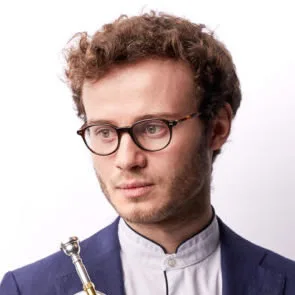
« Music is always a great shared experience. »

At just 24, Simon Höfele is one of the most exciting trumpeters of the younger generation. He is the current BBC Radio 3 New Generation Artist, has been an artist in the “Junge Wilde” series of the KONZERTHAUS DORTMUND since the 2018/2019 season, is an SWR2 New Talent, and a prizewinner of the special “U21” prize at the ARD International Music Competition as well as the German Music Competition 2016, among others. Alongside his musical projects, Simon Höfele is also committed to cultural policy and founded the association “Kunstverlust”, for which he works as a photographer, portraying people who actively stand up for the arts and against their destruction.
Classicpoint.net: What is special about the trumpet?
What is special about the trumpet for me is the great dynamic range this instrument offers. Everyone knows the trumpet as a loud instrument, and that is true! The trumpet can definitely be incredibly loud. But at the other end of the sonic spectrum, it can also sound piano and pianissimo, if one really wants it to.
How did you come to this instrument?
When I was just 5 years old, my father bought a small decorative fanfare on eBay. It was actually meant only for the wall, but I grabbed this “instrument” in my childish play and immediately fell in love with the trumpet. That was when the decision was made for me. Unfortunately, my four milk teeth fell out shortly after this decision. That is why I had to wait what felt like an eternity until my first trumpet lesson. But I suppose it was also a good test for my parents, to see whether I really meant it with my wish to play the trumpet ;-)
You are also interested in contemporary music and perform new works. Which current composer would you wish to write new literature for the trumpet?
Oh, there are so many! And that is exactly what I find so wonderfully fulfilling about contemporary music. There is such a great diversity in this era, like nowhere else! Every time I study a new work, I notice how multifaceted and colourful today's music is. For me, that is a sign that music truly stands above everything and connects every person, wherever they are, however different the music may be!
You are also very interested in photography. What fascinates you about it, and which subjects and areas do you focus on?
Photography is very important to me. It is like a place of calm or an oasis for me, where I can recharge and fully focus on music again with new energy. Of course, it is also more than that, but at the moment I am so busy with music that unfortunately photography sometimes gets a little neglected. But one cannot be in two places at once. What interests me most about photography is the analogue side. I own many different cameras, some of which date from 1956. I also have a darkroom and photochemicals so I can develop films myself. Analogue photography fascinates me in particular because it concentrates on what is essential. As little as possible stands between the subject and yourself. No 1000 attempts until the picture finally works, no constantly checking the previous photos on the camera screen, no flat batteries, no autofocus, etc. Of course, one occasionally misses the odd great shot, but the rest of the pictures simply have more soul and are more authentic.
You founded the association “Kunstverlust”. Can you tell us something about it?
Kunstverlust e.V. is a non-profit association that my good friend and flatmate Florian Wetzel and I founded. The initial idea was to create a portrait series in which the photographed people stand in front of a black canvas with light from above. A kind of portrait in which the facial features stand out particularly well, so to speak, character portraits. Added to this is a statement from the person about what art means to them. It was meant to provide a colourful statement as a contrast to the black-and-white, mostly rather serious photo! That was the first idea. So far we have photographed several hundred people, including a wide range of personalities such as the former presidents of the Bundestag Norbert Lammert and Wolfgang Thierse, the pop singer Clueso, but also students from our university of music. Simply anyone for whom the topic of cultural policy spending cuts is important. We have since grown, think bigger and are seeking sponsors for larger projects. So if you would like to support us, you are very welcome to become a member; the form is available on our website kunstverlust.de.
What does art mean to you?
For me, art is the feeling of discovering freedom anew each time and sharing it with others.
How do you define music for yourself?
I see it quite similarly with music. Music must convey a feeling, not just beautiful melodies. It must have something to say; then it does not matter at all what kind of music it is, E or U, Baroque or contemporary.
You are still very young. What are your visions for the future?
I approach this as calmly and relaxed as possible. I do not want to force anything. Nevertheless, I have thousands of ideas swirling around in my head. I am open to many things and look to the future with optimism. I get to make music and earn my living from it. That is truly an incredible privilege.
What bothers you most about being a musician?
Not much. Musicians are mostly cosmopolitan and wonderful people. If anything bothers me, it is perhaps the unconscious encouragement of egocentric traits in some people in this field. As soon as one 'has to' make music with such a person, it usually becomes very difficult, and what it is all about, namely the music, fades into the background. It is then no longer any fun at all... Music is always a great shared experience. The individual performer is important, but never more important than the music itself!
Interview by Florian Schär | Classicpoint.net | 3 September 2018
More interviews
All interviews →


