

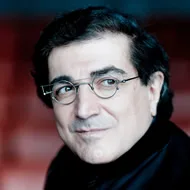
«Music does not have to be complicated, as long as it touches us as human beings and makes us better.»
«Music does not have to be complicated, as long as it touches us as human beings and makes us better.»
He is one of the great pianists of our time: Sergei Babayan, who in 1989 became the first Soviet artist ever to win a competition in the West without state support, is today probably one of the most influential musicians internationally, who with great technical brilliance and infectious joy in playing has shaped generations of younger pianists. The London Times praised him as a "ravishingly inventive virtuoso", Le Figaro lauded his "incomparable touch, his perfect phrasing and breathtaking virtuosity," and Le Devoir from Montreal put it simply: "Sergei Babayan is a genius. Full stop."
Sergei Babayan was born in Armenia and studied at the Moscow Conservatory with Mikhail Pletnev, Vera Gornostayeva and Lev Naumov. After his first trip abroad in 1989, he went on to win first prizes at several international competitions in succession, including the Cleveland International Piano Competition, the Hamamatsu Piano Competition and the Scottish International Piano Competition. He lives in New York as a citizen of the United States.
You were born and raised in Armenia, in the former Soviet Union. Now you live in America. How did you experience your childhood, and why did you move to America?
My path was shaped by the artists I met. Leaving the USSR was for me an act of liberation. I have always had conflicted feelings towards the Soviet Union. On the one hand, the Soviet Union gave me an education and made me a pianist. I feel absolute love and devotion towards my teachers, and I think of them every day when I play the piano. But I went through very difficult times, because there were some rather unbearable things. I am allergic to everything connected with communism; the concept is something against which I have a strong intolerance. On that day in 1989, when the plane took off from Moscow and my next stop was New York, I was able to breathe for the first time. It was the first time I felt truly free.
How and where do you get your inspiration?
What an interesting question, and seemingly so simple, but I cannot answer it, because it is indirect. I live my life, and in some moments some things are more important than others. I choose my repertoire according to the deep connection I feel with a piece, and this love arises through the moments in my life. I am inspired by books, actors, writers, musicians, composers and our greatest thinkers. So I cannot name anything concrete, because I do not know. It is a summary of what I see and feel, and it emerges in inspired moments. The greatest masters would say that inspiration comes to those who work; that is, if one does not practise and is unfocused, not committed or disciplined, one will not be able to do much with the inspiration that comes to one. However, if one is in excellent musical form, remains disciplined and concentrates on the beauty of life, inspiration will come to you and can bring about significant changes in your own music. One must prepare oneself for inspiration to come, in order to make use of it.
Which works are особенно dear to you, and why?
There are composers who have accompanied me my whole life. There are composers who come closer and then fade. Bach, Beethoven, Mozart and Schubert are some of the constants. And Schumann. And of course Rachmaninoff, always. And then, naturally, the French: Debussy, Ravel, Fauré. That is no small list! Especially close to my heart are pieces that have a great human influence — pieces that inspire me to be a better person. I find this very strongly in the composers mentioned above. I feel that I grow and improve with this music, which is very important to me.
What do you think of current new compositions?
As I have already said, music does not have to be excessively complicated, as long as it touches us as human beings and makes us better. Much new music may have innovative structures, but it may not touch us if its only intention is to create innovation. For me, new music must continue to evoke the important, deep human feelings such as love, warmth and forgiveness, in order to have the same value as the pieces that already mean so much to us. That is why Arvo Pärt is the living composer who matters most to me. His music is unique and has its own unmistakable style; it is not complex and so-called modernist, but expresses the most important feelings and ideas of being human.
You often perform as a duo partner with Martha Argerich. What is it like to make music with her and to work on pieces together?
Well, Martha is the most important teacher in my life. I was 13 when I discovered her recordings of the Chopin and Liszt concertos — one has to understand how rare that was at the Soviet school where I was trained. Only Martha knows how to awaken such warm joy and freedom in me through music. Behind what is performed effortlessly and with childlike lightness lies a deep pianistic intelligence that comes from the Italian school inherited from Scaramuzza. That is the genius of Martha's playing, a rare combination of gifted intuition and incredible work ethic. I have not yet met a pianist whom I respect more for her dedication to work than her.
What are your next projects?
This season I will perform a new programme entitled SONGS, a homage to the most beautiful melodies in the history of the art song. The programme aims to imitate the colours, phrasing and dynamics of the human voice, without using words.
Interview by Florian Schär | Classicpoint.net | 01.09.2024