

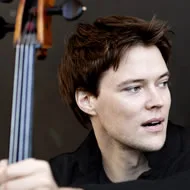
« The standard across the board has never been as high as it is today. »
Born in Munich and raised in Spain, Sebastian Klinger received his first cello lessons at the age of six. He later studied with Heinrich Schiff in Salzburg and Vienna, and with Boris Pergamenschikow in Berlin. After numerous national and international awards at various competitions and foundations, he won the German Music Competition in 2001. This was followed by debuts at the leading German festivals in Schleswig-Holstein, Rheingau, Mecklenburg-Vorpommern and Ludwigsburg, as well as multiple recitals at the Concertgebouw Amsterdam. In 2002, on the initiative of the Kölner Philharmonie, he was invited to perform as part of the Rising Stars Series (European Concert Hall Organization), which ultimately led him to the most important music centres in Europe and the USA (Carnegie Hall New York, Wigmore Hall London, Palais des Beaux-Arts Brussels, Konserthus Stockholm, Konzerthaus Vienna, among others). Sebastian Klinger now performs as a soloist and chamber musician throughout Europe, Asia and the United States.
Classicpoint.net: You were born in Munich but grew up on Gran Canaria until the age of 11. How did that shape you?
The years on the island were, of course, very formative. The people there, the language, the subtropical climate (with its incomparable Canarian light), the unique fauna and flora – and of course the sea have been very familiar to me ever since. At the beginning of the 1980s, we were still in the era before the digital revolution. Moving to such a place as a family was a real adventure back then – perhaps even more so than today, when all digital sources of information are always available to us in our globalised world. We lived inland in a wonderful house with a huge garden. When my brother and I weren't at school, you could basically always find us outside, exploring the area around the house, building something, collecting things, reading or playing with our dog. I also remember many fantastic island tours with family and friends, during which we discovered the incredible richness of colours and contrasts in the local nature. We regularly went to the sea to learn windsurfing at the Dunkerbeck family's surf school, among other things, but we also enjoyed the local cultural programme with concerts that remain unforgettable to this day. And that is how I began playing the cello there, and my first teacher became the principal cellist of the local orchestra.
Do you remember your first performance with the cello?
Of course, that was also there, at a school concert, where I was allowed to perform Vivaldi's E minor Sonata. Shortly before my performance I was incredibly nervous and didn't want to go on stage. But after my mother, who accompanied me on the piano, persuaded me, I played after all – and I still remember exactly how wonderful I found the feeling of finally playing the piece for an audience in a concert atmosphere.
What ultimately led you to want to make the cello your profession?
All my first cello records and CDs were by Slava or Yo Yo Ma. I listened to them for years on end and soon knew: what they were doing was what I wanted to do with my life too. And on the way there, I surprisingly remained fairly single-minded.
While studying with Heinrich Schiff, you shared a flat with Christian Poltéra. Could you tell us a few anecdotes from that time?
Ha, there are quite a few! For example, I remember a very funny, hush-hush operation in which, during a flat clearance, we had to dispose of a large, old mattress that had been sitting on the balcony for months, completely waterlogged and utterly mouldy, and it took us an eternity. I'd rather not reveal where we disposed of it! Or how we repeatedly tested the acceleration and top speed of Heinrich Schiff's car on the Austrian motorways, where speed limits apply. Had we been caught, it would surely have been worth a small report in the local newspaper…
Despite starting a solo career, you took on the position of principal cellist with the Symphony Orchestra of Bavarian Radio in 2004. Didn't you thereby damage your career?
That depends entirely on how you define career. For me, building a career in the sense of 'solo only' was never the priority. When the call came asking whether I'd be interested in auditioning for the BR, I was simply intrigued – partly because until then I had played very little in symphony orchestras. I never saw the point in committing too narrowly to a particular genre or instrumentation. I am therefore grateful to be able to enjoy a good mix of orchestral, chamber and solo work for so many years now. And some time ago, teaching was added as well!
Compared with 20 years ago, there are a great many first-class solo cellists on the market. Why are there suddenly so many?
I think this is largely due to the teaching work of great teachers: in Central Europe, I would mention above all Heinrich Schiff, Boris Pergamenschikow and David Geringas. All three ran outstanding cello classes for many years, and through their work they raised the standard of cello playing across the board and, fundamentally, into entirely new spheres. Fantastic cellists have emerged from these classes, and many of them now in turn train the next generation as professors. In this way, the standard of playing keeps rising and rising. Added to this today are a multitude of new sources of information, such as audio and video music streaming services and social networks, as well as masterclasses all over the world. There are also excellent elite academies today and far more competitions than in the past – all things that foster competition and allow the standard to keep rising.
How do you see developments among today's composers?
I'm no expert in that area. But I find there are phenomenal contemporary composers and so many worthwhile pieces for the cello alone. Unfortunately, far too little of this is still played in concert life.
What does your career plan look like, and what are your wishes for the future?
Sometimes I would like to achieve a better balance between family, performing and teaching. But actually I don't wish for very much else – ideally, simply a continuation of my life so far at a high musical level. Fortunately, one can keep learning at any age, provided one does not stop working on oneself and gets to play with the best colleagues.
What should change in the classical music market? Where do you see opportunities and risks?
I don't want to join too wholeheartedly in the general 'music-market bashing'. The term 'market' does imply that money has to be earned. Yet I sometimes do wonder whether all the aspects that do not concern making and listening to music itself have become far too important and far too large. I see the young generation of musicians and the quality of classical music as a whole in a very positive light. As I said before, the standard across the board has never been as high as it is today.
What interests do you have besides music?
Art, politics, the environment, sport …
I have a few hobbies too … at the moment, however, I spend my cello-free time mainly with my family – we have four little daughters, so there isn't much room for anything else.
Interview by Florian Schär | Classicpoint.net | 1.8.2019
More interviews
All interviews →


