

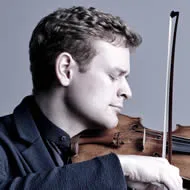
«We musicians should take more responsibility for our future audience.»
Sebastian Bohren is the winner of numerous competitions and promotional awards and a scholarship holder of the LYRA Foundation. In 2007 Sebastian Bohren won the promotional award of the Marguerite Meister Foundation in Zurich. In July 2011 he won the Curt Dienemann Music Prize in Lucerne, as well as a scholarship from the Carl Hirschmann Foundation. In 2015 he received a one-year work grant from the Aargau Cultural Council. In 2022 he received the "Der Goldene Bogen" award, presented by the Swiss Violin Making School Foundation. Sebastian Bohren has performed as a soloist with numerous orchestras in Switzerland and abroad. From 2013 to 2020 he was a member of the Stradivari Quartet. He directs the Stretta Concerts concert series as well as the Brugg Festival.
When did you decide to choose the violin as your profession, and why?
I started playing the violin at the age of eight, at the local music school in Möhlin. I liked it, but I wasn't particularly motivated, and I remember well that my mother came up with all sorts of ideas to motivate me to practise. When my family moved to Mellingen in 1998, I then started lessons with Markus Lehmann at the music school. That changed everything for me: he became my great role model, and I was determined to become a violinist. I had a rather romantic notion of what a violinist does – recording CDs, playing concertos with orchestra and owning a beautiful old violin. This dream has stayed with me to this day and drives me on. I am incredibly glad and grateful that my love for the violin has remained just as strong through all the difficult years of hard work, and so I owe a great deal to my teacher Markus Lehmann, but also to all the other teachers who have gone to enormous lengths for me!!!!
You are still young – what are your goals?
I have very many goals and dreams. For one, I want to keep improving as a violinist and reach my personal maximum, in about ten years' time. To that end I practise very hard and also play for selected mentors again and again. I want to develop my career as a soloist with orchestras, including outside Switzerland – I have very high aims there. There are many wonderful pieces I still want to learn and play with orchestras; lately in particular I have discovered a special passion for contemporary violin concertos – I always enjoy learning them enormously.
As artistic director of the Brugg Festival and the Stretta Concerts series, I want to make Brugg in the canton of Aargau a town known throughout Switzerland and internationally as a music town. Great musicians and renowned orchestras should regularly perform in the "Prophetenstadt". Together with the Brugg Festival team, we are also initiating an outreach project that introduces over 400 pupils from Brugg to classical music – this matters enormously to me. We musicians should take more responsibility for our future audience, tirelessly and inspiringly acting as ambassadors for the music we love.
You have had, or still have, a mental coach. How exactly can he help you?
My mental coach has worked with many outstanding Swiss footballers; I got to know him through a friend who was a footballer and at that time became the Swiss league's top goalscorer. Five years of intensive mental training have helped me focus on my strengths, act in a self-determined way and waste less time on unimportant things. I believe one should bring the prerequisite of always wanting to improve and being ready to give everything for it. It has also helped me prepare performances better and reduce nervousness. In my view, the combination of experience and preparation helps with this.
Do you also teach?
In recent years I have held a deputy teaching post and an assistantship at two Swiss music academies, and on the side I have privately taught a number of students with great dedication. However, I cannot make progress in all areas with the same intensity, and so I concentrate on my work as a soloist and promoter. I am always open to advising young violinists, though, and I am often asked for advice.
You run your own concert series and now a festival too. How did this come about, and what do you hope to achieve with it?
When I was 14, my father suggested that I look for more performance opportunities myself in order to gain experience, and so I began performing as a guest musician at church services in the Brugg region. I then got to know the imposing Stadtkirche and dreamed of playing a concert there one day. At 19 I then organised it on the spur of the moment, and I have not stopped since. This grew into the Stretta Concerts, which we still present with free admission and a collection and which now have a large core audience. The new Brugg Festival is the logical next step and is aimed at a younger audience: we want to be even closer to the pulse of the people of Brugg, and during festival week the town should truly "breathe" music. We want to build something that sustainably enriches the region and the whole canton of Aargau.
Looking back, where do you see the milestones of your career so far? What were the most important events or people for you personally?
On the one hand, my teachers were important to me: Markus Lehmann in Mellingen and Baden, then Jens Lohmann at the Konservatorium Zürich, Robert Zimansky and Zakhar Bron at the Zurich University of the Arts, Igor Karsko in Lucerne and Ingolf Turban in Munich. I was also tremendously lucky to be able to gain important stage experience as a member of the Stradivari Quartet – and to be allowed to play on a Stradivarius. The artistic director of the ensemble CHAARTS, Andreas Fleck, then supported me decisively and gave me many opportunities as a soloist. I can hardly identify real milestones; it has been more of a long-term development, with highs and lows.
Are there particular works or composers that suit you especially well or fascinate you in a particular way?
Yes, I particularly like playing German music of the Baroque, the Classical period and the early Romantic era – from Bach through Mozart and Schubert to Beethoven and Schumann. Bach's Chaconne and Beethoven's Violin Concerto are closest to me personally; I can rework and refine these works again and again. I also very much enjoy the violin concertos of the 20th and 21st centuries; this year, for example, I learned Peteris Vasks's new Violin Concerto and Kurt Weill's Concerto for Violin and Wind Orchestra.
Where do you see the greatest challenge in your artistic life?
There are constantly many challenges. Most important, though, is the balance between my engagements as a violinist and my activities as a promoter and music manager. I want to shape this balance optimally and reach the highest level in both disciplines.
What passions do you have besides music?
I love hiking, but I don't get to do it often enough. I enjoy spending time with my family. I also like to engage with history and political and social issues. On long-haul flights I like to watch films.
Interview by Florian Schär | Classicpoint.net | 01.07.2023
Photo: Marco Borggreve
More interviews
All interviews →


