

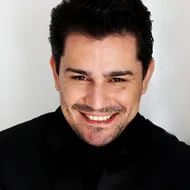
« I am a happy man! »
Saimir Pirgu first studied the violin in his home town of Elbasan in central Albania. From 2000 onwards, he went on to study singing at the Conservatory "Claudio Monteverdi" in Bolzano with Vito Maria Brunetti. It was there that Pirgu met Luciano Pavarotti, who looked after his voice and worked with him on many roles from his repertoire. Pirgu was discovered by Claudio Abbado, who invited him in 2003 to sing Ferrando in a production of Così fan tutte that he conducted in Ferrara.
Classicpoint.net: You first learnt to play the violin. What influence did this have on your singing studies?
When I was at primary school in Albania, the communist system, which was coming to an end, influenced the school system through music classes and various opportunities for artistic activity. Partly because I chose it and partly because the system dictated it, I studied the violin and completed my degree, but I never stopped singing. Studying an instrument contributed greatly to my musical preparation, trained my ear and refined my musical sensitivity. Without the instrumental training I enjoyed from such an early age, I certainly would not have managed to complete my singing diploma in just two years, win two important international competitions at the age of 20 and launch my career so early and with such great conductors.
You come from Albania. What significance does classical music have in Albania?
Albania is a country with a tradition of classical music. After the Second World War, our musicians mainly studied in the former Soviet Union and received a training shaped by Russia. In the years that followed, Albanian communism influenced musical education and promoted the development of the local musical tradition and of musicians who were often very well prepared technically. The Albanian people have always loved music. We have various theatres and symphony orchestras. I would say it is a music scene in miniature.
Your parents both worked in the metal industry. What was their connection to classical music, and how did they feel about your decision to become a singer?
My parents never had any connection to classical music. However, they always saw in me a responsible boy. Since they saw my natural talent for music from an early age, they always supported me in my artistic decisions, even when these might have seemed risky and reckless. Although my passion for singing was not handed to me by my family, it must be said that it was always within me. Even as a very small child, I loved to sing and performed folk songs for a small audience of friends and acquaintances. The big turning point came when I was at secondary school. As I have often said, I see myself as a "product" of the Three Tenors. I owe it to them that I began singing. I was about 13 or 14 and living in Elbasan, a small industrial town in Albania, and communism had only recently become a thing of the past, when I watched the famous Three Tenors concert at the Baths of Caracalla on television. I was fascinated. I recorded this concert and listened to it countless times. From that moment on, I knew that this would be my life, and so it came to be. I was not yet 18 when I completed my violin studies and left Albania to move to Italy, the homeland of singing. It was a harsh blow for my parents to see me leave Albania. But in this case, too, they trusted me and never questioned my decisions, also because they could see that my love of singing grew day by day. By Italian standards, they did not give me a great deal of money, but it was their life savings, and they let me go to live my dream. I was accepted at the Conservatory in Bolzano, where I met my teacher Vito Brunetti, who took me into his class as a student and believed firmly in me. Thanks to his teaching, I managed to complete my singing diploma in just over two years and to begin my career very early. My parents, who at first could hardly believe how quickly everything happened, became my greatest fans, and even today they accompany and support me in all my decisions. I am proud of them and will never stop thanking them for their trust in me.
You were mentored by Luciano Pavarotti. Can you tell us something about working with him?
Pavarotti supported me a great deal from the very beginning of my career. I met Luciano Pavarotti while I was studying at the Conservatory in Bolzano. The Maestro was in Merano (northern Italy), where he was taking a cure, and he enjoyed spending his free time listening to young, promising singers. He had therefore asked whether there were any young singers in the area, and my name had been mentioned to him. I introduced myself to him, and at that moment our friendship began. I studied with him the best-known works of the operatic repertoire, which I still have in my repertoire today. His advice is still very present to me. He was not only a great teacher, but also a good friend and mentor.
It was a great stroke of luck for me to be taught by Luciano Pavarotti. He was never too proud to give me valuable advice that was fundamentally important for my career. Above all, I remember our work on correct pronunciation, the passaggio and support.
That is why it was also a very special honour for me to win the Pavarotti D'Oro award in 2013.
What impressed you most about Luciano Pavarotti?
Pavarotti was always my idol: I was always particularly fascinated by his extraordinary vocal quality, his perfect technique, the way he paid attention to words and pronunciation when singing, as well as his always impeccable intonation and musicality.
As a person, I can say that he was like a king. He was aware of his qualities and abilities, but at the same time he was a person of rare intelligence and an intuition that allowed him to recognise immediately whom he was dealing with. He loved beautiful things and colours, and he was always ready to give his best, both in singing and in his private life. In his presence I never felt like a little boy, even though I was so young, but rather like a friend. This was a quality typical of Pavarotti and his circle of friends.
Claudio Abbado was the first great conductor to discover you. How did he come to hear of you?
By the age of 20, I had already won the "Enrico Caruso" competition in Milan and the "Tito Schipa" competition in Lecce, and had taken part in Alberto Zedda's Rossini Academy in Pesaro. Claudio Abbado heard of me just as he was casting a production of Mozart's "Così fan tutte" and wanted to hear me in an audition. I remember that on the day of the audition my flight was delayed and I arrived very late. I thought I had missed a great opportunity. I arrived and saw the Maestro rehearsing with his orchestra. He asked me to sing. I sang half the aria before he stopped me and said that I would get the role. I could not believe it. From that moment on, there was a wonderful connection with him; he was a very warm person. It may be because I was so young at the time, but I think that when you have the opportunity to work with great musicians like Claudio Abbado, you only become aware later of the greatness of what has just happened. It was a great stroke of luck to begin my career with one of the greatest conductors. For almost a decade, my greatest concern was to learn as much as possible, to do justice to the extraordinary start of my career and not to disappoint the expectations the Maestro had of me. This was the case with all the great conductors I have worked with and who believed in me, such as Nikolaus Harnoncourt, with whom I made my debut as Idomeneo in 2008, and Riccardo Muti, with whom I sang my first Verdi Requiem at the Salzburg Festival in 2011.
What do you enjoy most about your daily work?
In the first years of my career, I loved travelling and getting to know new places and cultures. Lately, I also enjoy being at home, as I have already travelled a large part of the world and am away 300 days a year. Although the desire to travel is no longer what it was 15 years ago, my love for my profession grows day by day. Making music, practising, perfecting myself, breathing music every day... That is the most beautiful thing about my profession. I am a happy man!
Where do you see the challenges or the unpleasant aspects?
A challenge I face every day is learning a role well, perfecting it and developing it slowly. The singer's profession, although full of sacrifices, has many positive sides. Among the negative sides is above all a certain loneliness that unites all singers. One is often far away from one's loved ones, lives for a few weeks in a place where one makes new friendships, before having to leave everything behind again when travelling to the next engagement. These are difficult situations that a singer must get used to and must face, but which are repaid immediately when stepping onto the stage, and all the more so when the work is well received by the audience.
You are still young and already have an enormous number of performances each year. How do you recover each time? How do you look after your voice?
It really is not easy, especially for a young singer, when one has to sing many performances a year. The first secret is the choice of repertoire and the sequence of roles in the calendar. New productions help to recharge one's energy and to prepare as well as possible for a role, since there is a long rehearsal period. In addition, one must know how to deal with colds and how to warm up the voice slowly and properly if one wants to look after it well, especially before performances. Good technique also helps greatly to protect the voice.
What interests do you have outside music?
I love life and the beautiful things it gives us. I love being among people, surrounded by friends and family, and spending a lot of time with them. I also love the sea; I enjoy swimming and snorkelling. I spend a lot of time in the fresh air and go running, I enjoy contact with nature and like listening to all kinds of music.
Interview by Florian Schär | Classicpoint.net | 1 December 2017
© Photo: Fadil Berisha
More interviews
All interviews →


