

«There are no two identical paths.»
«There are no two identical paths.»
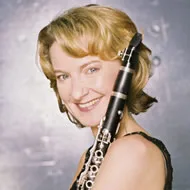
Sabine Meyer is today counted among the most renowned soloists in the world. It is thanks to her that the clarinet, once underestimated as a solo instrument, has reclaimed its place on the concert platform. Alongside her work as a soloist, Sabine Meyer has a particular affection for chamber music. In 1993 she was appointed professor at the Musikhochschule Lübeck.
Your grandfather was a clarinettist, and your father and your brother also play this instrument. Didn't you want to learn a different instrument?
My parents never pushed us children in any particular direction, but they recognised our musical talent early on and encouraged it. I began learning the piano at four or five years old, then the violin was added, and finally the clarinet at the age of eight. Although it soon became clear that I had the greatest talent and also the greatest enjoyment in making music on the clarinet, for about ten years I played all the instruments in parallel and also took organ lessons on the side.
Besides your grandfather, father and brother, your husband also plays the clarinet. Are your two children learning this instrument too?
My husband and I never pressed our children to pursue a musical career. The two of them make music and listen to it with pleasure: our daughter played the bassoon and now plays the piano, my son had a rock band at school, plays keyboard and piano and writes his own music – but they chose psychology and physics respectively as their fields of study.
As a sought-after soloist you have been constantly on the road for years, giving concerts all over the world. How do you manage this with two children?
When the children were still small, I never took them with me on concert tours; I left them in the care of the family. My husband and I always planned family life together, and our parents also helped us a great deal. I was never away from home for more than ten days and did not want to travel with a nanny and children. When the mother is under stress or needs to rest before a concert, the children get nothing from her, only the drawbacks of living in a hotel.
You and your husband have developed a systematic training method that aims to combine the powerful, rich tone of the German clarinet with the flexible tone shaping of the French Boehm system. Could you explain this in more detail?
Unfortunately, most clarinet teachers focus their main attention only on finger technique. We, on the other hand, have tried to train breathing technique, tone production, articulation and intonation just as systematically. To this end my husband published a comprehensive method book (“Clarinet Fundamentals” / Schott Verlag Mainz), which forms the basis of our teaching.
The goal is a body-driven, singing style of playing that combines the advantages of both clarinet systems.
You teach as a lecturer at the Musikhochschule Lübeck and also give masterclasses. What is important to you when teaching?
What is particularly important and also particularly exciting is responding very individually to each student. There are no two identical paths, and in this sense teaching is a very great enrichment in my life.
You are a strong advocate of new music and regularly commission works. By what criteria do you choose the composers?
At every time, including Mozart's time, there have been works in new music that are original and exciting, and works that get by with empty phrases and say very little. In today's new music it is really not easy to recognise the substance of a work or a composer, especially since many composers want to impress with extreme demands and technique and often with activism.
On the one hand, I don't like music where I have to take my instrument apart, bring along four sound engineers and even roller-skate while playing; on the other hand, I also don't care for the frequent contemporary music that tries to curry favour with the audience through many tonal echoes and effects. I engage a great deal with current music and believe that, with experience, it is indeed possible to separate the wheat from the chaff.
You have been at home on concert stages all over the world for many years. Are there individual concerts that have stayed особенно in your memory?
There are very many concerts in every season that stay in the memory, some of them – in chamber music – even in very small towns. So it is hard to single out any one in particular. Naturally, many concerts with my own ensembles (the Sabine Meyer Wind Ensemble and Trio di Clarone) were especially memorable because of making music with true friends, and certainly also the concerts with the Lucerne Festival Orchestra under Claudio Abbado, who raised the very personal relationship among the musicians to the level of the orchestra. Very profound experiences also came in the concerts with Sándor Végh or Gidon Kremer, and in working with the Academy of St Martin in the Fields and with the Vienna Philharmonic and Christian Thielemann.
You also breed horses?
Riding was a hobby for the whole family. A few years ago we still had five horses. Since the children left home, the number has of course decreased, and breeding has stopped too. But the horses we bred themselves are still there, of course, and as soon as time allows, I spend my hours in the countryside.
Interview by Florian Schär | Classicpoint.ch | 03.08.2012