

«I have two title categories.»

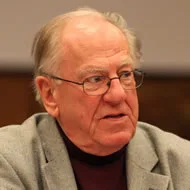
Rudolf Kelterborn's compositional output encompasses all musical genres and has been honoured with numerous prizes. Alongside his work as a composer, Kelterborn also taught music theory, analysis and composition at various Swiss and German music academies, served as Head of the Music Department at Swiss Radio DRS, as Editor-in-Chief of the SMZ, and as Director of the Music-Akademie Basel.
Classicpoint.ch: How exactly does a composition come about for you? Is it always the same process, or do you use different approaches?
Naturally, it makes a difference whether I have a commission to fulfil or whether I want to write a work "just like that". But in both cases, I develop a composition in my inner (aural) imagination, from the overarching architecture down to the sonic details, before I begin to write it down. In doing so, I record individual aspects in verbal notes or sketches. With compositions that involve texts, or even with music-theatre pieces, the process is more complex.
Do you also use digital tools when composing?
No.
What is the best way for you to arrive at new inspirations and ideas?
I relentlessly challenge my imagination, and I scrutinise my ideas very critically. I cannot explain how ideas come to me. But if, for example, nothing convincing occurs to me for a commission, I decline the commission. That is why I always request a period of reflection of several weeks for every enquiry.
Do you deliberately incorporate your own experiences and feelings into your music?
For me, my music expresses the fullness of my life, which encompasses everything I experience and feel, from the appalling to the wonderful. But it is not individual concrete experiences or momentary moods that I translate into music.
By what criteria do you name/title your works?
I have, so to speak, two title categories. Many works I call "Music for...", "Concerto", "Quartet", "Ensemble Book", "Chamber Sonata" and so on – these are, so to speak, neutral titles that say nothing about content, character or expressive atmosphere. Then there are titles such as "Dream Music", "Phantasmen", "Nocturne", "Adagio con interventi", "Fantasies + Flashes", which are intended to steer the listeners' associative imagination in a particular direction.
Which of your compositions do you currently like best?
With a catalogue of around 200 compositions, I cannot focus on a single work. Here is an extremely rigorous concentrate:
- The opera "Der Kirschgarten" (after Chekhov, 1979–81)
- Ensemble Book I for baritone and 14 instruments (after poems by Erika Burkart, 1990)
- "Namenlos" – 6 compositions for large ensemble, electronic sounds and baritone (1995/96)
- Piano Pieces 1–6 (2001–2004)
- Quartet for oboe and string trio (2009)
- Symphony 5 in one movement "La notte" (2011/12)
Do you understand professional musicians who cannot relate to contemporary music?
Actually, no... A competent and committed musician needs curiosity and openness. Accordingly, aspiring musicians should be "educated" by their teachers, which, however, is again only possible with curious, open-minded teachers...
Do you see an influence of the internet medium on the development of contemporary music?
Actually, no – but in this area I am not competent.
In the past, premieres sometimes provoked violent audience reactions, scandals and uproar. Why do such reactions hardly occur any more today?
Although, as a composer affected by such "uproar" (many years ago), I was not necessarily happy about it, the development you raise fills me with concern. Identifying the reasons requires profound reflection and research. They could lie in a growing inertia of the audience, in the specialisation of concert programmes (separation into old and new), but also in the non-committal nature of many new compositions.
Which current movement(s) in contemporary music particularly interest you?
At present (that is, after a long life as a composer), I am less interested in "current trends" than in individual composers – or, more precisely, in individual new works. That would yield quite a rich list, including many names of young colleagues.
Interview by Florian Schär | Classicpoint.ch | 8 July 2013
Image: Universität Oldenburg
More interviews
All interviews →


