

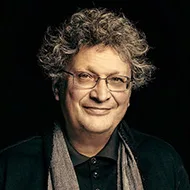
«I approach older pieces as though they were new.»

Jacobs studied philology at the University of Ghent and at the same time took singing lessons with Louis Devos and Alfred Deller. Before devoting himself entirely to music, he taught Latin and Greek for three years. In 1977 he founded the vocal ensemble Concerto Vocale Gent. During his career as a singer in the 1970s he performed with musicians such as Alan Curtis, Nikolaus Harnoncourt, Gustav Leonhardt and Sigiswald Kuijken. He then worked on several occasions as a conductor at numerous festivals, including the Innsbrucker Festwochen der Alten Musik.
Jacobs is known as a specialist in historically informed performance of early music and Baroque opera. As a conductor, he works with renowned orchestras and ensembles including the Concerto Köln, the Akademie für Alte Musik Berlin, the Freiburger Barockorchester, the B'Rock Orchestra Gent, the Nederlands Kamerkoor and the RIAS Kammerchor.
Since 1988 Jacobs has conducted at the Centre de musique baroque de Versailles. He also taught at the Schola Cantorum Basiliensis. From 1997 to 2009 he was artistic director of the Innsbrucker Festwochen der Alten Musik.
As a conductor, he has supplied the instrumental parts and the ornamentation of the vocal lines for several Baroque operas. There are numerous recordings under his direction on CDs and DVDs. Among them, with Mozart's The Marriage of Figaro, he received the Classical Grammy Award 2005 for best opera recording. His contribution to the international reception of Telemann was honoured in 2008 with the Georg Philipp Telemann Prize. With the Zürcher Sing-Akademie he recorded Beethoven's opera Leonore in its original version. In doing so, Jacobs, in the words of Eleonore Büning, proved to be "the fastest Beethoven opera conductor in recording history".
You first studied philology and then taught Latin and Greek for three years. How did that influence you?
I was very glad that I did it. Whenever I get to know a new piece, I ask about the sources. Greek and Latin help with Baroque operas, since the subjects often come from mythology. I was always glad to carry that with me.
After that you studied singing and now conduct. What led you to this step?
It was a process. As a singer I often sang repertoire, vocal chamber music and chamber music with voices. At some point I came across a Baroque opera from the 17th century. I told myself that it was so interesting and that nobody was doing it. I then brought it to the festival for early music and it was a complete success. At the first performances I was still conducting and singing, but that could not go on forever. In the end a colleague of mine sang instead. A great deal came out of that, including things I could never have imagined.
You are considered a specialist in performance practice of early music and Baroque opera?
That's three words I don't like. For me, early music is old in the sense that for Mozart the works of Handel were old. It should be noted that this term only came into being during this period. Yet there were only two generations in between. Of course the temporal distance makes a difference. But historically informed performance practice was and is always very important to me. My first activities were in this field, and through various collaborations I learned a great deal about performance practices.
But this should not be an alibi for a lack of imagination. And I am not a specialist. Because much of what I do now comes from later periods. I approach older pieces as though they were new pieces. In doing so I always try to free myself from old performance traditions. I study the piece, not only the music. First I take up the libretto, because it is the source, and it says a great deal about the composer. From it one can read and discover a lot that is new.
You have made a series of new recordings for harmonia mundi of long-forgotten works. How do you come across these works?
very little of what I recorded, and that was a great deal, did I find in the original historical sources. People do not understand how much of this music was published in modern times. For musicology as a discipline began as early as the 18th century. Various works were already being published at that time, for example in newspapers. One finds so-called monument editions of composers in libraries, for instance. There are therefore also facsimile editions from the 20th century; among them were 40 series from the 17th century in Italian.
You also published a book called «ich will Musik neu erzählen». How did that come about, and whom do you recommend it to?
It was a collaboration, but not a conventional book; rather a long interview with Silke Leopold, a well-known German musicologist. A woman who can explain things very well.
It deals with various unexpected aspects. For example, that I first fell in love with the music of Schubert.
You have made an incredible number of recordings. Are there any recordings by now that you regret?
There are recordings I have already forgotten. There are also recordings I no longer own myself. But they are all like children: just as a father cannot or will not say which of his children is his favourite, neither can I.
You have said that you are also interested in music of today. Now you come back to Schubert, but are you also interested in the very latest music?
I am not focused on it, in the sense that I do not plan to study music composed today in depth. Early music, even though I do not like this word, as I said, keeps moving forward in music history. In this sense my projects keep moving forward, but because of my age I will never come to contemporary music. Yet the music composed today, which can often be very complex, is only a tiny percentage of all the music produced today. Genres such as rock, pop or rap dominate today. I have great problems with that, because this music is so marketed and purely musically very trivial, and beats are confused with rhythm.
As an opera conductor you work with directors. Have there ever been moments of breakdown?
No, because when a good collaboration succeeds and both work on the same wavelength, a production is something very beautiful. But when I get the impression that the director does not want or cannot read the piece, then it is important to intervene in good time. One must not forget that an opera rehearsal period lasts six weeks, which is a long time. That would be an incredible loss of time. At the moment I am doing few productions but more and more concerts. The recent tours were always in four different venues, so one had to remain flexible. But such wonderful pieces came together that at concert performances people often said they had understood more than they did at a staged production.
Is there a musical experience that was especially significant for you?
What impressed me greatly as a child was the first performance of Bach's St Matthew Passion. It was a performance in the cathedral in Geneva, where I sang as a boy in the boys' choir. It was the first time I saw an orchestra and was able to experience the whole procedure. That influenced everything. Through it, music became the most important thing for me, including during my philology studies.
Do you have any projects coming up soon?
There is much I would like to do and some things I will do. This year I am again doing a proper opera production at the Staatsoper in Berlin, of Vivaldi. There is also a project with Brahms's Requiem, a favourite piece of mine, planned. Without realising this, it would be a pity to die.
Next up is the Gstaad Menuhin Festival.
Yes, but the church is very narrow, especially for such large works. With a choir of 40 men it will be a challenge. I wonder how it will sound.
Interview by Florian Schär | Classicpoint.net | 31 May 2021
More interviews
All interviews →


