

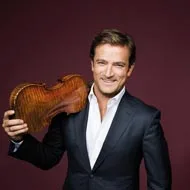
«I miss the audience.»
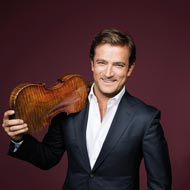
Renaud Capuçon was admitted to Gérard Poulet's class at the Paris Conservatoire at the age of 14. Three years later he successfully completed his studies in violin and chamber music. His other teachers included Thomas Brandis and Isaac Stern.
Renaud Capuçon's discography includes recordings with his brother Gautier, as well as Johannes Brahms's Double Concerto op. 102, and with Frank Braley. He regularly performs chamber music projects with Braley. He also appears regularly as a soloist in the great concert halls of the world. From 2006 to 2010 he was exclusive artist at the Konzerthaus Dortmund. Since 2014 he has held a professorship for violin at the Haute École de Musique in Lausanne. In 2016 he played at the annual concert for the national holiday in Vienna.
You play the Guarneri del Gesù «Panette» (1737), which once belonged to Isaac Stern. How did that come about?
I was fortunate to acquire this violin in 2005. It was bought for me by a Ticino bank and lent to me for years before I bought it myself. The meeting took place in Lugano. The first time I played this instrument, I had a great revelation about its sound. I knew at that moment that this instrument would be my musical partner for life.
You took lessons from Isaac Stern yourself. How do you remember him?
Isaac Stern was an incredibly impressive violinist. I was fortunate to meet him in 1995 at the festival in Verbier. I was able to work with him for a week. He was an extremely demanding teacher who understood every problem a instrumentalist might have and was certainly able to bring out the best in him.
Which musicians have shaped you in particular?
The musicians who have shaped me in particular are, of course, Isaac Stern; Claudio Abbado, with whom I played as solo violin in the Gustav Mahler Orchestra for many years; but also Martha Argerich, with whom I regularly perform; Daniel Barenboim, who is one of the greatest musicians of the century, with whom I regularly play and with whom I have many very profound conversations about music. And also many conductors, especially of the younger generation.
You direct the Sommets Musicaux de Gstaad. What makes this festival special?
What makes the Sommets Musicaux de Gstaad special is above all the location: it is a festival that takes place in the mountains, in Gstaad, in several churches, in the church of Rougemont, in the church of Saanen and in the chapel of Gstaad. You don't hear music in the same way when you are in the middle of winter, snow is falling outside and you retreat into a church to hear Brahms, Schubert or Beethoven, as you would in a large concert hall. The location, the proximity to the mountains and the fact that Switzerland has always been an exceptional host country for artists make it special. I feel at home there, and all the artists feel very comfortable there. The atmosphere of the festival, which we wanted to keep very intimate, is also a distinctive feature.
This year all concerts are taking place in streaming format. How did preparation differ, and how does it differ?
This year the festival will take place via streaming. Of course, it was with a heavy heart that I had to change the original programme, which was wonderful, but one simply has to adapt to the pandemic. Being able to present five concerts with major and young artists, but also with stars such as Martha Argerich and young musicians such as Alexandre Kantorow and Victor Julien-Laferrière, is also a way of showing that music is always present and of showing solidarity with the other artists and with the audience to whom we want to offer these concerts via streaming.
With the Festival de Pâques you have also founded a festival yourself. What makes this festival special?
I founded the Festival de Pâques d'Aix-en-Provence in 2013 together with Dominique Bluzet of Crédit Mutuel CIC. It is a very different format, with 35 concerts. I wanted a festival that exists and radiates across Europe at Easter, similar to the model of the Salzburg Easter Festival compared with the summer festival. In this spirit, I devised this festival with orchestral concerts, chamber music, recitals, masterclasses and much more centred on young artists.
You are normally constantly on the move. How is it at the moment with the pandemic situation? What are you doing?
Normally I am always travelling. Lately I still travel a little for concert recordings, but the travel is very limited. I am using this time to work, to look after my son, to be together with my family, and to work on countless ongoing projects: programming my festivals, teaching (I teach in Lausanne and at the Menuhin Academy in Rolle), and CD recordings. I still have a great deal to do.
What do you miss most at the moment?
What I miss most is the relationship with the audience and the opportunity to share music with the audience.
Where do you see personal advantages in the current situation?
I see no personal advantages in the current situation, except that I am allowed to be with my family much more often and have to travel less. Perhaps we were all too extreme before, travelled too much and did too many things. But I would much rather wish for there to be no pandemic, for a situation in which audiences can attend concerts and we can lead a normal life.
In your view, will the pandemic have a long-term impact on the classical music scene?
This pandemic will certainly have an impact on life around music and on concert life in general. Perhaps with regard to concert formats, travel and tours. The effects on musicians will certainly be severe in economic terms; there will be orchestras that close, concert halls that will get into financial difficulties. There will be many consequences, and things will not be easy to manage.
What are your passions besides music?
Writing, reading, meeting friends, very simple things in life, being at my country house in the south, having dinner with people I love, walks, very simple things, a few dishes I particularly like.
Interview by Florian Schär | Classicpoint.net | 29 January 2021
More interviews
All interviews →


