

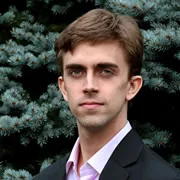
«I want my writing to lead the reader deeper into the music.»

The pianist Reed Tetzloff has long since made a name for himself as a young artist. He attracted international attention at the 15th Tchaikovsky Competition, where he was described as the «lyrical hero of the competition». The tours of this sensitive pianist, whom Gramophone Magazine recently praised for his «exuberant virtuosity», have already taken him to China, Europe and the United States.
Reed Tetzloff is also an accomplished writer. Huntley Dent of Fanfare Magazine praised Tetzloff's essay on Robert Schumann for its „exploration of the (musical) subtleties, far more profound than any other pianist who has ever attempted to comment on this music, almost on a par with Charles Rosen's sublime intellectual level.“ Tetzloff is currently working on a collection of essays about music and musical performances.
How did you originally come to play the piano?
I did not come from a musical family, but in our house there was a piano that my mother had inherited. As a very small child I went to this piano and played by ear certain melodies I had heard in Disney films and children's songs. At the age of 4 I began lessons in the Yamaha programme, which focused on "holistic" musical learning – group lessons, singing, solfège and so on. I had my first private piano lesson at around the age of six. Throughout my childhood I loved creating and improvising at the piano, and at the age of 8 I won a national competition for young composers. Today, as an adult, I no longer compose actively, because I have not yet found a compositional voice that I want to share with others at this point – yet the sense of active creation and improvisation still shapes my approach to performance.
You write your own CD booklets and also publish essays. How did that come about?
First of all, I love literature, and although many will say (and it is true) that music often goes beyond words, writing about music and trying to capture the power of music through language has always interested me. Perhaps I am particularly interested in how these two art forms (music and the written word) overlap, as in those moments when one can hear the melody in a Shakespeare sonnet or feel the symphonic sweep in Melville's prose, or the rhetorical language and the sense of spoken dialogue in a Bach prelude or a Schubert impromptu. I also believe that writing and reading about music can be a wonderful way to question a sense of complacency or "tradition" that can creep into our approach to a piece. Our ears are often too accustomed to hearing something in a certain way, and writing is a very effective means of asking ourselves: "Why?"
When I read the famous lecture on Beethoven in Thomas Mann's Doctor Faustus, I was overcome by the desire to hear all the musical works discussed again and to understand them more deeply. I am not a writer by profession (and certainly not one of Mann's genius), but I would like my texts to evoke a similar reaction: to lead the reader deeper into the music.
What does music mean to you?
I cannot describe it better than one of my favourite musicians, Robert Levin, has done: Levin speaks of how all great artists (not only musicians) are possessed by the need to describe human existence. And of course music is able to capture certain aspects of life in a particularly uncanny way. If we miss out on this music, we miss out on what gives us the capacity for self-knowledge and self-healing. This art is really about us, and we cannot afford not to know it.
Spirituality and transcendence are important themes for you. To what extent do they influence your music?
There are things in life that we long for but cannot quite grasp – they simply lie beyond the reach of ordinary human experience. C. S. Lewis summed this up in his writing on Christianity: "If I find in myself a desire which no experience in this world can satisfy, the most probable explanation is that I was made for another world." Regardless of one's own religious convictions, great music can offer hints of this deeper reality. One of my favourite quotations about music comes from the American composer Charles Ives: "Perhaps music was never meant to satisfy man's inquisitive certainty. Perhaps it is better to hope that music will always be the transcendental language in the most extravagant sense."
What are your visions and plans for the future?
Above all, to keep growing and to play better at 75 than I do now at 31! At some point I would like to work with historical instruments alongside the modern piano, which I love. Conducting is another goal I would like to explore later.
What are your favourite works or composers?
The ideal is to be able to say truthfully, "Whatever I am playing right now", and that is what I strive for. I also love discovering neglected works from music history. In general, however, I would admit to a preference for the German/Austrian tradition (Bach, Haydn, Mozart, Beethoven, Schubert, Schumann, Brahms). I also love a great deal of French music, which often feels like a refreshing holiday from the profound psychological experiences of German music. Charles Ives is a kind of hero to me, both because of his unique compositions and because of the heroic individualism he represents.
How do you recover from concert life, and where do you find renewed strength?
Normally I enjoy (on the whole) the hectic nature of travelling and performing, but there are definitely some challenges. For example, I almost always have trouble getting enough sleep on tour, and then I do not feel physically well. One or two weeks at home in New York are the perfect way to recover: I read, take walks around the city and indulge my love of baseball by going to a game or – even better – playing myself (I play in a pickup league that meets in Central Park).
What was your most beautiful musical experience?
Life with music brings so many encounters with beauty that it is difficult to choose one. The most memorable experiences can be had at home, simply studying scores and playing for oneself. Of course I have had many impressive experiences at concerts; a highlight recently was John Eliot Gardiner and the Orchestre Révolutionnaire et Romantique with Berlioz's Symphonie fantastique. As for my own performances, the concert at the Berlin Philharmonie this year is hard to surpass.
Interview by Florian Schär | Classicpoint.net | 1 October 2023
Photo: Steve J. Sherman