

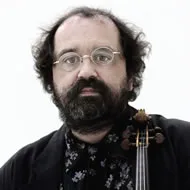
«There are various opinions.»
Rainer Schmidt has been a member of the Hagen Quartet since 1987, where he plays second violin. In 1989 he founded the Ravinia Trio. Rainer Schmidt teaches at the Mozarteum Salzburg, at the Escuela Superior Reina Sofía in Madrid and is Professor of Violin and Chamber Music at the Hochschule für Musik of the Musik-Akademie der Stadt Basel.
Classicpoint.ch: How did you actually come to join the Hagen Quartet?
I was studying in the USA during the 1986/1987 academic year. The quartet called me there and asked whether I would come to Salzburg to rehearse together and see whether we had a future together. It went very well, and a few months later I began.
Unlike the other three members of the quartet, you are not part of the family. Have there already been moments when you felt that?
From the very beginning I was treated like a new member of the family, which was lovely and touching. During our actual work, namely rehearsing and performing, I notice nothing. Those moments come more from the outside.
You have been with the Hagen Quartet for 24 years now. How do rehearsals work? Is there someone who takes the lead?
It depends. There is no predetermined leader, but rather changing initiatives.
In any group of people who work and live together intensively, there are inevitably different roles, hierarchical structures and the formation of smaller groups. How is it in the Hagen Quartet?
I can definitely rule out smaller groups. There are, however, various opinions from time to time. These are dealt with democratically, and so far we have reached an agreement every time that everyone can live with. Hierarchical structures, apart from those we have set up ourselves to facilitate certain procedures, do not exist. We naturally have different roles, but ones with which we can get along well.
Do you ever argue?
Very rarely.
What is the recipe for working together successfully and joyfully for so long, rather than gradually remaining together merely as a marriage of convenience?
Mutual respect, no "egos", setting the right priorities.
You always play second violin. What attracts you to this voice, and are there moments when you would like to play first violin?
I would certainly like to play the other instruments in the quartet at some point too; the cello in particular would appeal to me. Each instrument has its own very specific function, without which the quartet is incomplete. The meaning of the melodic line only becomes clear through the other voices. A typical role of the second violin is to give the whole its essential character in the first place.
Which string quartets do you particularly like?
There were and are some outstanding ensembles that I admire, and to whom I would like to express my thanks for the great deal of work they have invested.
You moved with the Hagen Quartet from Deutsche Grammophon to the small label Myrios Klassik. Why?
We no longer saw a place for ourselves at DGG. Artistically, it was no longer our home. Myrios Klassik, or rather Mr Stephan Cahen, offers us a great deal. We are delighted to have found this label and look forward to the recordings we will make together.
You also teach at the Musik Akademie Basel and in Salzburg. Where do you see the differences between these two institutions?
There are differences and similarities. Both institutions have tradition and are rooted in their cities, yet they also tell different stories. My home is now Basel, and I am very happy there.
Interview by Florian Schär | Classicpoint.ch | 12.10.2011
Photo: Harald Hoffmann
More interviews
All interviews →


