

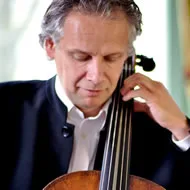
«This music opens up so much more than one hears and plays.»

The Dutch cellist Pieter Wispelwey is one of the first of a generation of performers who play the cello both in a modern and a classical manner. His solo career takes him to the most important concert halls in the world.
Classicpoint.ch: You have devoted yourself very intensively to Bach and have now released the 3rd recording of Bach's 6 Suites. What fascinates you about Bach and in particular about these 6 Suites for solo cello?
As a cellist, one must of course engage with Bach.
Beethoven composed five, Brahms two sonatas for violoncello; by sheer quantity, the most written for this instrument is by Bach.
Moreover, the 36 movements of the six suites are qualitatively completely timeless pieces. The 5th and 6th Suites, and also the 4th, are spectacular; Suites 1 to 3 are already mini-cycles in themselves, immensely charming and so full of character. What fascinates me is how Bach, with this modest and quite limited instrument, shapes a relatively simple line on the one hand and yet suggests an entire world with it. This music opens up so much more than one hears and plays. The cello suites mean no less than the orchestral suites, the suites for harpsichord and the partitas. Within the instrumental limitation, one always hears the universal.
You have included with the CD recording a DVD documenting conversations with the Bach specialists and professors Laurence Dreyfus and John Butt. Which insights from these conversations decisively influenced your interpretation?
One of the most important impulses I gained from the conversations was explained by Prof. Dreyfus: Baroque dance is fundamentally different from the dance of the 19th and 20th centuries. Baroque dance floats; it is not a dialogue with gravity but rather tries, so to speak, to hold the movement against it, to escape it. This means that in the hierarchy within the bar, the first beat is still the dominant one, but not necessarily the heaviest. To re-create this floating, especially with a rather ponderous instrument like the cello, which is essentially the bass, is particularly difficult, but also a very exciting aspect. The aristocratic, the noble, mingles with the gravity of the instrument and, so to speak, lifts it up.
You play with a 392-hertz tuning. How does it feel to play at this pitch?
It is simply exciting. John Butt had already recorded the Brandenburg Concertos at a pitch of 392 hertz with his ensemble. I have always been very curious about playing lower than 415 hertz. In concert I had already performed the suites several times at 400 hertz. 392, however, was relatively new to me. Perhaps the cello is somewhat "happier" at 400 hertz, depending on the room. But the Köthen pitch lets the suites sound in a different light; it brings a new colour into the inexhaustible sound world of Bach's suites. It enables a further level of authenticity, yet not of a dogmatic but of an adventurous kind.
Do you still feel like playing the suites with a modern cello and bow, or do you no longer do so at all?
I always want to play them, whether on a modern or an old instrument. Playing is always a kind of translation, meaning that one must always find a language that is meaningful. Perhaps 400 hertz in good, appropriate acoustics suits me a little better, but playing the suites in a large hall with a modern cello, thus translating differently, can be just as exciting.
You describe the cello suites as a provocation. In your opinion, what is provocative about the compositions?
The provocation lies already in the fact that they were written for solo violoncello senza basso. We know nothing 100% certain about them. That is, they are provocative because they are experimental. They are also an invitation for the listener and player to reflect on what the essence of music-making is. In this sense, the provocation is to be understood philosophically.
You play many movements very fast, so that, even though they are stylised dances, one could not dance to them. What are your considerations in choosing the tempo?
When making music and choosing the tempo, it is simply a matter of decisions. What is important to me is that the six movements of a suite form an organic whole with contrasts. In the faster movements such as the gigue or the courante, I think it is, given the integral sound and tempo, absolutely permissible to make them very fast, so that each suite forms a coherent unity and sounds as if cast from a single piece.
You play the 6th Suite on a cello piccolo. How does playing the 6th Suite feel on a 5-string cello?
It is a truly fairy-tale instrument and quite exotic for modern musicians and string players. It is a delight to play! It is very expressive and produces a radiant tone. The piece positively blossoms as a result. It is simply wonderful to play the 6th Suite with the high E string.
You studied with Anner Bylsma, who also engaged extremely intensively with Bach and made important recordings. Do you still exchange ideas with him today?
I have certainly not spoken with Anner Bylsma for 25 years. At the age of 14 I lay awake for nights after hearing a lecture by him. However, I never studied Bach with him. He has such an individual relationship to Bach's music, one which I also wanted to have – that was clear to me early on. But I was equally aware that I would have to develop this not by asking, but through my own feeling, in my own language. I cannot judge whether I have succeeded. For Anner Bylsma and his approach to Bach I feel something like love and affection.
Do you already have ideas for a 4th recording?
I have already begun the fourth recording in Tokyo. It will be something like a Bach-suite guerrilla recording on my Guadagnini cello.
If Bach were still alive, what would you definitely want to know from him?
From him, as with all composers of past epochs, I would want to know how he plays, how good he is, what is important to him when playing. For he must have been an extraordinarily good musician. And like his contemporary colleagues, he was a super-specialist in the music of his time, that is, of modern music.
Interview by Florian Schär | Classicpoint.ch | 7.3.2013
More interviews
All interviews →


