

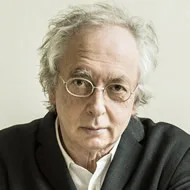
« I want to make the music transparent. »
Philippe Herreweghe is a Belgian conductor. He studied piano, harpsichord and organ, and then medicine and psychiatry. He was already conducting a choir during his student years. His ensemble, which was still an amateur group in its early days, attracted attention from musicians such as Nikolaus Harnoncourt and Gustav Leonhardt. He thus took part in Harnoncourt's complete recording of the Bach cantatas.
Herreweghe has since become one of the most important protagonists of historically informed performance practice. In 1970 he founded the Collegium Vocale Gent, which he has led ever since; it devoted itself to pre-Baroque music as well as producing groundbreaking recordings of Johann Sebastian Bach's cantatas. Herreweghe is also the director of the Paris-based "Orchestre des Champs Elysées". Since 1999 he has been the first conductor of the "Royal Philharmonic of Flanders" based in Antwerp. In 1982 he took over the artistic direction of the Festival for Early Music in Saintes. In 2010 he founded his own CD label, "phi".
Classicpoint.net: You studied medicine and psychiatry. You then worked as a trainee doctor and conducted your choir in the evenings. Later you devoted yourself fully to music. Did you ever miss medicine?
I started studying piano at the conservatory very early, alongside my regular school. I had already received a diploma at the age of 14. I attended a Jesuit school. There was a choir there. We had to rehearse and sing every day. The choir director was a professional musician. So we sang very beautiful music: Bach, Schütz, etc. I led a musical double life at that time. With the piano, I mainly learned the piano literature of the Romantic period. Alongside that, we sang church music, which was mainly so-called early music. In those days, choir directors were not professional conductors. I was interested in psychiatry and thought that I would later work as a psychiatrist and conduct Bach as a hobby. That is why I studied medicine. Alongside that, however, I founded my choir and soon worked at a professional level. My collaboration with Gustav Leonhardt and Nikolaus Harnoncourt inspired me further. From then on, I wanted to devote myself exclusively to music. I think I became a better musician than I would have become a psychiatrist.
Did your studies in psychiatry sometimes help you in your work as a choir director?
No, not directly. However, I am convinced that complete musicians should know a great deal. The more one studies, the deeper one can immerse oneself in music, and the more one can understand. In this respect, my medical and psychiatric studies have been very important to me. I would take this educational path again. As a conductor, you do not have to practise eight hours a day. It is important to educate yourself broadly. In addition, during my studies I spent three years working with schizophrenic patients. That shaped me greatly as a human being. Psychiatry means dealing with sick people; conducting means dealing with complicated people!
Your collaboration with Leonhardt and Harnoncourt was decisive for your full commitment to music. Can you tell us about the beginnings?
From Leonhardt I learned a great deal about articulation, ornamentation, intonation etc., which I had not really known from the piano. His great strength was rhythm. Leonhardt was completely committed to music. He always placed himself in the service of music and, compared with other musicians, never misused music for other purposes. Harnoncourt had a rhetorical, dramatic power which convinced me even more in later music. Leonhardt was a very conservative musician who held the view that everything after Mozart was no longer music.
My piano teacher Marcel Gazelle also influenced me greatly. He was the accompanist of Yehudi Menuhin. I have studied a great deal in my life: medicine, psychiatry, piano, harpsichord, harpsichord (cembalo), singing and also bassoon. What I have done the most in my life is conducting, and I taught myself that.
Can you describe your ideal sound?
What is most important to me is clarity. I want to make the music, so to speak, transparent. My recordings should be transcribable by a good musician. My challenge is always to articulate the music so clearly that it could be notated by ear.
Bach's sacred works have been at the centre of your life for almost all of it. Are you a believer yourself?
For me, almost all good music is religious. Great music is sacred music. I would describe myself as etymologically religious. We are all connected with one another and with the world. In my view, in this sense all people are religious.
What interests and pursuits do you have besides music?
I actually have no free time. I am always working. But that is not exhausting for me. I read a great deal and travel a great deal. I spend 280 days a year in hotels.
Interview by Florian Schär | Classicpoint.net | 2.4.2018
© Photo: Michiel Hendryckx
More interviews
All interviews →


