

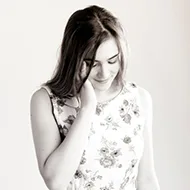
«The tension should be in the music.»

Nadège Rochat is an expressive voice among young cellists. Alongside her broad musical interests in the Baroque, Classical and Romantic repertoire, she enjoys exploring forgotten composers, world music and contemporary pieces.
She began playing the cello at the age of four and first studied in Geneva, then in Cologne with Maria Kliegel. She attended masterclasses with, among others, Heinrich Schiff and Anner Bijlsma, and completed her studies at the Royal Academy of Music with Robert Cohen, where she is now a professor. She won several first prizes at Swiss, German and British competitions and was twice awarded the Swiss SUISA Prize for the interpretation of contemporary music. Nadège Rochat has performed, among other venues, at the Tonhalle Zürich, the Musikverein Vienna, the Konzerthaus Berlin, Carnegie Hall New York, the Mariinsky Theatre St. Petersburg, the Beethoven-Haus Bonn, the Konzerthaus Dortmund, the KKL Luzern and the Victoria Hall in Geneva.
She has worked with orchestras such as the Scottish National Orchestra, the BBC Concert Orchestra, the Staatskapelle Weimar, the Dortmunder Philharmoniker, the orchestra of the Norddeutscher Rundfunk (NDR), the Württembergische Philharmonie Reutlingen, the Sinfonieorchester Biel/Bienne, the Nordwestdeutsche Sinfonieta, the Orchestre des Pays de Savoie, the Orchestre de chambre de Genève and the Amadeus Chamber Orchestra of Polish Radio.
You were born into a musical family. What are your earliest musical memories, and what led you to the cello?
Music has been part of our life for as long as I can remember. I desperately wanted to join in, the way children imitate their parents. So that I wouldn't damage their instruments, my father roughly built me a one-stringed viola out of wood, so that I could pluck the string for my own amusement.
Then, when I was four years old, they finally decided to put a real instrument in my hands. My aunt is a cello teacher, so they sent me to her.
You studied at the Royal Academy of Music, where you now teach a class yourself. What is especially important to you in teaching?
I am incredibly grateful to my own professors. When you teach an instrument, and art in general, you give so much of yourself. You pass on things that it took you years to discover and realise. It is so rich and complex: some of what you want to pass on is never really understood or realised by some students, yet you must keep trying. On the other hand, those same students may learn something else very quickly, something that took you a very long time! Every person is different. What my first professor, Maria Kliegel, taught me about pedagogy (I was her assistant in Cologne for two years) is never to try to guess what a student is capable of, but always to expect the very best from each and every student. Because everyone learns at a different pace. One can never really know what someone is capable of, and underestimating students, demanding too little of them, is a great mistake. From my second professor, Robert Cohen, I remember above all his generosity, his goodwill at any price, and the absence of competition. It is a delicate subject, because in the end I have prepared for the same career as he did. But for him and for me it is about much more than that: it is about giving a gift to humanity in the form of a love of music. It is an important task, which is why we need musicians who are masters of communication, and why I teach.
Since you were 13, you have devoted yourself to belly dance and have been enthusiastic about flamenco. What is the fascination for you?
Everything... First of all, the complexity of these two musical styles. If you don't engage with them much, you can't imagine how complex they are. I am also interested in languages, and ultimately these two dances and their music are other languages. I support the scientific theory that language shaped the development of our brain, and not the other way round. When you engage with a foreign language, or with unfamiliar music, you learn to think in a differentiated way. That is fascinating. I also find the attitude of musicians of "popular" music inspiring (I do not like to describe classical music as unpopular; for me, all music is popular). I mentioned above our special task of conveying music as a gift. I believe this task is even more pronounced in so-called popular music than in classical music. Probably because so many institutions have meddled in classical music, and the pursuit of technical perfection has become almost pathological.
How does this passion for dance influence your cello playing?
For me it is about having as few physical tensions as possible when playing the cello. The tension should ideally be in the music, not in the body that produces it; otherwise much expression is lost. Through dance (at least belly dance) you learn to move according to the natural possibilities of your body and gravity. This gives natural strength, and physical relaxation allows the mind and heart to be open to creativity.
Do your cello students have to dance too?
Quite recently I actually recommended my former belly dance school in London to a student! It is wonderful for back problems, and by the way it is also good for men (my first teacher, back in France, was a choreographer from Egypt and a great dancer!).
Have you ever been annoyed that you chose the cello, of all instruments, where moving while playing is quite restricted?
It is not about how much you move, but how... Pina Bausch expressed this very well with her ballet "Kontakthof" (with non-professional dancers aged 65 and over). And when you watch an old man dancing salsa, you understand it immediately.
In 2020 you performed several world premieres of works written for you. How did this come about, and could you briefly introduce the works to us?
Unfortunately only one premiere took place: the work "Apocalypse" by the French composer Gilles Colliard for solo cello, in October 2020; everything else was postponed because of Covid. I am looking forward to playing "Elegia di un Silenzio" for cello and orchestra by Raffaelle Bellafronte on a tour of Italy in winter 2022/23, and in March 2022 to the world premiere with the Theater Orchester Biel of "Fulgores" by Lorenzo Palomo in a re-composed version for cello, guitar and orchestra (I am currently working on it with the composer).
You are interested in philosophy from Europe, Asia and the Arab world. Which ideas are especially important to you?
I am interested in the question, which Schumann also explored, of the place of music and of the musician in this world, because I sense that it is very important. "Tones are higher words", the composer is supposed to have said. And since I believe that words shape our reality...
For me, music and life cannot be separated (in this world, very little can truly be separated from one another). Music allows us to experience the world as though through a lens, and philosophy also concerns itself with this. Since I devote myself to music every day, it is refreshing to view everything through a different lens.
What future plans and dream projects do you currently have?
Before the pandemic I had very concrete ideas about what I would be doing in a few months and even years. Now I am going with the flow... First of all, many concerts until the end of the year (France, Germany, Mexico, Switzerland). I have started composing, and I am doing interviews with colleagues for an online cello magazine (cellomagazine.online). It is great fun! One wish? To play Schumann's Cello Concerto once with the conductor François-Xavier Roth.
Interview by Florian Schär | Classicpoint.net | 27.10.2021
More interviews
All interviews →


