

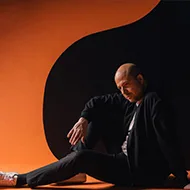
«As a listener, every kind of music gives me something.»

While the Stuttgarter Zeitung praises the "fascinating and enormous expressive power" in Moritz Winkelmann's piano playing, the Hildesheimer Zeitung describes him as a "pianist personality" and an "exceptional artist". Moritz Winkelmann performs concerts all over the world and is a prize winner of the Bonn Beethoven Competition. He has made music with, among others, Itzhak Perlman, Stefan Blunier, Helmut Lachenmann and Wolfram Christ, and has appeared as a soloist with the Beethoven Orchestra Bonn, the Kölner Kammerorchester, the Kurpfälzisches Kammerorchester and the New York Classical Players. About his performance of Franz Liszt's Piano Concerto No. 2 with the Staatstheater Niedersachsen, the Hildesheimer Allgemeine Zeitung wrote: "The musical intensity of this exceptional artist allows the composition to mature into a thriller of the finest kind."
Over the past few years, Moritz Winkelmann has earned a special reputation for his Beethoven interpretations. In February 2022, his recording of Ludwig van Beethoven's last three sonatas, together with Helmut Lachenmann's Wiegenmusik (1963) and Marche Fatale (2017), will be released by Hänssler Classic.
His first prize at the Richard Laugs Competition in Mannheim was followed by his debut at the Rheingau Musik Festival. International engagements have taken him to Carnegie Hall New York, the Beethovenhalle Bonn, the Slovak Philharmonic Bratislava, the Mannheimer Rosengarten, the Stuttgarter Liederhalle and the Beethovenhaus Bonn, as well as to the Schwetzingen Festival, the Schleswig-Holstein Musik Festival, the Ravinia Festival in Chicago and Music@Menlo in California. Concert tours have regularly taken him, besides Europe and the USA, to China and Japan. Radio recordings were made in collaboration with SWR, WDR, DR Copenhagen, WBJC Baltimore Classical Radio and WFMT Chicago; television broadcasts on ZDF.
Lessons with his grandfather Prof. Gerhard Wilhelm were followed by undergraduate studies with Prof. Michael Hauber at the Musikhochschule Mannheim. Subsequently, as a scholarship holder of the DAAD and the Studienstiftung des Deutschen Volkes, Moritz Winkelmann studied with Leon Fleisher at the Peabody Conservatory of Music in Baltimore, where he completed his studies with distinction. Ferenc Rados and Marisa Somma have supported his artistic development in special ways.
In 2021, Moritz Winkelmann accepted a call as Professor of Piano at the Staatliche Hochschule für Musik und Darstellende Kunst Mannheim. Previously, he taught at the Musikhochschule Stuttgart and at the Konservatorium Bern. He gives masterclasses internationally and has served as a jury member at international competitions. He was a scholarship holder of the Kunststiftung Baden-Württemberg, is artistic director of Klassik im Klösterle in Weil der Stadt and a recipient of the Mozart Prize of the Stuttgarter Mozart-Gesellschaft.
You are going to release a new recording featuring Beethoven, Lachenmann's Wiegenmusik and Marche Fatale. How did you come up with this programme?
Both are composers I have been engaged with for many years. I played Helmut Lachenmann's Wiegenmusik as a teenager already. At the same time, I also got to know Helmut. That was through my grandfather, in whose choir Helmut sang as a young man. Wiegenmusik was the first atonal work I learned. The notation alone was a challenge. But over the course of many years the piece has grown very dear to me. Say what you like about new music – I find Wiegenmusik beautiful. And Beethoven has always felt like a constant companion. His music draws me in in a very powerful way. That is why I wanted to play precisely these two composers on my debut album.
The way the works are arranged on the album creates a listening context that makes what has become familiar newly experienceable. None of the works is under the influence of the other; the contours become clearer through their proximity to one another. And yet a unifying atmosphere emerges, which I find very appealing.
You teach at the Musikhochschulen in Stuttgart, Bern and, new since this year, Mannheim. Could you describe your teaching style?
At the Musikhochschule Stuttgart and the Musikschule Konservatorium Bern I taught until the end of the summer semester 2021. I gave up both posts for the professorship at the Hochschule für Musik und Darstellende Kunst Mannheim, starting in the winter semester 2021/22.
I strive to have as many teaching approaches at my disposal as possible, so that I can help the young colleagues. I like to adapt my teaching to the person I am working with. Some students benefit more from an "I believe in you", while others are truly inspired by a "Convince me". Recognising this is very important in order to enable ideal support. All people are different. In part, that is also what makes teaching fun.
Aren't too many musicians being trained nowadays?
I don't think so. There are naturally more musicians than positions in orchestras and at universities. But these are not the only fields open to musicians. A great many of them work as freelancers. It is a professional profile that, depending on how it is shaped and on personal inclinations, can be made up of many elements. For example, a combination of private teaching, various kinds of engagements and regular work as an accompanist. This can be very fulfilling and, in many respects, of social relevance. On the one hand in a direct way, for example in instrumental teaching for children and young people, or through engagements at weddings and funerals. But also through the fact that musicians preserve one of the greatest cultural heritages of our civilisation, carry it within themselves and pass it on.
You also get involved with children to popularise classical music?
Yes, for exactly this reason. We know that children who do not come into contact with classical music through their family in many cases never gain access to this world for the rest of their lives. Yet it can bring people great strength and moments of happiness. It is a pity when this is denied to someone. And it is also about the future and the morals of our future society. Before I received the call from Mannheim, I worked a great deal with children and young people in my teaching. Knowing that it is not only about playing the scale evenly, but also about being able to change an entire human life with music, has inspired me and given me the strength to take on this demanding task. In my concert series "Klassik im Klösterle" in Weil der Stadt, we invite children and young people from the local schools in connection with the concerts to come to the Klösterle for a presentation with the artists. There they get to know the musicians, learn that this is a real profession, listen to music – and of course they can ask as many questions as they like.
You are also a jury member at international competitions. What do you pay most attention to there?
Beethoven has already told us what we should pay attention to: "To play a wrong note is insignificant. To play without passion is inexcusable." I pay attention to the artistic statement. If it moves me, that is already a very strong argument. I imagine where the journey might lead for the participant. How much does he or she burn for music, how strong is the need to fill the notes with meaning and to play expressively. The profession of musician is not exactly easy. The challenges are countless, both inner and outer. By this I mean, on the one hand, the artistic engagement with music and with oneself, and on the other hand the tremendous effort of establishing oneself professionally. How much a musician burns for the work has a strong influence on how far he or she can develop. Ultimately, of course, a competition produces an overall picture, which I let affect me as a person and an artist. I try not to be a judge but a colleague. One can criticise a great deal. It does not make me happy to notice all the shortcomings and to devalue the performance accordingly. As a juror, however, I am still relatively at the beginning. So far I have not had to experience a situation in which I had to choose between two artists where that is really not possible. I hope it will never happen to me. That would weigh on me.
Which composers and musical periods do you like best?
As a performer, at least at the moment, I am most at home in the Classical period and German Romanticism. That is my focus, but of course not a limitation. As a listener, every kind of music gives me something; I love the drive of Baroque music, I am overwhelmed by Mahler, I swoon over Rachmaninoff and feel strong emotions with Alban Berg. And with hip-hop.
Do you also compose yourself?
I do not compose. The height of my ambitions are arrangements, which I sometimes play as encores in piano recitals. However, I often try to see the works through the eyes of the composer. I believe that one plays works differently when one becomes aware of the abundance of possibilities that were available to the composers, namely all the notes that exist. Sometimes we musicians look at the score as if it were an act of God. But Schumann, for example, had to choose every single note, just as a poet must choose every syllable. And from these he chose a combination and sequence that can move us to tears or make us leap for joy. When I as a performer am aware of this, my way of making music regains a breath of freedom that lets it breathe.
What would have become of you if things had not worked out with the piano?
That it would not work out was not an option. I never even asked myself this question. I probably owe that to a certain youthful enthusiasm. I like to think back to the time when I was not yet the pianist Moritz Winkelmann, but simply Moritz Winkelmann. Someone for whom everything could still go in any direction. I do not know what would have become of me. Perhaps a pilot? I am fascinated by aviation and by large aircraft. Certainly something that would have meant freedom to me in some form. But I am in fact very sure that I could not have chosen better.
What personal visions do you have? What do you wish for and what do you most want to achieve?
I would like to record the Beethoven piano concertos and learn the Goldberg Variations by Bach with plenty of time and calm. Otherwise I always heed the old saying "The journey is the destination". For of course I constantly strive for artistic development. But that will remain so until the end. The goal will therefore never be reached. If I saw happiness only where this goal has been reached, I would probably have a very sad life. But that is by no means the case. I consider myself very happy and am grateful to be able to live a fulfilled life as a musician.
What passions do you have besides music?
I enjoy being on the move – I like sitting in an aeroplane, I feel comfortable on the ICE, and long car journeys I find relaxing. While travelling, my thoughts are free. I will never tire of watching a sunrise from an aeroplane. Actually, I pursue most things in life with a certain passion.
Interview by Florian Schär | Classicpoint.net | 23.12.2021
More interviews
All interviews →


