

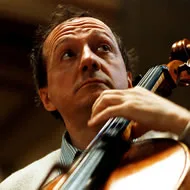
«His playing was still very powerful.»

The Hungarian cellist Miklós Perényi is one of the great cellists of his generation. Since 1974 Miklós Perényi has taught at the Franz Liszt Academy in Budapest, where he has held a professorship since 1980. His solo career takes him to all the major music centres of the world.
You received your first cello lessons at the age of 5. Can you remember them?
The cello was my father's favourite instrument. Before I was born, my father had already come to an arrangement with my first teacher. My father had agreed with him before my birth that he could teach me. Private lessons began at the age of 5. At 7 I then passed the entrance examination for preparatory studies and entered the academy of music. At that time Zoltán Kodály was still the jury president.
After you won the Pablo Casals International Cello Competition in Budapest, Casals invited you to his masterclasses in Puerto Rico in 1965/1966. How did you experience Pablo Casals?
Pablo Casals was already 87 or 88 years old. However, when teaching, he still played for his students to show exactly what he wanted. His playing was still very powerful, which impressed me greatly.
You were then invited several times to the Marlboro Festival. Which musicians did you play with there at that time?
I played a lot with Felix Galimir, but also with members of the Emerson Quartet and the Guarneri Quartet, with Edith Beinemann, Michael Schwalbé and many others.
What do you remember from these Marlboro Festivals?
The opportunity to play with so many outstanding musicians was wonderful. Playing in the orchestra under Pablo Casals was also an impressive experience.
You have taught at the Franz Liszt Academy in Budapest since 1974 and received your professorship in 1980. Looking back over the last nearly 40 years of your teaching, what has changed in your approach to teaching?
Through practice I have built up a great store of experience. This makes it much easier to respond to individual students. It is great fun to keep exploring compositional structures anew with the students.
Over these 40 years, do you also see general differences among students? For example, has the level, the ability to learn, the capacity to absorb etc. of students changed?
At the beginning of my teaching career, students had a much more individual style of playing. Today students play in a more conformed and uniform way. A noticeable difference in level could be observed from the 1970s onwards. Alongside the emergence of new compositions, the way of overcoming technical problems has also changed.
Besides your concert appearances and teaching, you also compose. When and why did you begin composing?
I began composing more than 30 years ago. I compose every day. It gives me great pleasure to find the best solutions, even though it is sometimes very demanding mental work.
Do you compose with the cello, at the piano, or without an instrument?
I compose mainly at the piano, but also at the cello or entirely without an instrument. My music is based on twelve-tone music with a certain tonality and harmonic stability.
You maintain a close collaboration with András Schiff. How did this collaboration come about?
In 1975 we first gave a duo recital in Budapest, arranged through a concert agency. Since 1989 we have played together every year. Recently I have also often performed as a soloist under his direction as conductor.
What do you do outside of music?
I tend my garden and regularly water the trees. I also enjoy taking short bicycle trips, and I love hiking.
Interview by Florian Schär | Classicpoint.ch | 2 November 2012
More interviews
All interviews →


