

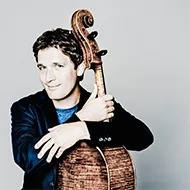
«I feel the need to surround myself with people.»
With captivating musicality, instinctive stylistic assurance and an exceptional musical maturity, the cellist Maximilian Hornung is conquering the international concert platforms. As a soloist he performs with such renowned ensembles as the London Philharmonic Orchestra, the Pittsburgh Symphony Orchestra, the Philharmonia Orchestra, the Tonhalle-Orchester Zürich, the Orchestre National de France, the Czech Philharmonic, the Vienna Symphony, the Swedish Radio Symphony Orchestra, the Deutsche Kammerphilharmonie Bremen, the Symphonieorchester des Bayerischen Rundfunks and the Bamberger Symphoniker under conductors such as Daniel Harding, Yannick Nézét-Séguin, Mariss Jansons, Esa-Pekka Salonen, David Zinman, Pablo Heras-Casado, Semyon Bychkov, Bernard Haitink, Manfred Honeck, Antonello Manacorda, John Storgårds, Mario Venzago, Jonathan Nott, Andrew Manze, Krzysztof Urbański and Robin Ticciati.
At the age of 16 you broke off school and began studying the cello. Would you recommend that?
Not as a general rule, but in my case it was exactly the right thing to do.
At 23 you had been appointed principal cellist of the Symphonieorchester des Bayerischen Rundfunks and gave up the post after four years, so that you could devote yourself entirely to your work as a soloist and chamber musician. In hindsight, was that the right decision?
My four years in this particular orchestra and in this particular position were incredibly important for my musical and also my personal development. I got the position very early, at an age when others are only just beginning their studies. In that sense I regard that time, to some extent, as a kind of postgraduate study or internship. Had I not had those four years, everything that came afterwards would not have been possible. And so, yes, both joining the orchestra and leaving it again after four years still feels absolutely right.
Do you sometimes miss playing in an orchestra?
Yes, I definitely sometimes miss playing in an orchestra, but really only sometimes. The great symphonic repertoire is simply incredible!
You describe yourself as a gut musician. What is for you the optimal balance between analytical engagement with a work and intuitive music-making?
When the two support each other and do not get in each other's way.
You are also a professor in Munich. What is important to you in teaching?
I place great value on my students finding their own, completely individual voice. For us musicians the journey is always the destination, and that requires a lifelong engagement with oneself and the instrument. Preparing my students to take this journey independently and in all its facets is my highest aspiration.
There are an incredible number of very good cellists. What is the atmosphere among you? Are you in contact with others, or is the competitive situation too strong to allow friendships?
I feel the need to surround myself with people who inspire me, who excite me, and with whom I have the sense that we can progress together. This is entirely independent of which instrument they play, where they come from, or whether they are musicians at all. But, to answer the question, there are indeed a few, very outstanding cellists among my (close) friends.
How are you experiencing the current pandemic situation?
Very mixed. Sometimes with hope, sometimes with frustration, sometimes with anger, but mostly with the determination to somehow make the best of it.
What are you taking away from this time?
A very well-stocked and well-organised wine cellar.
What are your plans for the future?
At the moment I think less about future plans and am more glad when anything at all works out. After this pandemic the future will surely be even harder to plan than it already was, so at most I dare to dream of hopes.
What passions do you have besides music?
I love cooking enormously and I love good wine.
Interview by Florian Schär | Classicpoint.net | 24.03.2021
More interviews
All interviews →


