

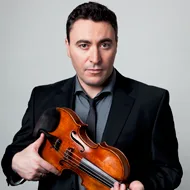
« There is nothing more powerful than love »

Violinist Maxim Vengerov, born in Russia in 1974, began violin lessons with Galina Turchaninova at the age of five. Today he performs on all the major stages around the world. The artistic director of the Swiss Menuhin Music Academy speaks in this interview about his career, his many mentors, his three professions as violinist, conductor and teacher, and his work as a juror at the Isaac Stern Competition.
Classicpoint.net: You studied with Zakhar Bron and followed him from the Eastern Bloc to the Lübeck University of Music in the 1990s. Could you tell us about that time?
Before I studied with Professor Bron, I had been with Galina Turchaninova for five years. As a student of Bron, I went to Lübeck to both study and perform. It was a really exciting time for me, especially since I came from Russia. At that time Russia was still part of the Soviet Union, and the cultural difference between my new destination and my background was extraordinary. As a young person it was a very important time to get to know Western culture, to understand where the differences between Eastern and Western culture lay, and to spend time absorbing the great Western offerings. When I came to Germany I was already at an advanced stage, because in Russia I had a fantastic, intensive musical education – I studied not only violin but also harmony and other musical disciplines. Looking back, it was a truly amazing time, because at 13 I was already a travelling musician, about to see the world for a second time.
When you won the Carl Flesch Competition and suddenly received 70 engagements around the world, you were still not sure whether you should become a professional musician. Why did you have this uncertainty, and what ultimately made you decide to become a musician?
I learned from two great teachers for 11 years in pedagogy. The result was that everyone regarded me as a professional musician, because my repertoire was very large. I was no longer seen as a child prodigy. After my studies with Bron, I decided not to have any further teacher. Once you have been with such a great teacher, who else could you have? The level with Bron was truly exceptional, but I had to leave him because of a family situation. So I had to work alone and discover music for myself. Around that time I contacted Isaac Stern for a short lesson. He asked me to play the scales, which I then did. He told me I could not connect two notes together, and said he was very glad that I had so many concerts and engagements in London, Japan and the United States, but that I had not yet reached musical professionalism. I asked him to help me and to tell me what was wrong. He replied that he could of course tell me, but he believed I had the potential to find it out myself. He told me that when he was 16 he had also been alone, without a teacher. If he could discover music for himself, then I could do the same. That set me on a challenging path, because I understood that I had to change my direction.
I listened to orchestras, symphonies and operas, and studied harmony and music analysis as well as many other disciplines beyond the violin. This really helped me broaden my horizons, because I realised that I could not have a career as a violinist without additional knowledge. A year later I had several teachers, none of whom were violin teachers, and I was performing intensively, giving 70 concerts. When I turned 17, I met the great Rostropovich and Barenboim, who became my mentors for life. With them I recorded a large part of the core repertoire. They opened up new horizons and perspectives in my musical life, and I am very grateful to them.
In 2007 you had an injury to your right arm and could not play the violin for four years. How did this affect your future career?
I never had an arm injury! I needed time to take stock of my life. People cannot understand how one can leave a great career to study something else. Nobody believed the real reason, so they invented an arm injury. What actually happened was that I felt I had to stop doing what I was doing and instead learn to conduct. If I had continued performing while conducting, I would not have been able to learn in a profound way. I really wanted to learn the art of conducting from the inside. I told everyone that I would return in 2011, which I did, because in May 2011 I played Brahms in Brussels. Since then I have been playing again, but at a different level, because the study of conducting gave me a deeper understanding and a new dimension to my work as a violinist. The great concertos are mostly written as symphonies, into which the violin parts are integrated. If you want to understand the texture of the orchestra, you need a basic understanding of what the orchestra is. When you are able to conduct, you move into another dimension, because you can speak the same language as the conductor. This process helps me enormously; I have certainly gained a much deeper understanding of the works of Brahms and Beethoven.
Rostropovich and Barenboim – what can you tell us about these two personalities? What was your relationship like, and what did you learn from them?
They were completely different, like the sun and the moon. I remember that both werequite hard on me. Once, before a concert, I played Sibelius's Violin Concerto for Barenboim. I was satisfied with the way I played the whole piece, since I had performed it successfully a month earlier. But within a few seconds, Barenboim's silence completely destroyed all my confidence! Those seconds felt like an eternity. I asked him whether he was happy. He said that I could certainly play the piece, but that it was not Sibelius's Violin Concerto. I asked him what it was, and he gave me the score and said I had to find out one evening.
The next morning I saw him again, and he told me that practising alone was not enough; instead I had to connect my violin part with the orchestral lines. After the first rehearsal he encouraged me, saying I had made a good start.
However, when I then gave concerts with Barenboim, he still insisted on his interpretation. When I played with Rostropovich, he threw an enormous amount of information at me, but he left me alone to shape the musical content as I felt during concerts. And those were the fundamental differences between Rostropovich and Barenboim. Rostropovich truly gave me the stage and let me shape things freely.
You also serve on competition juries. What do you look for when selecting the best?
I have been involved in many violin competitions. One of them is the Isaac Stern Competition, where I will sit on the jury at the final round next year. At the Wieniawski Competition in Poland I was on the jury twice, which was a remarkable experience because of the competition's innovative aspects. I conducted the entire preliminary selection live and heard 220 players in nine cities around the world. The second time, I made a preliminary selection of 250 players from America, Europe and Japan. From this number I had to choose 45. It was remarkable, because each time I listened to the players, I gave them 20 minutes to play and then we always had 5 minutes to talk. I saw what was within them and what they really needed. My idea of the competition is not who reaches the final or even wins it. For me it is important that everyone who takes part gains something from it. They must be transformed. It is also a great platform for young musicians to meet and interact.
History teaches us that not all prizewinners make it to the top. I believe the competition is a way to compare young players with different repertoires. For example, you may play Mendelssohn's Violin Concerto very well, but your Bach may not be so stylistically interesting.
In competitions we have the opportunity to see what the player can do. We recognise that these young people cannot yet be called mature musicians; they are only in their twenties. That is why we concentrate very much on their potential and on how we believe their playing will sound in a few years. It is very rare to meet a young player who can already be regarded as a mature musician, but it is possible.
You see music as a healing tool in our hectic age. How and why can music help us?
Music is light and music is vibration. Whatever vibrates therefore has the power to affect people. It is very important always to choose the repertoire and the music that you are absolutely in love with. The greatest energy there is, is love. There is nothing more powerful than love. And if you are not sure that you love the composition you are playing, then it is better not to play it!
I greatly admire the work of the American-Maltese composer Alexey Shor. He is Composer in Residence of the Armenian State Symphony Orchestra (ASSO), and I am his Artist in Residence. That is how we joined forces for the upcoming European tour. We are making a fine tour through five cities in January, and for the programme we will combine Bruch's "Violin Concerto No. 1" and Ravel's "Tzigane" with new, emotional works by Alexey Shor, presenting either "Barcarolle" or "Lonely Sail" depending on the concert. In addition, the ASSO is performing the European premiere of the Second Symphony by the Armenian composer John Ter-Tatevosian, "The Fate of Man".
Shor's work is beautiful and melodic and fits very well with the rest of the ASSO's programme. Sor's music has density and is essentially songs without words that describe nature. They are very closely connected with aspects of nature, and that is why all the names he gives his pieces refer either to the sea or to something similarly picturesque. A great example of picturesque music is Debussy's La Mer. The music simply speaks for itself and helps us to understand it.
I believe there are two kinds of music. One kind is that created by Brahms and Beethoven. You play the symphony, you feel the structure, and it is like a monument. Then there is the picturesque type, by composers such as Debussy, Fauré and Poulenc. What is interesting about their music is that it lets the audience imagine what the composer intends.
Last year you made your debut as an opera conductor and took extra singing lessons. What comes next, what do you still want to learn?
One day I would like to compose something. I have conducted most of the great compositions, and now I am itching to compose myself. However, I want to do it when I have time and when I am not in a hurry. I want to let it happen when it has to. Combining my three professions as conductor, violinist and teacher is quite a challenge, and having a family is a full-time job!
I am also really looking forward to working with the Armenian State Symphony Orchestra and Sergey Smbatyan on the European tour. I met Sergey when he was in his early twenties, and as a violinist he is very talented. Although he does not often perform on stage, he understands the violin, and that makes you feel very comfortable with him. The orchestra consists of talented players who have great energy and enormous potential.
Which recording or project are you most proud of?
I am proud of the recording of Tchaikovsky's Violin Concerto that I made with Myung-Whun Chung and the Orchestra of Radio France in 2015. I think it sounds different to me now, since I have been playing it in a more symphonic way ever since I conducted Tchaikovsky's Symphony. Chung is also a great conductor and a fantastic partner, and the orchestra did an amazing job.
I am also proud of the performance I gave live from Carnegie Hall last year in a recital with the pianist Roustem Saïtkoulov. The concert lasted almost two hours! We played works by Rachmaninoff, Paganini and Kreisler. We also played Ernst's The Last Rose of Summer, of which I am proud, since I was only ten years old when I first played it! So I took it up again to indulge in memories.
Apart from music, do you have another passion?
My passion is my family. My children also play instruments. My eldest has just made her first orchestral debut in Russia, playing the piano.
Interview by Florian Schär | Classicpoint.net | 3.01.2020
Photographer: © Benjamin Ealovega
More interviews
All interviews →


