

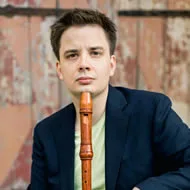
«Historically informed performance means understanding, not blindly copying.»

Max Volbers is one of the most versatile young musicians in the field of early music, as a recorder player, harpsichordist and, increasingly, as an ensemble director. In keeping with the sound worlds of the 17th and 18th centuries, when musicians naturally mastered several instruments, he explores the early music repertoire from very different perspectives as a multi-instrumentalist. A major concern for him is uncovering new repertoire, whether through paraphrases, pasticcios or transcriptions. He also regularly devotes himself to new music and works with composers on commissioned pieces again and again. He studied at the Mozarteum University Salzburg with Dorothee Oberlinger, Walter van Hauwe, Reinhard Goebel and Florian Birsak.
When and where was your interest in early music awakened?
That was certainly with my first recorder teacher, Brigitte Meier-Sprinz, a very capable musician and educator who understood how important it is to kindle a fire of enthusiasm in children. With her I did not only play early music, but of course a large part of the recorder repertoire lies exactly there. She very quickly took the 6-year-old, under-challenged, insufferable child I was out of group lessons, arranged individual lessons for me and fed me well ("Futter"). Later the piano came along, at 11 the organ too (a school organist was needed), then school choir, orchestra and so on.
In my youth I therefore played practically everything that came under my fingers and toes, from medieval music to Brahms, Bartók, French Romantic organ music and pop music. But the great love, where I always felt truly at home, has remained early music to this day.
You perform as a recorder player, harpsichordist and ensemble director. Do you do this deliberately, because musicians of the 17th and 18th centuries were also multi-instrumentalists?
No, historically informed performance means understanding, not blindly copying. In my case it simply happened automatically: during my school years I played the piano ambitiously, and one day a harpsichord was standing in my flute teacher's room – in hindsight not a great instrument at all, but somehow it fascinated me completely. I do what interests me – and by chance it turned out that, alongside solo flute playing, I also perform as a harpsichordist and ensemble director from the harpsichord.
If anything, it's the other way round: the repertoire of the 17th and 18th centuries was designed for musicians who as a rule could play several instruments – and, by the way, one had better be able to compose well too, if one had any self-respect. In the 18th century there was a fine distinction between "Musikus" and "Musikant"; whoever could only "play" was held in lower regard. The idea that one had to commit either to composing OR to performing, and then to just one instrument, came later, and at the same time the repertoire changed. The pieces became technically so demanding that as a musician one hardly has any choice but to specialise in a single instrument. That does not mean that Baroque music is easier than Classical and Romantic music, but it works differently, more holistically. That I can perceive the music I play intensely from three different angles is, in my view, a great advantage.
You enjoy uncovering new repertoire and engage with paraphrases, pasticcios and transcriptions. What are you looking for?
The recorder has an incredibly beautiful original repertoire, which I also love to play in concert again and again. Nevertheless, I love setting out in search of new repertoire for my instrument. The ideal I try to achieve is that the result never sounds like tinkering, or that one thinks: "Oh what a pity, now he had to shift it up an octave because the range of the flute ran out here – well, you can tell it's really a violin piece". A good arrangement can always be recognised by the fact that the piece sounds as if it had originally been composed exactly that way. It happens quite often that I start arranging a piece and set it aside at some point, because I realise: this will always sound contrived. Incidentally, I always look for something that feels, at least, like "mine". I am asked from time to time for the scores of my transcriptions, but I never hand them out. My transcriptions are certainly never the last word...
In short: within early music I seek new pieces that were never composed in this form, but could have been composed in this way!
You have just won the prestigious German Music Competition. Has much changed since then?
Oh yes, one must say that the competition of the German Music Council is certainly one of the competitions with the best follow-up support. What is impressive is what happens after the competition: concert placement and promotion, intensive career advice, networking – and of course the CD.
You are also strongly interested in new music. What fascinates you about it?
During my studies I resisted new music for a long time – if I'm honest, simply because I found it much harder to learn the pieces. I can learn a difficult Baroque concerto in two days if need be, but with pieces like Berio's "Gesti" I just wanted to throw the flute against the wall during practice in the first semesters! My teacher Dorothee Oberlinger eventually gave me the piece "nah, getrennt" by Mathias Spahlinger as a "radical cure" – it is so incredibly difficult! The second part consists of a rapid sequence of closely spaced sixteenth notes, so one first has to learn many new, numbered fingerings and assign each fingering to the right number; if you move just one finger wrongly, a note that lies completely outside the narrowly defined pitch range is guaranteed to come out – and you hear immediately: that was wrong.
I cursed so much! But at some point it went "click". Later it happened that I was repeatedly allowed to work with composers on new works, and this joint searching, giving feedback and trying things out are of course things we do not have in early music. When you play so much music that is 270 years old or older, it is quite nice for a change to deal with living composers.
Where do you see the parallels between early and new music?
I must say in advance that I am not really a friend of this terminology. Early and new music are terms that sound so contrary and suggest things like "yin and yang", "left and right", "good and bad", "organic waste, residual waste". Music history is much more complicated and fluid. And if they were not defined by convention, what would early and new music be? Anything written more than two weeks, three years or 10 years ago could be called old. Besides, "old" carries this negative touch of dusty, musty, unwieldy.
But to answer the question: I don't know whether one can cement general parallels, but I encounter such parallels constantly on a case-by-case basis. For example, musical forms play a major role in both early and new music – in the case of new music through the breaking up of any form whatsoever. Another common feature is improvisatory elements. And for me the greatest parallel, of course: both the flute and the harpsichord have their repertoire precisely in these two worlds, because they were forgotten in the epochs in between and were only truly rediscovered in the 20th century.
Where is your path leading, what are your visions?
Of course I have projects in mind that I want to realise, and anyone who says they don't particularly want to perform once in the famous hall X with world-class orchestra Y is not being honest. But I try not to focus on this too much. Better to have my thoughts on the next concert than too much on the over-over-over-over-next one. Of course this is not easy, because without long-term plans and ideas one gets nowhere. So I do have plans and visions, but I try to store them well in my mind and devote time to them when I also have the time and attention for it.
If you had one wish regarding your musical career, what would it be?
That I always manage to remain as independent as possible in artistic matters and retain artistic sovereignty over myself. For this one needs people around one – whether colleagues, staff at labels, agencies and so on – who trust you and believe in you, even when you come up with an idea that at first glance sounds completely far-out, hard to sell, old-fashioned, overly intellectual or whatever else.
How do you prepare for concerts immediately before you perform?
I don't really have any rituals, and I am only rarely nervous before concerts – instead I like to get tired. Between rehearsal and concert you will therefore usually find me in the nearest café refuelling on caffeine. Right before the concert my phone goes away and I check and tune my instruments. Ah, I do have one small ritual: at concerts where I play flute, I check with great obsession whether the winding for the foot joints is sitting well. In sixth grade, during a school concert, the foot of my flute once came off in the middle of a piece and in front of the whole school – I would have much preferred to sink into the ground...
What passions do you have besides music?
I cook very passionately, preferably with my wife (I don't cook badly, but she cooks better – just don't tell her that!), bake bread and love cycling (and at the moment far too seldom) up the Salzburg mountains. Well, the descent is usually more fun, I admit it! For very current reasons I should check before the next ride whether there is a suitable child trailer for my gravel bike – so it will certainly never be boring...
Interview by Florian Schär | Classicpoint.net | 01.12.2022
Image copyright: Theresa Pewal