

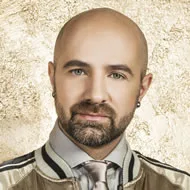
« Opera is for me the mirror of the world. »
Max Emanuel Cencic is one of the most fascinating and versatile artists in the world, dedicated to rediscovering and performing the music of the 18th century. With his virtuosic mezzo-soprano, Max Emanuel Cencic demonstrates how technically brilliant and at the same time modern and sensitive baroque singing can be. He has been on stage for exactly 35 years and performs worldwide at the great opera houses, such as the Vienna State Opera, the Theater an der Wien, the Opernhaus Zürich, the Opéra Royal in Versailles, the Bavarian State Opera, the Staatsoper Unter den Linden Berlin, Barcelona's Gran Teatro del Liceu, the Théâtre des Champs-Elysées and the La Monnaie opera house in Brussels.
Classicpoint.net: Was there a particular moment in your life when you consciously decided to become a singer?
Rather late, as I was not entirely sure whether I wanted to sing. If you play an instrument or dance as a child, it is clear-cut, because you can decide for yourself whether to pursue it as a career or not. With singing, it is uncertain whether the voice will still be good after the voice break. So one has less "control" over it. I only decided at the beginning of my twenties to really make singing my profession.
What does opera mean to you?
Opera is for me the mirror of the world.
What are the greatest challenges for a countertenor?
Being able to make a difference within a firmly established system of classical opera. Worldwide, 100 operas have been firmly in the repertoire for 50 years. Of these, only three or four are baroque operas, which are perhaps performed only every few years. That is not much.
Have you ever experienced audience members hearing a countertenor for the first time at a concert and reacting strangely?
I experienced that in the 1990s. Nowadays, rarely. But that depends greatly on the audience. One must distinguish between listeners who only want to hear run-of-the-mill classical music, i.e. who want to be commercially entertained, and listeners who regard music and art as a form that should invite challenge and dialogue.
Is a talent for countertenor singing already apparent before or only after the voice break, or can it be assessed at all?
That varies from individual to individual. There are no rules.
You appeared on television at the age of 6 and had already given 800 concerts by the age of 16. At 19 you had had enough and no longer wanted to perform at all. What was your emotional state, and why did you return to singing?
One never feels good when one has to admit to oneself that things are no longer going forward in life. But it is a life lesson that all of us go through. One is not always just the winner, and sometimes life goes downhill as well. That is entirely normal, though, and I do not want to address this specifically in my own case. Many people go through all kinds of situations involving loss. It is up to us to deal with it and somehow cope. Everyone reacts differently. I am probably more of a fighter by nature, so giving up was not an option for me.
Baroque music is your passion. What is your view of new compositions by today's generation of composers?
I have no opinion on contemporary classical music, as I have too little experience and therefore do not wish to judge.
You also work as a director. How do you approach a production? Does much still change during rehearsals, or have you already thought through your production completely before the first rehearsal?
I always start with an idea and play through the libretto in my mind. Directing is a true blessing for me, because I find fulfilment in it, in shaping my own dreams and realities. It is this tremendous freedom of imagination that guides me. The vision and the arc must be right. Details can always be changed, and I then work these out with singers who, thanks also to their stage experience, bring the story to life.
What are your most recent projects?
I will be singing "Serse" in Karlsruhe, as part of the Internationale Händel-Festspiele, and "Polifemo" at the Salzburg Festival, in the Felsenreitschule – which is an immense honour for me.
What do you enjoy doing besides music?
I have wide-ranging interests in art, travel, languages and cinema.
Interview by Florian Schär | Classicpoint.net | 2.11.2018
More interviews
All interviews →


