

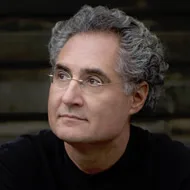
« The world would be a better place if more Schubert were played. »
He only began his first proper piano studies at the Detmold University of Music at the age of 14. An age by which other talents have already completed their first piano competitions. »I jumped onto the very last train for a career as a pianist.« For Matthias Kirschnereit had previously spent five years living in Namibia – where proper piano training was out of the question. Despite the fame that Matthias Kirschnereit has long enjoyed internationally on his extensive tours, he is entirely free of any star airs. He gives around 50–60 concerts a year and, in addition, has been a professor at the Rostock University of Music and Theatre since 1997.
Classicpoint.net: You only began proper piano studies at the age of 14. Before that you had lived in Namibia for five years. Could you tell us about your time in Namibia?
When I was 9 years old, our family emigrated to Namibia; my father was a pastor and eventually Regional Dean of the German congregation in Windhoek. For me it was an extremely exciting journey, by liner from Trieste to Walvis Bay, including the Crossing-the-Equator initiation ceremony! At first I was disappointed by the barrenness of the Namibian desert, as I had grown up in the forest by the Großer Plöner See in Schleswig-Holstein. But over the years I came to love the timeless, endless expanse of the country and its wild nature.
Like my older siblings, I attended the German private secondary school in Windhoek, and at the time I found wearing the school uniform, as well as the checks on hair length (!!!), extremely irksome ?!
Things on the piano didn't amount to much: at the newly founded conservatory of music, people were waiting for a piano prodigy from Europe. I believe it was Josef Bulva. He was due to appear, and kept on not appearing — a waiting for Godot. Eventually, after a three-year break, I resumed my piano lessons with a wonderful teacher at the conservatory: Ernst van Biljon, who later went on to sell property... I practised little, yet soon became one of the best in my year and was allowed to take part in student concerts. I enjoyed all of this, and somehow the idea of becoming a pianist took root. In the isolation of Namibia, however, I was incredibly naive; there is a sentence that shaped my attitude at the time: “I want to become a great concert pianist and I practise 20 minutes a day!” Looking back, that is quite outrageous!
Over the years, and as puberty set in, I became ever more aware of the unbelievably unjust political circumstances of apartheid. I had two friends; we called ourselves the “Namibia Trio” and we planned to form a rock band modelled on Deep Purple, trying to “save” the world.
At some point I realised that I could only pursue my dream of becoming a pianist back in Germany. At the age of 14 I left Windhoek alone, without my parents...
What is your connection to Namibia today?
Namibia is a part of me; I spent an important and formative period of my life there. On numerous visits in the years that followed, I gave a good many concerts in Windhoek and Swakopmund, and I would very much like to give something “back” to the country and its wonderful people. I am still puzzling over what a workshop such as “Mozart goes Desert” or something along those lines might look like.
Without knowing very much about the country's current political and social situation, Namibia seems to me to be a proud, warm and exceptionally dignified African country.
I was last there two years ago; it is a joy to hear the enthusiastic “Welcome to Namibia” right at the airport and to marvel at the wonderful diversity of people on Independence Avenue in Windhoek. I hope to visit this magnificent country again with my family as soon as possible. I wish the people and the country all the very best – and plenty of good rain!
After moving to Africa with your parents at the age of 9, you then decided at 14 to return to Germany alone. How did this change feel for you?
Looking back, I must say clearly that at 14 one is still REALLY young, and that leaving one's parents 11,000 km away and then setting up a shared flat with my older brother certainly meant a risk. But at the time I felt “mature” and ready enough to manage my life on my own – I was certainly quite naive, precocious and probably rather well-behaved, which in hindsight provided a certain degree of self-protection. On the whole I was extremely happy to have found a wonderful person in my teacher Prof. Renate Kretschmar Fischer at the Detmold University of Music, who supported me very attentively.
At 16 you even left school in order to make up for lost time. How did people around you react?
Yes, leaving the Christian Dietrich Grabbe Gymnasium in Detmold early caused a scandal at my school. Everyone — the teachers, the fellow pupils, the headmaster — showed no understanding at all and probably thought I had completely lost my mind and was extremely unwise. “What if you develop tendonitis at 30? What if you no longer feel like playing the piano at 30? What about your pension?” I remember questions like these from my fellow pupils well. One day I was summoned from class straight to the headmaster's office. An audience! He made it clear to me: “We know people like you — you'll end up as a piano teacher in Barntrup!” That hit home! Even though he later told me, years on, that he had only wanted to warn me in advance against my own fanciful notions and to give me a literary-humanist education, I never quite forgot those words. Naturally, looking back, it is an amusing anecdote. But let's be honest: Barntrup is a lovely village in East Westphalia; would it really be such a downfall to teach there? No, teaching is important and worthwhile everywhere!
So, support for my decision to leave school before the Abitur came exclusively from my family and my teacher.
What would have become of you if you had stayed in Namibia?
That is hard to say. My former friend from the Namibia Trio later became deeply involved in the liberation and independence of the country and was for a time imprisoned. I would certainly never have become a farmer, and running a restaurant serving crocodile specialities is rather unlikely too. Music is my greatest passion – perhaps otherwise I would have gone to Cape Town to deepen my studies. But these are all idle speculations…
In your portrait Vita you write that you are “on the trail of the emotional richness, the breath and the human traits of music”. Could you explain this in a little more detail?
The portrait Vita was written by a journalist, who formulated these sentences. But I have not retracted them; it really matters a great deal to me to listen, through music, to the thoughts and visions of composers and to tell stories with their language. Stories that are sometimes inspired by life, stories that also let things resound which cannot be named in words. Take Mozart, for example: an opera composer through and through, yet even in an instrumental sonata there is sometimes cheerfulness, sometimes drama, sometimes seduction, sometimes doubt, sometimes a longing for death, sometimes triviality. To sense this, to experience it, to suffer with the composer and to express in sound what one has heard inwardly, is a deeply timeless, joyful and vital undertaking.
You are artistic director of the “Gezeitenkonzerte Ostfriesland”. What sets this festival apart?
First of all: truly wonderful artists in a unique, magical setting, mostly in the picturesque small churches of East Frisia. Where else can you hear artists such as Maria João Pires, Christian Tetzlaff, Grigory Sokolov, Sabine Meyer, Angelika Kirchschlager, Daniel Hope or Elisabeth Leonskaja in an almost intimate setting? East Frisia is not a mere stopover. Artists and audiences alike “slow down”, and unforgettable artistic experiences arise in a fascinating environment.
Our programme is broad, ranging from composer portraits, where Jörg Widmann, Wolfgang Rihm, Helmut Lachenmann and Peter Ruzicka, among others, have so far been present in person at the Emden Kunsthalle, through our “heart”, chamber music, to popular orchestral concerts in the style of the Proms, and jazz and world music evenings — there is a great deal on offer.
The promotion of young musicians, our “Gipfelstürmer” (summit climbers), is a very important concern to me. Intensive cooperations with TONALi Hamburg and Rhapsody in School underline our activities to ignite young audiences for classical music.
You are also a professor at the university in Rostock. Would you admit a student today who only began practising seriously at 16?
Well, starting at 16 is really late. It is rather unlikely that someone would only begin lessons seriously and then go on to study. But there are occasionally students who only really get going more intensively at 11 or 12, and if they are talented, work very diligently and above all truly “burn” for music, then it can be a very interesting path. Certainly not if winning the Warsaw Chopin Competition is the highest goal, but musical life is wonderfully diverse. And for those who are good, committed and creative, I believe a place should be found. I am always saddened when I sense that anything other than a major solo career — including outstanding chamber music or song interpretation — is regarded as something inferior, not to mention teaching. Especially for pianists, the professional profile will always be put together like a patchwork from individual fields of activity. That can be very exciting and fulfilling.
How do you assess the current training situation at German music universities: few positions for musicians, studies mostly geared towards soloists — with most students ending up as music school teachers?
As I have said: one has to be good, creative and also flexible. Tragically, the profession of music teacher in Germany is nowhere near as respected and remunerated as would be appropriate for such an important and responsible task. That musical education influences, inspires, challenges and builds community in young people in many different ways is widely known. Yet, unfortunately, teaching at general schools is often treated very step-motherly, and anyone who wants to secure a place at the youth music school in Hamburg, for example, can expect a waiting time of around 5 years.
Here, politics is truly called upon. I always say that the world would be a better place if more Schubert were played. Of course, that is naive; Schubert, as is well known, appeals only to the very smallest part of our society, and I am well aware of that. But I am firmly convinced that one cannot hear and love Schubert while at the same time paying homage to extreme right-wing ideas – because Schubert, above all, presupposes empathy.
Where do you see the potential in today's classical music business?
I see many positive developments that strive to “give the future a hearing” – to quote TONALi's motto. TONALi, as well as the “Rhapsody in School” initiated by Lars Vogt, are two initiatives that I have always been glad to support actively. I also very much welcome the many talent-promotion programmes that universities have launched to nurture young musicians.
Indeed, the “concept” seems more important than ever these days: putting together a programme that does not consist merely of each performer's favourite pieces, but builds connections and bridges. Music education, too, is undoubtedly becoming ever more important. There are many exciting festivals that are establishing themselves anew, while the classical chamber music series seems rather to be in retreat. Yet in all of this one must NEVER lose sight of the true task of the interpreter: “Bring the work to life without doing violence to it!” I try, as far as I can, to heed this motto of Edwin Fischer's! Nothing surpasses a moving, stirring, beautiful and also shattering musical experience.
Interview by Florian Schär | Classicpoint.net | 1.7.2019
© Image: Neda Navaee
More interviews
All interviews →


