

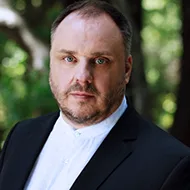
«What is ok for me can already be too much for others.»
The German baritone Matthias Goerne is one of the most versatile and sought-after singers of his voice type worldwide. He regularly appears in internationally renowned concert halls and opera houses as well as at major festivals, and has worked with nearly all of the leading conductors and orchestras in Europe, America and Asia.
Matthias Goerne sings on the great opera stages of the world, including the Vienna State Opera, the Bavarian State Opera, the Royal Opera House Covent Garden in London, the Opéra National de Paris, the Teatro Real in Madrid, the Opernhaus Zürich, the Metropolitan Opera in New York and La Scala in Milan. His carefully selected operatic roles range from Pizarro (Fidelio), Wolfram (Tannhäuser), Amfortas (Parsifal), Marke, Kurwenal (Tristan und Isolde), Wotan (Die Walküre, Das Rheingold), the Wanderer (Siegfried), Orest (Elektra) and Jochanaan (Salome) to the title roles in Béla Bartók's Duke Bluebeard's Castle, Paul Hindemith's Mathis der Maler and Alban Berg's Wozzeck.
From 2001 to 2004 you taught as professor of lieder interpretation at the Robert Schumann Hochschule in Düsseldorf. Why did you stop, or do you still teach today? What did you enjoy about teaching? What is important to you in it?
I no longer teach, except for master classes or privately and a few masterclasses in connection with festivals and concerts. I had only a three-year contract there, as I also wanted to work more from home. Düsseldorf was well located in terms of connections. I wanted to try being an endowed professor, but had to find that it was not for me. I am not convinced of teaching lieder interpretation. It only makes sense if the universities also want it. This type of teaching is like a foreign body, and there are repeated minor squabbles; it also requires an enormous amount of time. It is only worthwhile for the very best students.
What about a professorship in singing for you?
Even less so. The level of singing and the prerequisites here are lower compared with Korea or the Eastern European countries, which have much better musical material. The requirements here are also significantly laxer. Far too many people are admitted here, partly so that the courses are filled. If one compared this with international standards, one would notice that this does not work. For me it made no sense, since I could not see enough talent, and so I lost the motivation for it.
How have you experienced the Covid period with the lockdowns etc.? What did you personally do during that time?
The first period was surprising; I had so much time. But then things picked up again with recordings and streams. I had many concerts in Spain, Italy and the Netherlands. Perhaps 2–3 per month would have been better, but I thought that if life had always been like this, it would have been easier to combine private life and work. One was so used to a high tempo that one never noticed it before. Now I could spend much more time with my family. Nevertheless, I do not want to gloss over the lockdown at all. Many people suffered from it.
For a singer, health is especially important. Do you take any special precautions in your life?
What harms the voice most is faulty technique; there is nothing more damaging. Of course I avoid shaking hands with someone who has a cold, but I do not panic. Spicy food, for example, is also not good for the voice. But just as people differ, so do their sensitivities. Certainly there are certain things that are bad for everyone, but everyone experiences certain things as worse and others as less so; I too smoke a cigar now and then. What is ok for me can be too much for someone else. One does not need to forbid oneself everything, but neither should one bang the drum like a king every day.
What is interesting for you about singing? Where does your fascination lie?
It is much less about the singing than one might think. It is more about communicating on topics that are important to one. I believe that a good voice, texts and music, when they come together, are more compelling than merely hearing or reading them. In the best case, there is an enormous strengthening of understanding for both.
What about language: is it important to understand the language and, as a singer, to render it correctly?
Pronunciation can of course be learned. But to be able to use every language idiomatically, one would have to live in each language region for at least ten years. I would never move to Paris or Geneva; that would be a huge effort for me. I don't know what I would have done had I been born in England or Finland. There are, however, few lead singers who do not come from the German-speaking world and sing in German. One knows that Hungarian is one of the hardest languages to learn, yet I have been singing Duke Bluebeard's Castle for years. Because I have sung it so often, I understand the text even though I do not understand the grammar. Many Russian singers will experience the same with Italian or German, and vice versa. One must work a great deal on phonetics. At some point it feels right, but a native speaker still has the clear advantage in this respect.
One of the greatest exceptions is Felicity Lott; one could not hear that she was not German but English, and that she lives there. But that is rather rare. I do not find it a problem at all; I also find it nice sometimes to hear a colouring. I have heard many singers who made an important contribution to art although they sang in a language foreign to them.
Which role do you forbid yourself, even though you would like to sing it?
Falstaff, for example. I have been offered it again and again, but I would consider it completely wrong. There is a repertoire I have not yet performed but could, and much that I have not yet performed but would like to. I prefer then to take what suits me rather than what is far removed, just to prove something. King Roger is an outstanding Polish opera, and I have been offered it very often and declined. Why should one expect the audience to endure a German singing Polish when he has only learned it phonetically? Artistically, that is a great limitation.
In what ways has your voice changed with age?
I think the range has expanded. The timbre has changed, but I would not yet describe my voice as aged. The strain is also quite different in older age. A strength enters the voice that makes it possible to sustain a sound much longer, but one thereby also risks no longer being able to sing piano. That can be prevented, however, if one changes the repertoire regularly. That way one does not become fixed on one style of singing. And I believe I have succeeded in this very well over time. There are also spontaneous outbursts, which now come much more easily to me than in my younger years.
By what criteria do you choose your accompanists?
By ability, interest and quality. There are people who always take the same partner. Of course I have some lifelong contacts, but what is appealing is the difference in strengths and the individual approach. That excites me enormously. I consider the sovereign mastery of the instrument and finding one another to be most important.
You alternate between recital evenings and opera performances, and sometimes have barely any time in between. How difficult is the switch for the voice?
In principle it is better not to sing for a few days, so the muscle can relax, but that too is very individual. If one does it long enough, however, one can get used to it.
When rehearsing an opera, several leading protagonists must work together (director, soloist, conductor). Friction is therefore predestined. How do you deal with it?
First the question is who is conducting, who is the director, and does the production already exist? Usually one always finds a way to make it appear meaningful.
What passions do you have besides music?
Everything is so interconnected. I do not have to occupy myself with music every day, because the musical part of the year is already very large. But having a life of individual freedom is very important to me, and perhaps this time has taught one that again. It has certainly contributed to sharpening one's thoughts. The passion is to stand up for freedom and to reflect on it.
Interview by Florian Schär | Classicpoint.net | 27.10.2021
More interviews
All interviews →


