

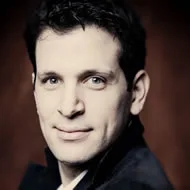
«My dogs always travel with me.»

Luca Pisaroni has sung his way into the ranks of the most interesting singers of his generation. Since his debut at the Salzburg Festival with the Vienna Philharmonic under Nikolaus Harnoncourt at the age of just 26, he has been acclaimed by critics and audiences on the opera, concert and song stages of the world.
Classicpoint.ch: When did you discover your voice and your passion for singing?
I decided to become an opera singer as early as the age of 11. I owe my passion for opera to my grandfather Franco, who introduced me to this wonderful art form when I was 9 years old. I still remember Boris Christoff's "Ella giammai m'amò" from Verdi's Don Carlo, Carlo Bergonzi's "Quando le sere al placido" from Verdi's Luisa Miller, or Luciano Pavarotti's "E lucevan le stelle" from Puccini's Tosca. I was hooked. Pavarotti's glorious voice is the reason I chose this path very early on. I feel very fortunate that I was able to make my dream come true and turn my passion into my profession.
Can you remember your first visit to the opera?
My first opera was "Aida" at the Arena di Verona in August 1986. Unfortunately, I no longer remember the cast or the conductor. I only remember that it was a magical night for me. I could not believe how a human body could produce a sound capable of filling an entire open-air amphitheatre.
Can you remember your first operatic role?
My first operatic role was Figaro in Mozart's "Le Nozze di Figaro". I made my debut in Klagenfurt (Austria) in 2001. I remember it very fondly. I was very naive and had little idea of what it takes to be an opera singer. It was very exciting to be part of a real production, having just finished my studies. Everything was simply wonderful. After a few rehearsals, I realised that I still had a great deal to learn, and that being an opera singer requires much more than just a good voice. I had a long way to go before becoming a complete artist.
You describe Harnoncourt as your mentor. What did you learn from him?
Yes, the conductor who has influenced me most is definitely Nikolaus Harnoncourt. He conducted my debut as "Masetto" in Don Giovanni at the Salzburg Festival in 2002. That first collaboration changed my view of music forever. Harnoncourt is pure energy to me. His passion, his knowledge, his commitment and his respect for music transform everything and everyone he touches. I think he is a little "crazy", but in a good way, one who pushes us forward and makes us better people.
Which operatic role do you enjoy singing most?
I don't have a favourite role. I love all the roles in my repertoire. At the moment I am singing Enrico VIII in Donizetti's "Anna Bolena" at the Zurich Opera House, followed by the Vienna State Opera. I love playing this character because he is truly nasty. It is fun to play the villain on stage. I always choose roles that challenge me, whether vocally, dramatically or both. Above all, I love roles that undergo an exciting development over the course of an opera. I always try to give the character a personal and unique dimension.
Which operatic character is closest to your own personality?
If I had to choose one character, it would be Figaro from Mozart's "Le nozze di Figaro". It is the role I have sung most in my career: almost 150 performances in 14 different productions. I love this role because he is such a great guy. He is intelligent, full of energy, bold and loving. He is, as I often say, the perfect son-in-law. I also like how the audience can connect with him and share the emotions during a performance.
How do you study a role?
Learning a new role is a very exciting process. Sometimes it can be a little frustrating when things don't work the way you would like them to. But most of the time it brings a lot of new discoveries. It is like a voyage of discovery. For example, in 2012 I sang Rossini's Maometto II at the Santa Fe Opera. Maometto is one of the most difficult roles Rossini wrote for bass-baritone. It requires solid technique, an even voice, coloratura, legato, and low and high notes. Everything. I began working on the role three years before the first rehearsal. Some roles are very difficult. You have to work hard, let things rest, work on them again, and so on. I practise my roles a great deal. With the help of many fantastic coaches and voice teachers, I give myself enough time to develop the role and to find my own interpretation.
Your dogs accompany you on every tour. Do they listen to your rehearsals and concerts?
Lenny (a Golden Retriever) and Tristan (a small Dachshund) always travel with me. When I sing and the concert venue does not allow dogs backstage, they stay in my dressing room or in the hotel room. I love having them with me. They give me a sense of being at home and help keep me grounded. Most of the time Tristan sleeps under the piano when I am practising. That is why I think he likes my singing.
Singers are very particular. The fear of flu, sore throats and so on is ever-present. How do you deal with it?
I have no hysterical fear of becoming ill. It is part of our profession, and one learns to live with it. I follow simple rules that help me stay in good general shape: I eat healthily (sometimes almost boringly so!), I exercise regularly, I take supplements to support my immune system, and I have a large collection of scarves… ;-)
Do you have any rituals before or after a performance?
I have no specific rituals, except that before every performance I go jogging or skipping. What I love most before a concert is the walk with the dogs. It helps me focus and prepare mentally. I also enjoy the night-time walk after a concert. It helps me relax well after the adrenaline rush of the performance.
Interview by Florian Schär | Classicpoint.ch | 1 April 2015
Photo: Marco Borggreve
More interviews
All interviews →


