

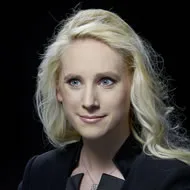
«Abroad, people handle their own musical history with far more attentiveness than here in Switzerland.»
Lena-Lisa Wüstendörfer is Music Director of the Swiss Orchestra and, as Artistic Director of Andermatt Music since 2022, shapes the concert programme of the Andermatt Konzerthalle. Alongside her performing work, Lena-Lisa Wüstendörfer publishes on reception and interpretation history, particularly on Gustav Mahler and Felix Weingartner. The volume Mahler-Interpretation heute (edition text + kritik, 2015), which she edited, was named by the Neue Zürcher Zeitung NZZ as among the "most fascinating" publications on Mahler reception in recent years. In June 2019 the monograph Klingender Zeitgeist on Mahler's Fourth Symphony appeared with the same publisher; it was reviewed as "pioneering" and "highly stimulating pioneering work" (Stifter Jahrbuch). She has repeatedly taught as a lecturer at the University of Basel.
Born in Zurich in 1983, Lena-Lisa Wüstendörfer studied violin and conducting at the Basel Academy of Music, and musicology and economics at the University of Basel, where she also received her doctorate. She deepened her conducting studies with Sylvia Caduff and Sir Roger Norrington and was assistant conductor to Claudio Abbado.
Your goal with the Swiss Orchestra is to revive Swiss works from the Classical and Romantic periods. Why?
Swiss Classical and Romantic music has fallen into oblivion in our cultural history. Few people today are aware of the musical treasures of the 19th century that lie hidden here – particularly in the symphonic field, which is my specialty. Abroad, people handle their own musical history with far more attentiveness than here in Switzerland. With the Swiss Orchestra we want to shed light on this blind spot and make it tangible in concert. For our 5th anniversary on stage, which we celebrate this year in November with our tenth tour, we are stretching the arc even further: from the Viennese Classical period through early Swiss Romanticism to the present day – with Mozart, Beethoven, Friedrich Theodor Fröhlich and Helena Winkelman.
Which Swiss work is especially dear to you, and why?
Since I study these forgotten works in depth, there are naturally several that mean a great deal to me. If I had to choose one now, it would probably be Hans Huber's 1st Symphony, also called the Tell Symphony. It is an impressive Romantic work that depicts Swiss nature and legend musically in a congenial way, without becoming crude. Huber's symphonies are outstandingly composed, which earned him, among other things, the recognition of Richard Strauss.
How do you go about searching for unknown works?
That varies, of course. I often comb through estates in university libraries or find material when examining private collections. Increasingly, I also receive submissions from people who know and share my passion for Swiss Classical and Romantic music. When selecting pieces I mostly rely on my intuition. I read the scores and, if the musical quality convinces me, I like the composition and possibly also see a relevant connection to current themes, I begin planning and realisation, which can extend over a period of up to two years – depending on whether the piece already exists in print or must be newly edited from the manuscript.
You are Artistic Director of Andermatt Music. What distinguishes Andermatt Music?
With Andermatt Music we bring music beyond well-trodden paths to the highest-altitude concert hall in Switzerland. We host around 20 concerts a year here. The programme is based on three pillars: "Swiss Orchestra – Schweizer Klassik", "World Stage – Weltbühne" and "Local Roots – Heimat Klänge". Alongside the Swiss Orchestra as resident orchestra, acclaimed classical stars, internationally renowned orchestras and outstanding formations from central Switzerland regularly perform. We deliberately combine tradition with innovation. This guiding principle is reflected both in the music and in the architectural openness of the Andermatt Konzerthalle, where the audience and backstage areas blend seamlessly and listeners and musicians meet in an intimate atmosphere. Rarely does one come so close to the performers as here.
You studied violin and conducting, but also musicology and economics, and completed a doctorate. To what extent have the different studies benefited one another, and what was perhaps difficult?
My motivation was, alongside my studies of violin and conducting, to understand precisely the genesis of compositions and their cultural context. This context is essential for me to grasp the subject matter thoroughly. Without this background knowledge in musicology, my professional work in this form with Swiss Orchestra would not be possible at all – from research in the archives to examining manuscripts and performance. The greatest challenge for me was probably fitting these different courses of study into my schedule.
In your view, where are the greatest challenges in conducting?
For me it is crucial that an orchestra forms an organic whole. This requires smooth interaction that enables optimal ensemble playing. Sometimes the conditions for ideal harmony are quickly in place, sometimes more effort is needed to establish them. This depends on various factors, the acoustics of a concert hall for example.
How would you describe your ideal sound for an orchestra?
That depends on the particular piece to be played. What matters to me is the variety of sound characters an orchestra can produce. A forte can be harsh, but it can also sound soft. Playing these nuances is what counts, in order to make music speak.
What are your passions besides music?
I enjoy reading crime novels and like walking through the city with open eyes and ears. I also passionately love baking Guetzli – by now I am a true specialist in Mailänderli.
Interview by Florian Schär | Classicpoint.net | 01.11.2024
© Image: Dominic Büttner
More interviews
All interviews →


