

«It is the process of equal rights for the individual voices.»

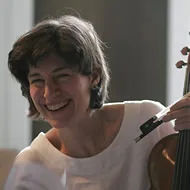
Kim Kashkashian is travelling the world both as an internationally renowned soloist and as a sought-after chamber music partner. She has also repeatedly taught at universities herself. After professorships in Freiburg and Berlin, she accepted a call from the New England Conservatory of Music in summer 2000 and returned to the USA. Her collaboration with contemporary composers has in some cases resulted in world premiere recordings, which have helped to expand the relatively small viola repertoire.
Classicpoint.ch: Your parents emigrated from Armenia. You were born in Detroit. You have premiered works by Armenian composers. What characterises today's composers in Armenia?
Armenia has always had one foot in the Middle East and one foot in the Euro-Russian tradition and culture. I recognise the expression of both influences in earlier as well as in today's compositions.
Why did you switch from the violin to the viola after only a few years as a child?
The range of the instrument, the alto voice, captivated me.
You are very strongly committed to the field of new music and actively seek out composers to persuade them to write works for the viola. What criteria do you use to choose composers?
I pay particular attention to whether I feel comfortable with and can identify with the emotional expression and the palette of tone colours of a work, with its structure and its arcs of tension.
Is it difficult to persuade composers to write works for the viola?
Not at all!
Up to the 20th century there is very little literature for the viola as a solo or soloist instrument. What do you see as the reasons for this?
It is multifaceted and has to do with the development of musical styles. The so-called middle voices were mainly used as harmony-providing filler voices, and only gradually were they also given leading roles. Compare, one after another, the scores of Haydn, Brahms, Schoenberg and Ligeti. It is the process of equal rights for the individual voices. The development of the solo repertoire is the same.
If you could turn back the clock, which composer would you most have wished to write a work for the viola?
Perhaps Dvořák, and of course Schubert without a doubt!
Do you also engage with other musical styles, such as world music or jazz?
Jan Garbarek invited me to play a few of his compositions. But apart from this collaboration, I have never set foot in the jazz world as a performer. Working with folk music from all cultures, on the other hand, seems to me to have a direct connection to classical music. Ultimately, it is the same language and grammar that is used.
You have lived and worked in both America and Europe. Where do you see the differences with regard to your work?
There still seems to be a great divide in the significance of contemporary music, where we hear quite different directions of composition. In the USA we have increasingly begun to include informative segments at concerts, in which the compositions are explained. This helps both the performers and the listeners.
Which project is currently closest to your heart?
I have a project running called «Music for Food». In it, musicians raise funds for those musicians who have no resources. In my homeland, one in nine people has hunger as a daily basic problem. That is an unimaginable situation!
What does Kim Kashkashian actually do when she is not playing the viola?
When I really do set the viola aside, you will find me at the academy of Kung Fu and Tai Chi. There I try to develop my abilities further through training.
Interview by Florian Schär | Classicpoint.ch | 02.11.2011
Photo: Claire Stefani
More interviews
All interviews →


