

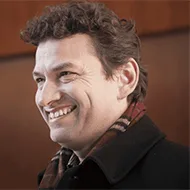
«I find this division into East and West obsolete.»
For the village of Riggisberg (Canton of Berne, Gantrisch Nature Park), where he was born in 1970, he has been directing the festival Klangantrisch, founded as Treffpunkt, Crossover Festival, since 2015. Before founding it, from 2005 to 2012, he was musical director of the Zentrum Paul Klee in Berne. As successor to Jirí Belohlávek, he served as chief conductor of the PKF Prague Philharmonia between 2005 and 2008.
In his home city of Berne, he studied the flute (Heidi Indermühle) alongside his school education, as well as opera and orchestral conducting (Ewald Körner). In Zurich, Basel, Siena, Paris and as a member of the European Mozart Academy, he received numerous artistic impulses from Aurèle Nicolet, Ralf Weikert, Charles Dutoit, Manfred Honeck and many others.
As a flautist, he performs numerous concerts with his ensembles "mit vier" and "Ensemble Paul Klee", but also in a chamber music group with Magdalena Kozená, Sir Simon Rattle & friends. Their project "Soirée" toured in 2016 and 2019, was released on CD by Pentatone and will be recorded again in 2022.
You are active both as a flautist and as a conductor. What advantages and disadvantages does this double workload bring?
As a conductor, one should above all be a good musician. I actually see no disadvantages in the double track; otherwise I would have given up playing the flute long ago. At the start of my career, managers, concert promoters and agencies advised me to focus on one thing, because that would be easier to market. Today I am allowed to present myself as what I am. In the working process, it is a disadvantage for me as a flautist that as a conductor I tend towards perfectionism, which makes me very merciless towards myself. But for the result, this in turn is an advantage. Another important advantage: I know very well what it takes to master an instrument perfectly, to keep one's nerve before a difficult passage, and to stay in shape even as one grows older. I have great respect for the skill and the strain placed on my musicians. When orchestra members know that I am not only a musician myself but also a good instrumentalist, when they sense that I know what I am talking about, I can demand a lot from them; the respect is then high on both sides, without any power games becoming necessary.
You are also artistic director of the Murten Classics festival. What distinguishes this festival?
I recently handed over the artistic direction of the Murten Classics. After 22 years. Since 1999, we have developed the festival from a weekend gathering among friends into a still very personal, familial, but much larger event, now national, with around 35 concerts. The programme of the symphony concerts was always dramaturgically stringent, but not elitist, because as a non-subsidised cultural organiser, the Murten Classics depended on high occupancy. This was in fact always above 90% in recent years. In the smaller concert formats (baroque, vocal, chamber music, contemporary concerts), the common thread of the festival theme could be explored in depth, and we also wanted to offer more daring programmes. During my time in Murten, the programme was more important than the performers, i.e. less reliance was placed on big names than on a consistent, yet colourful and lively programme design. There are more than enough big names performing the same programmes over and over again.
What are your plans and visions for the festival?
My successor, Christoph-Mathias Mueller, is taking over a festival in excellent form. I hope that he does not make changes at all costs, but also that he soon brings in a distinctive profile of his own, because after more than 20 years a festival needs this kind of change. That was the main reason I wanted to hand over the festival, not because it no longer suited me or because it had become difficult on a personal level.
You are musical director of the Sinfonie Orchester Biel Solothurn. What has the orchestra done during the current pandemic?
I am very happy to be part of a team at TOBS (Theater Orchester Biel Solothurn) excellently led by Dieter Kaegi, which always wanted to remain active. So as early as April 2020, we began giving small-group balcony and garden concerts for our neighbours, for housing estates and for retirement homes. Organised privately but officially announced, documented, and also widely covered by the media. Then we were among the first to go into the studio; in early June we recorded the first of three CDs of works by the forgotten Swiss late-Romantic Joseph Lauber (1864–1952). The second CD, recorded in December 2020, will be released soon. In summer we performed a large number of open-air concerts; from September we produced mainly for the theatre, and for example Janáček's first opera "Šárka" only premiered in May 2021. In addition, we streamed selected concerts, e.g. the Beethoven Concerto with the Queen Elisabeth Music Chapel in Brussels, and in January Schubert's "Unfinished" and Mahler's "Das Lied von der Erde" for the local television channel "Telebielingue". We made a Christmas film, including carols to sing along to at home, among other things. With "Der Bürger als Edelmann" by Richard Strauss we ventured into new filmic territory. We recorded a few works for "NomadPlay", an interesting online format where, for example, an amateur musician or a pupil or student who wants to practise the clarinet part in a Brahms symphony can see the clarinet part on their screen at home and hear everything except the clarinet part itself. Music minus one online. This gives our orchestra great visibility; NomadPlay has followers from Buenos Aires to South Korea. Also very important to me during the pandemic were the support formats for young artists. For example, in February the conducting class of the ZHdK came to us and was able to use all the parts of a cancelled subscription concert for practice purposes. Young conductors in some cases could not practise on their instrument for a whole year, and we were determined to stay engaged and keep playing. A professional orchestra that does not play is like an uninhabited house: it soon becomes dilapidated and in need of renovation. Speaking of houses: during the pandemic we were able to move into our new orchestra house, the Zwingli Church in Biel-Bözingen. We want to turn this wonderful sacred building from the 1960s into a lively, modern centre for culture and encounter from which an entire district can benefit.
What sound and which qualities are important to you in an orchestra?
The sound is of course something very personal. I maintain that the same work sounds completely different with the same orchestra under two conductors. I strive for tonal transparency and stylistic certainty, from the Baroque to the music of our time at the very least. The Urtext is far more important to me at first than my own interpretation. I want my orchestra to play with pleasure and enthusiasm, and not under unnecessary pressure. A stress-free sound is much more beautiful. One should be allowed to argue during rehearsals, and the word concert also contains "certare" in Latin ("to strive", "to contend"), but also the word "con": it is a contest together, a joyful competition.
You conduct many Eastern European orchestras. How did this collaboration come about?
When I finished my studies at the beginning of the 1990s, Eastern Europe had just opened up; it was a vast new field that opened before me as a young Western European. I first became truly aware of this almost limitless potential during my stay at the European Mozart Academy in Kraków. While many Eastern European musicians sought their livelihood with Western orchestras, I had the opportunity, while still very young, to conduct major symphonic works or to appear as a soloist with national orchestras in Eastern Europe; such an offer would never have been made to me here. I was able to learn, learn and learn again. At a time when I was still nobody, great responsibilities were entrusted to me. The Sibiu Philharmonic (Hermannstadt, Romania), for example, offered me the vacant chief conductor position in 2002. I am endlessly grateful today for this and for countless other opportunities, and I would like to give something back to these orchestras today. For instance, I still perform with them for a modest fee and perhaps also persuade excellent soloists to come with me for a fraction of their usual fee. This leads to very beautiful, intense encounters and deep shared experiences. Culture must be built more on encounter than on business. I hope that during the pandemic we have learned a good deal in this regard.
Where do you see the main differences between East and West with regard to classical music?
After more than thirty years, I find this division into East and West obsolete and also arrogant. There is actually no difference at all. The mechanisms are absolutely the same. The budget gap between the centres or capital cities and the regions or the provinces is large, as it is with us, although in the regions great ideas sometimes arise, as creative thinking is especially challenged by budget shortages. In communist countries, drill, channelling and the concentration on talent at a young age were more pronounced than with us, and culture was publicly funded across the board, available to everyone as a fundamental right, whereas in Switzerland in particular it has always been a "nice to have" for good times, which must be cut back in bad times or at least fundamentally called into question. On the other hand, culture with us was never censored. Even today, in post-communist countries, many institutions, for example in the academic sphere, struggle with rusty structures. But many young artists return home after study periods abroad and are slowly but surely reforming the system.
Besides cultivating the standard repertoire, discoveries and rarities are a passion for you. How do you go about discovering such works?
I read a lot, listen a lot and see a lot, and I spend a lot of time in nature. I have many friends and acquaintances who have nothing to do with music. Conversations with them broaden my horizons. Interest comes from "inter esse", being in between; I am right in the middle of it, so I do not need to proceed in any particular way to find what I am looking for. I practise my profession with passion. That is why I am a happy person.
What would you consider your greatest musical successes?
I am pleased that almost all the orchestras I have conducted have invited me back. It fills me with joy that, wherever I worked for a longer period, I never had a bad departure, even after ten or twenty years. And I am equally pleased to be able to make a difference in a so-called unimportant place as I am to perform alongside Sir Simon Rattle at the Berlin Philharmonie or to appear at the Wigmore Hall. What matters is not where, but what, how and with whom. Let us be honest: success must be had within oneself; a career takes place between head and heart. After all, what is more important given our limited working life of between 50 and 70 years: that we devote our entire lives to success, media presence and the number of likes, or that we were happy, were able to lead a fulfilled private life, and could look at our reflection without fundamental shame?
I practise my profession with passion. That is why I am a happy person.
What visions and goals do you have for yourself?
To keep learning, keep moving forward, set high goals, never forget who I am and where I come from, but never stop dreaming.
What passions do you have besides music?
Literature is very important to me, as are the visual arts and the performing arts. Besides culture, I need a lot of movement: travelling, hiking, cycling, swimming, dancing tango. And always, again and again: family and friends. Without them, nothing else would be possible for me.
Interview by Florian Schär | Classicpoint.net | 11.5.2021
More interviews
All interviews →


