

«Schöne Welt, wo bist du?»

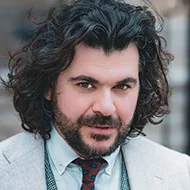
Baritone Kartal Karagedik has earned critical acclaim for his “virile, Mediterranean-tinged voice”, which has been praised for its “tender warmth and emotional depth”. Having sung more than 40 roles, Karagedik's repertoire stands out for its range, from Verdi to Gluck. His appearances include iconic roles such as Renato in Un ballo in maschera, Simon Boccanegra, Don Giovanni, Il Conte Almaviva in Le Nozze di Figaro, Germont in La Traviata, Enrico in Lucia di Lammermoor, Zurga in Les pêcheurs de perles, Rodrigo in Don Carlo, Oreste in Gluck's Iphigénie en Tauride and Tchaikovsky's Eugene Onegin. He has performed at opera houses including the Hamburgische Staatsoper, Opéra Vlaanderen, the Savonlinna Opera Festival, the Grand Théâtre de Genève, the Opéra de Monte Carlo, the Torre del Lago Puccini Festival, the Teatro Comunale di Bologna and many others. In 2025, Kartal released his debut album PROMETHEUS – a collection of Schubert songs on classical antiquity and mythology, accompanied by pianist Helmut Deutsch. Born in Izmir, Turkey, Karagedik began his vocal studies in his home city and in Istanbul before entering the Accademia dell’Opera Italiana in Bologna. Since 2015 he has been a resident artist at the Hamburgische Staatsoper. Alongside his singing career, Kartal is also an acclaimed and award-winning photographer. Since 2014, his numerous solo exhibitions have received wide public recognition.
You grew up in Turkey and completed your undergraduate studies there. You then moved to Italy to continue your studies. What did you learn in Italy?
Before I tell you what I learned in Italy, I must say that in Turkey I acquired a solid foundation in vocal technique. Thanks to the clear, logical and effective system that my teachers taught me, in particular Professor Güzin Gürel, I felt confident and well prepared. I still apply these principles today.
After winning a prize at the AS.LI.CO competition, I went to Como for six months. It was an incredible opportunity to work on a role (none other than Falstaff) with real maestros and to prepare for a full staged performance, being guided at every step. This Falstaff debut was also my debut in Europe. Having come to Italy from Turkey, I can say that I learned a great deal about the tradition, the language of singing and the old Italian style of singing.
My time in Bologna was more stage-oriented, although it was short, only seven months. Soon afterwards I received an offer from the Theater Magdeburg, where I began my first professional engagement, before moving to the Ensemble Erfurt and then to the Hamburgische Staatsoper, where I am still a member of the company.
Where do you see the greatest cultural differences between your home country and your current place of residence (Germany)?
I cannot speak for the whole of Turkey, nor for the whole of Germany. I grew up in a secular family in Izmir, a very open, progressive and modern city. When I first moved to Europe, I did not experience this as a great cultural change, but of course it was the desire to make music where it was created that drew me to Europe.
Even now, living in Germany, I still travel a great deal as an artist. I can readily say that I feel I do not truly belong anywhere. Perhaps it is also good that a traveller or artist has this feeling, that they regard themselves as a cosmopolitan. I am always fascinated by different cultures and enjoy adapting to new surroundings and their cultures. But honestly, I do not feel that I truly belong to any particular place. Incidentally, this connects me very personally to the question: Beautiful world, where are you?
Your latest album is called “Prometheus”. How did you come up with this name?
The idea for the album was clear to me from the very beginning. I wanted to record a collection of Schubert songs dealing with mythological themes. When we had completed the 21 songs and I immersed myself in their texts, I was struck by how masterfully Schubert captured the conditio humana: our fears, hopes, inner conflicts and our joy. And all of this in just a few minutes of music. This emotional depth made the album's title obvious: Prometheus. The Titan who not only stole fire from the gods, but also created humankind itself.
For me, Prometheus is perhaps the first symbol of humanism. He defied the will of Zeus, not out of vanity or ambition, but out of compassion. He believed in the potential of humanity and chose to empower it, even when this meant great personal sacrifice. By stealing fire, he brought people knowledge, freedom and creative power. It was an act of rebellion, but also of love. He stood against the tyranny of a single ruler, against Zeus, who wanted to keep humanity in darkness and dependence. In this sense, Prometheus is much more than a mythological figure. He is the eternal symbol of resistance to oppression, of revolt against absolute power, even when the price is suffering.
Goethe's poem, which Schubert set to music, captures this rebellious, almost revolutionary spirit perfectly. The Prometheus we hear in Schubert's song is proud, defiant and deeply human. He creates human beings in his own image, not to serve the gods, but to feel, to weep, to rejoice and to live freely. This vision moved me greatly. This is not merely a story from antiquity, but a timeless message about dignity, defiance and the spark of humanity that lives in us all.
On this album, then, we embark on a journey through ancient myths, but we also engage with very current ideas about power, freedom and what it means to be human.
How personally interested are you in mythological themes?
I am very, very interested! Mythology has really become part of my life. My wife and I have had countless conversations about archetypes in mythological narratives, about how relevant they still are, and how we can recognise these archetypal patterns within ourselves and even in the dynamics between people. It is fascinating to see how the same scenarios keep repeating over time. I find the whole subject absolutely fascinating, and its depth seems to be endless.
You also work in photography. What exactly do you do in this field?
I started photography as a child. My grandfather was a photographer, and his cameras were toys to me. Even today, every time I pick up my camera, I feel the same childlike joy. As a singer I travel a great deal, and my camera always accompanies me, not only as a companion but sometimes even as the main reason for the trip. Over time, photography has become an indispensable form of expression for me.
The focus of my photographic work is shown in my solo exhibitions, which I often combine with song recitals. My most recent exhibition, HIATUS, was devoted to capturing moments of stillness. Images that seem to freeze time and convey a sense of calm amid the hustle and bustle of everyday life. Each time I press the shutter, I feel that time pauses for a heartbeat. With these images I try to create spaces in which viewers can pause, breathe and perhaps rediscover something within themselves.
There is a deep connection between my photography and my music. Both are based on contrasts of light and shadow, sound and silence, and both are driven by emotion. I try to photograph the way I sing, and I sing the way I photograph.
Photography also gives me a sense of balance in life. On stage I am at the centre of attention. That is a very extroverted experience. But behind the camera I can step back, observe and become the eyes that look upon the world. It is the calm, introverted counterpart to the intensity of the stage.
You can find a selection of my photographs on my website under the heading “KK as Photographer”: www.kartalkaragedik.com
Which philosophical themes interest you most?
I am not sure whether it is philosophical enough, but one of the most important topics for me personally lately has been the process of individuation of the Swiss psychiatrist Carl Jung, and all of Jung's other theories. Working on “Prometheus” for this album has opened up a completely new world for me, particularly the world of archetypes and Jungian theory.
Viewing my own journey, and even the stories of the operatic characters I portray, through this lens has fundamentally changed my life. It has given me a new understanding, not only intellectually but also emotionally and artistically. There are many books by Jungians on this subject, but if anyone is interested, I would particularly recommend two: “Gods in Every Man” and “Goddesses in Every Woman” by Jean Shinoda Bolen.
Which question about humanity would you most like to have answered?
I would really like to understand how the collective unconscious actually works – where its roots lie and how it affects us all. It is such a powerful idea, and I keep wondering where these shared patterns come from and why they resonate so deeply across cultures and times.
What do you hope to achieve as an artist?
Naturally I have ambitions and dreams that are slowly taking shape and becoming concrete plans. But my real goal is for my professional development to go hand in hand with a deepening of my artistic abilities, so that I can express myself more clearly, make bolder decisions, and be freer and braver in my work. I believe it is my task as a performing artist to create the world of a story, a world in which composer, performer and audience meet. When this happens authentically, magic arises, and people from different eras come together. I want to achieve this feeling as often as possible.
What are your other passions besides music?
Life is a miracle, and I live it passionately. I also appreciate good food and wine, and I have a keen interest in psychology. Another passion, perhaps somewhat unusual and not entirely healthy for an opera singer: pipe smoking. It is a ritual that I value greatly.
Interview by Florian Schär | Classicpoint.net | 01.11.2025
More interviews
All interviews →


