

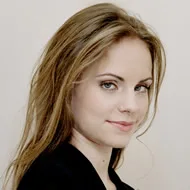
«It would be naive to believe that I can do that.»
«It would be naive to believe that I can do that.»
Born in Munich in 1983 to German-Slovak parents, Julia Fischer is currently one of the leading violin soloists. She began her musical journey at the age of just under four and was already being taught at the age of nine as a junior student by the renowned violin professor Ana Chumachenco. At just 23, Julia Fischer became a professor at the Hochschule für Musik und Darstellende Kunst Frankfurt am Main. From 1 October 2011 she will be a professor at the Musikhochschule München.
Classicpoint.ch: For 10 years you practised piano and violin with the same intensity. Do you still give concerts on both instruments today?
From time to time I also play the piano in concert – roughly once a year, and then usually chamber music, or I accompany a colleague.
What ultimately tipped the balance in favour of the violin?
No idea. I have thought about it often and there are various explanations. My brother was already the pianist (though he is now an engineer), the violin can be taken anywhere, my teacher Ana Chumachenco (on the violin) ... but in truth I don't know.
You were already giving frequent concerts all over Europe while still at school and taking your Abitur. Was there envy and resentment from fellow pupils and teachers?
There were certainly one or two isolated cases, but in hindsight it ultimately seemed normal to everyone, since everyone had grown up with it. I was simply the violinist who was more often on stage than at school, and somehow that was just accepted by everyone. Besides, I was lucky, because there were several musicians at our grammar school. The cellist Johannes Moser, for example, was also at my school and three years above me.
A student at the Musikhochschule at nine, the youngest professor in Germany at 23 – have you ever had the impression that it all happened far too quickly?
I only know it this way, so I cannot compare it with any other life.
Questions about success at a young age come up in every interview. Does that annoy you, or do you have some understanding for the media's always same questions?
I have understanding for it. And it is a difficult subject – what is too much, what is too little? And probably there is no ideal case.
Is it important to you to retain control over your own image in the media?
It would be naive to believe that I can do that. I can only try to protect my privacy and my family.
You yourself attained a remarkable artistic maturity at a young age. Can such maturity be learned? How do you try to teach it to your students?
I fear that artistic maturity is the one thing that cannot be taught. Artistic responsibility, however, can be conveyed.
You became a mother at a young age. How do you reconcile all the travelling and the many concerts with having a child?
It is rather strange that we live in a time in which becoming a mother at 26 counts as "young"... It is just as much of a balancing act as for any other mother (or father).
Your project "Rhapsody in School" takes you into school classes to promote music. How do you experience today's children in relation to classical music?
Partly curious, partly also bored, but in the end we always have a lot of fun, and at least the children then know that Bach, Beethoven and Brahms were German composers.
Apart from your talent and success, why are you a musician?
Those were not the reasons for becoming a musician. For me, music is simply the primal form of expression that connects all people. That is why I wanted to dedicate my life to it.
Matthias Pintscher has written a violin concerto for you, which you will premiere at the Lucerne Festival on 11 September, that is next Sunday. How did this come about?
Matthias and I have known each other for many years. Four years ago he attended a concert of mine in Frankfurt with the New York Philharmonic, where I played Brahms. Afterwards he came to me and said he would like to write a concerto for me. Then we considered together where, how and with whom we would like to perform it. Since Vladimir Jurowski conducts a great deal of Matthias's music and is highly regarded by us both, I then asked Vladimir whether he would do this with me.
Did Matthias Pintscher consult you during the composition?
No. Matthias knows exactly what he wants himself. But at the moment (i.e. one week before the performance) we are still discussing tempi and little violinistic details...
How have you experienced studying the work?
I find it very interesting, and I am now very excited and curious about the first rehearsal.
Interview by Florian Schär | Classicpoint.ch | 05.09.2011
Photo: Felix Broede/Kasskara