

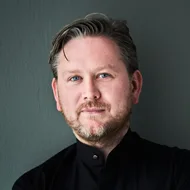
«Conductors should try to help every musical ensemble preserve its unique identity.»
«Conductors should try to help every musical ensemble preserve its unique identity.»
After taking up conducting in his mid-twenties, Jonathan Bloxham was Assistant Conductor of the City of Birmingham Symphony Orchestra under Mirga Gražynite-Tyla from 2016 to 2018, assisted Paavo Järvi, and was invited several times to conduct the Deutsche Kammerphilharmonie Bremen. Since then he has conducted various orchestras across Europe.
He has recorded albums with the London Symphony Orchestra (2022) and the Nordwestdeutsche Philharmonie (2021, Strauss and César Franck). The latter was described by MusicWeb International as «irresistible».
As Artistic Director of the Northern Chords Festival, he has commissioned young composers such as Vlad Maistorovici, Jack Sheen and Freya Waley Cohen. Jonathan Bloxham studied conducting with Sian Edwards, Michael Seal, Nicolas Pasquet and Paavo Järvi, after studying the cello at the Menuhin School and the Guildhall. As a former cellist, he made his concert debut at the Berlin Philharmonie in 2012.
Jonathan Bloxham is currently Music Director of the Luzerner Theater.
You were initially a founding member of the Busch Trio, with which you regularly performed at Wigmore Hall, the Southbank Centre and on BBC Radio 3. Why did you want to become a conductor?
As soon as I could play a few notes on the cello, I joined my local youth orchestra in the north of England. I immediately fell in love with the symphonic sound, the energy of playing in a group, the concentration and the discipline, and even at a young age I was studying scores to see how everything fits together. A few years later, while studying at the Yehudi Menuhin School, I told the music director that I would one day like to try conducting... and his advice was very clear: wait! And that is exactly what I did. Most of my twenties were spent in chamber music, learning to listen, to adapt and to compromise, how to work together... I believe all these skills are very important for a conductor. When I was 26, I had the opportunity to conduct a student orchestra in London, and already in those first moments on the podium I felt at home.
Do you still play the cello today?
Not enough! I am very fortunate to still play some chamber music concerts. I miss that repertoire. And I love the physical contact with the instrument. But when I decided to switch from the cello to conducting, I knew it had to be 100%. Conducting requires my full concentration, and for me it would be a compromise to pursue both professionally.
Your conducting career began with an invitation from Paavo Järvi. How did that come about?
I was very fortunate to take part in masterclasses with Paavo Järvi in 2015 and 2016. His clear, practical and craft-oriented advice had an enormous influence on my way of conducting. He then kindly recommended me to the Deutsche Kammerphilharmonie Bremen, which booked me for their summer festival concerts – the very series Paavo first conducted with them. I must say I learned a great deal from this orchestra too – conducting it is like driving a super-fast sports car!
How did you come to opera as a conductor?
I fell in love with opera during my time as a student at the Royal College of Music. As it happened, many of my friends from my first year in London were opera singers. Before that, my musical world had centred on solo and chamber music for cello. As a cellist, I tried more and more to play like a singer, where the bow is the breath, and the articulation is the different vowels or consonants at the beginning of a note or a word. In summer 2018 I assisted at the Glyndebourne Festival, a magical world of opera, and I think it was a natural development from there... I was hooked!
Since 2023/24 you have been Music Director at the Luzerner Theater. What are your ideas and goals for this theatre?
In this first year it was about getting to know the theatre and the city, listening to my new colleagues and, of course, our audience. People have made me feel very welcome here! It is important to me that we always have a very open, creative operatic practice and that we encourage a willingness to take risks in rehearsals and performances. Trust is so important for this, between musicians and directors, between the orchestra and the singers... we all have to support each other. From a musical point of view, I am very glad that we are opening the next season with Mozart's "Idomeneo"!
Which works do you most enjoy conducting?
That changes almost daily – the quick answer is: whatever is on the music stand in front of me! But from the perspective of opera: when bel canto operas and Mozart are on the programme each season, that makes me very happy!
You have already conducted in many parts of the world. How do you experience the different cultures?
I am very fortunate that my work allows me to travel a great deal. Of course every country has a different culture, but perhaps even more beautiful is this: even two orchestras in two neighbouring cities can have completely different cultures – a different approach to sound, to interpretation, to rubato... I think it is so important that we conductors try to help every musical ensemble
preserve its unique identity.
What other passions do you have besides music?
I am probably a cliché – wine (mostly red!) and food! During the COVID lockdowns I organised a Zoom cooking competition, which became quite serious. Professional chefs came to judge our culinary creations – unfortunately, of course, only based on our descriptions and our presentation!
Interview by Florian Schär | Classicpoint.net | 01.07.2024
© Image: Kaupo Kikkas