

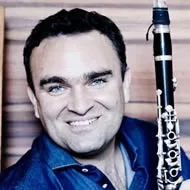
«When I compose, I think like a player.»
«When I compose, I think like a player.»
Jörg Widmann is one of the most exciting and versatile artists of his generation. He is currently the holder of the “Creative Chair” with the Tonhalle Orchester Zürich, appearing in varying roles as composer, soloist, chamber musician and conductor. At the Freiburg University of Music and Performing Arts he holds a professorship for clarinet and a professorship for composition.
Classicpoint.ch: You are a clarinettist, conductor and composer. To what extent do these disciplines enrich each other?
When I compose, I think like a player. I imagine a sound physically. For me, a Bartók pizzicato flung out is not something abstract but a process that has to do with gravity and force. Or the breath of the wind player – that naturally helps me when composing, once I know what is possible and how it works. As a player I keep discovering new things in music that inspire me to compose. That can happen in a rehearsal, when I hear a section on its own and a sound fascinates me, or when I hear a new sound from a fellow musician while warming up – and then, as I have since my earliest youth, I ask straight away. New sounds electrify me, but even when no music is sounding, music is constantly playing inside me. Conversely, as a performer I naturally pay close attention to the compositional craftsmanship.
This season you hold the position of Creative Chair with the Tonhalle Orchester Zürich. What can we expect, and what do you hope for?
I experience it as a wonderful mutual enrichment. Especially at the opening concert, where I performed my Elegie for clarinet and orchestra with the Tonhalle Orchestra, I was thrilled by the incredibly homogeneous, soft sound that the Tonhalle Orchestra gave my music. That sound and the collaboration with the orchestra during rehearsals were tremendously gratifying for me. I can also feel and hear from the musicians that, through the many performances on tour, my musical language is being increasingly understood by the orchestra and is gradually passing, so to speak, into the orchestra's DNA. Chamber music with the Tonhalle Orchestra musicians is equally important to me in this collaboration. A great many different pieces of mine are being performed. I am also really looking forward to a chamber performance of Mozart's Clarinet Concerto without a conductor. I also give lectures and masterclasses at the university. I take such a residency very seriously and want to throw myself into it wholeheartedly.
How do you feel at the world premieres of your works?
I am terribly nervous. When I sit in the audience as a composer, I feel completely at the mercy of others. Even when the best musicians and conductors act as midwives, I am so hypersensitive about my own pieces. As a musician on stage I at least have the illusion of having things in my own hands. As a composer, at the premiere I hand the piece over; it is no longer only mine. It is a very painful and at the same time wonderful process.
What have been the most beautiful experiences at your premieres so far?
The most recent premieres of my orchestral works in Paris (the viola concerto) and in Berlin (the piano concerto) with the Berlin Philharmonic were both received by the musicians with such goodwill and openness. The rehearsal work was also very gratifying.
Do you still change your compositions at the first rehearsals, or do you take advice from performers?
Of course, if something clearly does not work, I try to find a better solution. That is also what makes it exciting, that I cannot foresee everything. I do get annoyed when I have made a mistake. But I also enjoy arguing passionately and I welcome emotional reactions. I far prefer that to people being left cold.
How does your compositional process work? How do you come by ideas, and how do you proceed in concrete terms?
My problem is not that I have too few ideas, but that I have too many. My task is to order them and to give each piece a different, coherent form. Ideas can arise anywhere; they are simply there and have their right to exist. They are naked, unprotected, indeed, in a certain sense sacred. And then the mind begins to work. Doubts arise. With my piece “Insel der Sirenen” (Island of the Sirens), for example, the central idea is that one hears and works only in the top two octaves, in stratospheric registers. The only thought that grows ever stronger and ever louder within me is: when can I produce a low sound for the first time? How long can I hold out without one? These are like poisoned arrows lodged inside me, fired against the original idea. Mostly this inhibits me and makes me unhappy, so that there is a magnetism pulling me away from the desk, because I am not yet ready. With every piece, however, there then comes a “point of no return” – not always a happy one, but a painful one too – where I notice that the magnetism towards the desk becomes unbearably strong. Up to that point this is my period of incubation. It can last weeks, months, or, in the case of my Babylon opera, even years. Once that point is reached, though, I have to get the idea onto paper. Then I can scarcely sleep or do anything else.
To what extent are your works political?
Not all of my works are political. My first opera “Das Gesicht im Spiegel” (The Face in the Mirror) is explicitly political, as is the Babylon opera, which deals with a functioning, multicultural society that was heavily attacked, and with the conflict between the Babylonian and the Jewish peoples, yet in which, after three and a half hours of opera, something like a possible reconciliation is hinted at.
Or my Mass, which is coming to Zürich. I nearly failed with the setting of the Gloria. The first line is “Gloria in excelsis Deo”, fine and good. The second line is “et in terra pax”. That is what we human beings have not fulfilled, what we have not managed to achieve. And we cannot blame any deity or deities for that. We have to do it ourselves. I set this in a very radical way, as an antiphon. The “in terra pax” enters in five-part strings piano and is constantly being overwhelmed by the Gloria. Only at the end do they miraculously come together after all, if it succeeds in a performance. Another example is the Kyrie, which lasts 25 minutes – the suffering human being and the invocation of a possibly absent God. That is also a clear statement.
Looking back on the works you have composed so far, how would you describe your development?
I always try to confront my weaknesses and keep developing. As a clarinettist I play a melodic instrument. Ironically, though, in my early years as a composer I had a problem getting an ensemble to sing melodically. I had to work that out step by step. At first I composed only for small ensembles. Only later did I dare to take on larger forces. What has remained the same is my preference for a certain harmonic language.
Interview by Florian Schär | Classicpoint.ch | 1.12.2015
© Photo: Marco Borggreve