

«That is a whole new dimension of playing trio.»

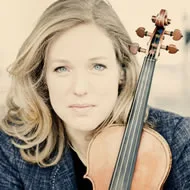
The violinist and violist Isabelle van Keulen is one of the most sought-after artists of her generation. Raised in the Netherlands, she is today a regular guest on the great stages and at the major festivals. Since autumn 2012 she has taught at the Lucerne University of Music.
Classicpoint.ch: You are both a violinist and a violist. What do you particularly enjoy about these two instruments?
The delightful thing is that I don't have to choose between the two instruments! The violin is always allowed to sing (to play the 'first' violin!), whereas the viola, especially in chamber music, is more able to determine the colour. As an inner voice, one can mediate between high and low, and shape the connection between the other voices. Sound-wise, one also benefits greatly from mastering both instruments. One learns a great deal about sound production on the viola, in order to make the violin sound 'richer' again.
You once said that you deliberately do not play certain major classical works that don't appeal to you. Which pieces are these?
It is always dangerous to venture onto the thin ice one is tempted towards: naming favourites (or, conversely, non-favourites). There are phases in life when one has played certain works so often that one needs a break. This has less to do with the works in question than with one's own situation! And usually one discovers such compositions again in a different light, because one has progressed oneself and can approach them anew.
You are very committed to contemporary music. What attracts you to new music?
As all-round musicians, we are obliged to engage with the whole musical tradition and with the various styles. That means, for example, that one must see Mozart in the tradition of Haydn and Bach. From that, in turn, grew Beethoven's ideas, Schubert and so on, right up to the present day. We live now, and I personally feel called to play works composed today to the same extent as those composed in the past. Of course there are sometimes modern works that perhaps will not survive forever, but which are nonetheless interesting because they represent a spirit of the times.
How do you motivate yourself when you have to play an extremely difficult contemporary piece, into which you invest a great deal of practice time, knowing full well that you will hardly perform the piece again?
Knowing that one plays a piece only once, one must never approach the work with that attitude: it can very well be scheduled again. Besides, I see studying these demanding works as a kind of sport. Precisely because they are so difficult, one can also get a lot of 'gymnastics' out of them and acquire great dexterity. That is less boring than always playing the same exercises! I also believe that studying contemporary literature keeps the mind fit.
You have just taken up a teaching post at the Lucerne University of Music. What are your expectations?
I have reached a point where I look forward to passing on the experience I have gathered over the past nearly 30 years to young, talented people. In any case, I expect curiosity from my students, a willingness to be open and to want to work independently, and of course discipline. However, I also believe that enjoyment is part of making music, and I will place great emphasis on stylistic awareness and on the ability to communicate with the audience. I will also try to educate the students in a versatile way, so that they become musicians rather than 'merely' violinists!
In 2009 you joined the Leopold String Trio. Did you deliberately seek out this line-up, or did it simply come about?
It simply came about. In 2007 I was asked by my two colleagues. The trio repertoire is not especially large, but it is rather fine, except that, apart from a few pieces such as Taneyev, the entire Romantic era is more or less absent. We will shortly perform Michael Tippett's Triple Concerto. That is a whole new dimension of playing trio! The trio line-up is very delicate. This is shown not least by the fact that all composers have tried to write for at least four voices. Moreover, the three instruments are very exposed and have individual sounds. The great challenge is the attempt to nevertheless find the fusion!
You have been playing with the pianist Ronald Brautigam for over 20 years. Does the interpretation of pieces that you play again and again change?
The collaboration with Ronald Brautigam has of course become very well established over the 22 years. Our large repertoire certainly includes pieces that keep returning. These include, for example, the Beethoven sonatas. They may have developed over the years in the sense that Ronald has engaged intensively with the fortepiano in recent years, and thereby also influenced my sound production and interpretation. Nevertheless, we have always tried to play as naturally and as close to the source as possible, and not to approach music with show or false motives. Fortunately, in recent years we have not grown apart either, but have both remained very true to the music.
Do you have plans for the future?
For about a year now I have been actively engaged with tangos, above all those of Piazzolla, which had already fascinated me passionately as a child. I have founded a quartet with Christian Gerber (bandoneon), Ulrike Payer (piano) and Rüdiger Ludwig (double bass). Next summer we will have a fine tour with concerts at the Schleswig-Holstein, Rheingau and Amsterdam festivals. By then our first tango CD will also have been recorded.
What do you do privately when you are not occupied with music?
A healthy mind in a healthy body: I exercise regularly, and I also very much enjoy working in the garden, as it is almost a meditative activity. Otherwise I like to cook and read a great deal.
Interview by Florian Schär | Classicpoint.ch | 3.12.2012
© Photo: Marco Borggreve
More interviews
All interviews →


