

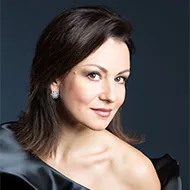
«One must find a balance between mind and body.»
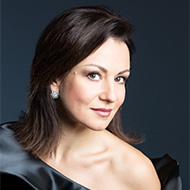
With a voice that the New York Times described as "a shimmering soprano of attractive size" with "brightness", "bloom and warmth", Irina Lungu is counted among the leading opera artists of today.
Irina Lungu completed her vocal studies at the Voronezh State Conservatory under the baritone Mikhail Podkopaev. After winning several important international competitions, she was selected while still a student at the Accademia della Scala by Maestro Riccardo Muti for the opening production of the 2003/2004 season at La Scala, as Anaï in Rossini's Moïse et Pharaon.
Since then she has performed numerous roles on this prestigious stage: Adina in L'elisir d'amore and the title role in Maria Stuarda, Marguerite in Faust, Nannetta in Falstaff, Oksana in Čerevički, the title role in Sancta Susanna and Violetta in La traviata under the musical direction of Lorin Maazel in the production by Liliana Cavani. In 2008 she returned to the same production, and in 2013 she sang the role in the new production by Dmitri Tcherniakov under the direction of Daniele Gatti.
Ms Lungu has sung with some of the world's greatest conductors, including Riccardo Muti, Lorin Maazel, Daniele Gatti, Michel Plasson, Daniel Oren, Gianandrea Noseda, Nicola Luisotti, Daniel Harding, Gustavo Dudamel and Stéphane Denève, and has worked with directors such as Franco Zeffirelli, Luca Ronconi, Robert Carsen, Laurent Pelly, Pierluigi Pizzi, Deborah Warner, Claus Guth, Eimuntas Nekrošius and Liliana Cavani.
When and why did you decide to make singing your profession?
I always say that I did not come to singing; singing came to me. In fact, I have always been making music. When I was six years old, I started learning the piano. Then choral conducting, and then I met my singing teacher, who introduced me to opera and operatic singing. So it was not really a decision on my part; rather, things happened in my life that eventually made it possible for me to take up this profession. It was both a personal effort and a little bit of destiny that I became an opera singer.
As a student at La Scala, you made your debut as Anaï in Moïse et Pharaon under Riccardo Muti. How did that come about?
In 2003 I won a scholarship at the Academy of La Scala in Milan. I began my studies in September 2003. Moïse et Pharaon was planned for the season opening at La Scala that year, and they were still looking for a soprano for the second cast after Barbara Frittoli. They sent me the score, and I auditioned for Maestro Muti, who chose me. That was partly a stroke of luck, but also my willingness to learn immediately and to work hard. I have to say that these things are easier when you are young than when you already have a career. It was a fantastic experience that introduced me to this world and immediately raised my bar. It was a great challenge, but also a stroke of luck.
How do you look after your voice?
There are some very important things one must observe to protect one's voice. The most basic is making sure that the voice is technically set correctly, that it sits forward in the mask and is supported by the breath. Equally fundamental is to keep working on the voice so that this correct technical setting is maintained at all times. Without these basics, vocal health is not possible for anyone. The second point is the right repertoire. I have always been very careful to take one step back in the development of my voice, in order to spare it and not to rush. Another point is the pace of work: sometimes the gaps between projects are very short, but the ideal is to allow yourself breaks and periods of study. Finally, good preparation is important too. Physical health is also important, which is why I do sport; I jog. In general, I can say that it is a complex matter, because you cannot feel well with your voice if you are not mentally and psychologically healthy. One must find a balance between mind and body. It is a bit like with athletes. Recovery of the voice is also important, especially for singers who travel a lot. It is not an easy job, but one that requires a great deal of health and mental balance.
Do you sing exclusively in opera, or do you also give recitals?
At the beginning of my career I gave many recitals, but now they have become rare. I devote myself more to opera productions, where I can not only sing but also appear as an actress. That is something that inspires me greatly. I love being able to demonstrate my skills as an actress. But I also believe I have talent as a singer of songs. I enjoy listening to other singers' recitals and would be glad if in the future I could find the time for recitals.
What does opera mean to you, and what were your first operatic experiences as a child?
As a child I had no experience of opera. I was already 18 years old when I saw my first opera. It was "La traviata" in a provincial theatre. It was not a great experience, and that is also why, at the beginning of my career, I wanted to sing everything except La Traviata, because that experience had traumatised me. But as fate would have it, I ended up singing more than 250 performances of Traviata. Perhaps that first operatic performance was simply a sign of fate, telling me that I had to overcome something I carried within me. In general, I think it is very important to give children the opportunity to come into contact with opera early on. After performances I often meet people, some of them very young, who tell me that they began to be enthusiastic about opera after seeing a performance with their school class. That is why I also consider education in this context to be very important, because it gives young people access to this very exclusive and sublime art and broadens their horizons a little.
Which operatic roles do you like best?
I love all the operas I sing, and I think that when a singer embodies a role, it is always an act of love for the character, the music and the composer. I love them all from the bottom of my heart, each of the women I portray on stage. Of course, among them there are roles and operas that I particularly like. Certainly Traviata, because without loving it I could not have interpreted it so often in so many different productions. And then there is a role that I have sung in only one run of performances, but which is certainly among the roles that suit me best: Massenet's Manon. Then, of course, there are also operas and roles that I have not yet sung but in which I would like to make my debut, such as Norma or Adriana Lecouvreur.
Have you ever received requests from directors that you did not want to accept?
That has happened now and then, but it was never anything scandalous; mainly it concerned stage movements that were too uncomfortable for singers. But one can always talk about such things, and a solution can always be found. It has never happened to me that a director insisted on one thing and said, "Either this or nothing." I am very open and consider myself a very versatile singer; I also like trying my hand at acting. Usually I accept such things very willingly if it is an idea that convinces me. On the other hand, it is also a director's task to convince artists of his ideas. I have never had an unhappy experience in this respect.
Would you like to direct an opera yourself one day?
Yes, I would very much like to direct an opera myself. I really want to do it one day, because I always have so many ideas. I often watch a performance and think I would have done it differently. So, honestly, that is something I would like to do one day.
How has your voice changed over the course of your career?
When I sing, my voice seems to stay the same. But when I listen to my recordings, I notice that it has changed a little. And others tell me so too. It is like being with a particular person every day: it seems as though a child is not growing. But it is growing, and so it is with the voice. Because I practise every day, it always seems the same to me. But I also notice that over the years of my career it has become firmer, richer in overtones and nuances. That is why I now feel ready to take on a new repertoire.
On your Instagram profile you regularly post cooking and baking videos. What are your favourite recipes?
Yes, I love cooking passionately, but above all I love good food more than anything! Cooking relaxes and inspires me. I try to eat well and healthily wherever I am, to maintain my eating habits while experimenting. I believe cooking is also an art, one that requires a great deal of precision, just like singing. I especially like Italian cuisine, which I consider the most perfect in the world. I love cooking risotto, especially Milanese risotto.
You are also a passionate skier. Are you more of a relaxed skier or a daredevil?
I love skiing. However, I did not learn it from childhood; I only learned it very late, when my son was small. On the one hand, to spend time together while skiing; on the other, because I live in Italy. And it would be a shame not to ski when you live in one of the countries with the most beautiful mountains in the world. I have fallen passionately in love with skiing and can no longer imagine a winter season without it. I myself am a very cautious skier, but I always have a little devil beside me who wants to push me further when skiing. So I have to master that, which is very nice. Otherwise I would probably relax too much in my free time, and instead, when skiing with my son, I always have small challenges to meet. Skiing is simply wonderful!
Interview by Florian Schär | Classicpoint.net | 20.07.2021
More interviews
All interviews →


