

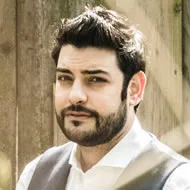
« A voice is like a flower: it must be respected and nurtured as such. »
Ilker Arcayürek is the first prizewinner of the International Competition for Lieder Singing of the Hugo Wolf Akademie Stuttgart 2016. The year before, he was a finalist at the BBC Cardiff Singer of the World competition and was chosen by BBC Radio 3 as New Generation Artist until 2017. In autumn 2016 he gave his much-anticipated recital debut at Wigmore Hall in London. Since the 2015/16 season, Ilker Arcayürek has been an ensemble member at the Staatstheater Nürnberg. Ilker Arcayürek was born in Istanbul and grew up in Vienna.
Classicpoint.net: Your family moved from Turkey to Vienna so that your half-sister could receive good violin training. How did you experience this move?
It was autumn 1989 when we moved to Austria. We were not familiar with the wind and cold in this form. On our first day there, we went for a walk, and my mother, out of concern for me, bought the first jacket she saw. Unfortunately it was bright pink and far too big for me, but it kept me warm! I also remember my first "spare ribs" in a beach café on the Alte Donau. Since then, ribs have been my favourite dish. Not being able to see the sea any more and suddenly having to speak a new language was certainly the biggest adjustment, but I quickly got used to the new living conditions. As a five-year-old, one certainly doesn't have as many demands as an adult.
Your sister later no longer wanted to play the violin, but you developed a passion for music. What sparked your interest?
My mother loved listening to classical music. Our CD player was active almost day and night. We listened to CDs of various genres together, from Guns N' Roses and Tina Turner to Glenn Gould and Anne-Sophie Mutter. My first CD of classical singing was the "Three Tenors".
You were admitted to the Wiener Mozart Knabenchor and enjoyed singing. What did you like about it?
The group dynamic gripped me immediately. We very quickly grew together as a group and did a lot together outside the choir.
There were children from many different countries, and various denominations were represented in the choir. It was an enrichment for my life to grow up in this environment and to be able to have my first experiences in the world of music.
After that, life became difficult. Your parents separated and your mother moved back to Turkey. You lived practically without money with your sister. You even dropped out of school to take casual jobs in order to survive. Can you tell us about this formative period?
I had a number of challenges to overcome in my youth, but I would nevertheless like to stress that I had a happy childhood. I try to complain as little as possible and, despite everything, to be grateful for what I have and to remind myself that many people may be even worse off.
Sometimes the circumstances were not fair, but you hold most of your life in your own hands and can achieve your goals through hard work and with a bit of luck.
That is what I did and what I continue to do. I was healthy, clear in mind and had talent. So I already had all the prerequisites to build a career on it and only had to take this rocky but beautiful path.
The music academy initially did not want to admit you, as you were judged to be too shy?
I am and was a very sensitive person, which is why it was believed that I could not keep up with the elbow tactics at the academy and especially in the world of opera. Some professors at the academy had never stood on stage themselves, which I consider very questionable. For example, I would not want a driving instructor who had never sat behind the wheel of a car, and who knew only in theory how it "correctly" works. Even today, I see from my circle of acquaintances that talents are often misjudged and immediately put into a box.
A voice is like a flower, and it must be respected and nurtured as such. It begins as a mere bud and must blossom slowly. If one is impatient and waters too much, the plant dies. If one waters too little, it dies too. The balance must be right, and one must follow this patient path until the flower blooms in full splendour. This is probably a subject on which I could talk and philosophise for hours.
Why did you keep fighting? What was your driving force?
Singing was the only thing I wanted and was able to do, and the only thing that fulfilled me. I also felt cheated by fate and had a great deal of anger inside me. I turned this anger into ambition, did not accept the situation at the time and decided to test my luck.
At the Opernstudio Zürich you then made your breakthrough. Did you have a Plan B?
I was the only one who joined the Opernstudio without having studied, and I had a lot to catch up on. Some things I perhaps grasped instinctively even better than some others.
The Opernstudio was a very instructive time and gave me a realistic view of the profession of singer. For me there was no Plan B in life, and I still see it that way.
What are your next goals and projects?
I am looking forward to my US debut in New York, San Francisco and Santa Fe, and I hope to stay healthy in the future and, despite my career, to be able to spend as much time as possible with my daughter and my wife.
What are your favourite roles and songs?
At the moment I love singing Schubert's Winterreise. Because I did not have the easiest path, I see many parallels, I have made the work my own, and I am moved every time I sing it. As a lyric tenor, one is glad when one occasionally has the opportunity to sing not the lover but a war hero, and to make excursions with characters such as Idomeneo, Ulisse, etc.
I greatly enjoy developing and portraying such characters during the rehearsal period.
How do you prepare for a role?
First musically, then psychologically, and finally physically. I try to think, walk and then act as the character does.
Do you have any rituals before you go on stage?
I am not superstitious at all and try to avoid rituals. I am usually also too nervous to think about rituals. But I warm up my voice every day, and afterwards it's "eyes closed and through".
Interview by Florian Schär | Classicpoint.net | 1 January 2019
© Image: Janina Laszlo
More interviews
All interviews →


