

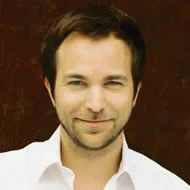
«I sometimes listen to my recordings from the past.»

The pianist Herbert Schuch has made a name for himself as one of the most interesting musicians of his generation, thanks to his dramaturgically well-thought-out concert programmes and CD recordings. In 2013 he received the ECHO Klassik for his recording of Viktor Ullmann's Piano Concerto and Beethoven's Piano Concerto No. 3 together with the WDR Symphony Orchestra under the direction of Olari Elts. As early as 2012, Herbert Schuch had already been awarded an ECHO Klassik in the category "Chamber Music Recording of the Year" for his recording of the quintets for piano and wind instruments by Mozart and Beethoven.
Classicpoint.ch: You were born in Romania and moved to Germany after your first piano lessons in your home town. Where is your home today? What still connects you to Romania?
My home is definitely Germany. Since I was born in Romania as the child of a German family and German is my mother tongue, the moment of arriving in 1988 in Nuremberg, in this country that was really foreign to me, when I was eight years old, was something like coming home. Finally everyone spoke the same language as I did! My family was not purely German, though. My cousins were brought up speaking Hungarian, because my uncle had married a Hungarian woman. My mother's maiden name was Draskovic, a Serbian name. So it was all multicultural, if you like. The Romanian state was quite tolerant of its minorities. There was, for example, a German school, which my brother attended. That of course also had historical reasons. Until the early 20th century, the population of the so-called Banat was predominantly German and Hungarian. These people then became, virtually overnight, Romanians, after this region was ceded to Romania following the First World War. The influence of the old Austro-Hungarian monarchy could still be felt linguistically, though. My grandmother still spoke of Paradeisern when she meant tomatoes… By the way, I only spoke Romanian in kindergarten and during my first two school years, but nothing of it has remained. The only connection to Romania I still have is my first piano teacher, Professor Maria Bodo. She laid the foundation of my technique, and I really owe her a great deal.
Your teachers were all over 50 years old. Did you select them deliberately?
No, not deliberately! Herr Kurt Hantsch, with whom I continued my lessons in Germany, more precisely in Rosenheim, was simply the best and strictest teacher there locally. He had still heard Edwin Fischer. There is still barely any room in his flat, as everything is filled with books, scores and thousands of CDs. Karl-Heinz Kämmerling in Salzburg was finally the first address my father was able to find for me in the region when I was 12 years old. So I then studied with him in Salzburg alongside my grammar school, and got a sense of how important the Central European repertoire is for us pianists! Together with Brendel, these were the teachers who shaped me the most. All three were born around 1930! I am really very happy that through these people I was able to take something from that epoch, which lies so far back.
In recent years you have also worked with Alfred Brendel. Could you tell us something about that?
One can of course describe lessons with Alfred Brendel, but that will never show the intensity that this encounter always had. Despite all the differences that naturally exist on points of detail, I have never met a musician who thinks, experiences and suffers through music with every fibre of his soul and body. You also search in vain for his famous humour in lessons. It is serious, incredibly precise, and always in search of the right character in connection with sound, agogics and articulation. But I feel a little helpless now, because written down, all of this is just commonplace. To really find out what a lesson with Alfred Brendel is like, I would now have to play something and explain through the sound which mental processes arose in Brendel and then, over time, in me as well. Still, if I am to try to pick something out of the wealth of information, Brendel as a pianist always tried not to be a "pianist", but to present an orchestra, a string quartet or a singer on stage. That really applies to almost all German and Austrian music! From Bach to Schoenberg, the piano is just a brilliant yet at the same time wretched medium for expressing thoughts directly. That is why, as a pianist, one must always think: how is this supposed to sound now? Are there 4 or 80 people playing right now? That question never arises with Chopin. There it is always a pianist accompanying himself on the piano while singing.
In your CD and concert programmes you seek surprising combinations. How do you go about putting your programmes together, what is important to you in this, and how do you find these combinations?
It varies. The Schubert-Janáček cycle, in which I combine the great piano works of Schubert with the far too little known piano pieces of Janáček, and which I performed in six concerts in Salzburg, I owe to an inspiration in my sleep. For my "invocation" programme, it was the call from Nike Wagner, who requested a piano evening on the theme "Invocation" for the Kunstfest in Weimar. So I then simply began to assemble music on this theme.
Schumann has always been one of my favourite composers. I put together my album "Sehnsuchtswalzer" in the Schumann anniversary year 2010, to celebrate his early cycles of dances and to reveal the hidden connection between Carnaval Op. 9 and a waltz by Schubert. Many ideas arise in conversations with other musicians and artists. Creativity thrives on exchange!
When you won no fewer than 3 major competitions in a single year, you attracted international attention. Did you enjoy playing competitions? What was your key to success? Did you play differently in a competition than in a concert?
My last competition was over 10 years ago; that time now seems endlessly far away. In any case, I thought back then that competitions were the only way for me to build a career. That has a great deal to do with my teacher Karl-Heinz Kämmerling, who more or less gently persuaded all his students to take part in competitions. I was somehow lucky. I quickly won several major competitions and of course also enjoyed those successes. Apart from a certain sporting aspect, however, competitions above all taught me how important it is to be thoroughly prepared. I did take the competitive element as a spur to engage with the pieces as well and as intensively as possible. I never played any differently than in a concert, but after a few competitions that did not go so well, I came to the realisation that I would rather not play Schubert sonatas in competitions. The views of the jurors were too varied, and I was probably in no way equal to this music back then either. But growing only happens with experience. And that is better gained in concerts than in competitions.
You are still young. Looking back, where do you see your main developments?
I see a few major lines. On the one hand, the certainly very sheltered school years, in which I practised a lot and performed little in public. I went to school quite normally and took my Abitur. So it was all rather relaxed. Then the intensive study period in Salzburg with many unforgettable concert experiences! Outside the festival season there is a very exciting musical scene, including for new music. I really heard a lot there and made many discoveries. Lachenmann, Klaus Huber and Toshio Hosokawa were personally in Salzburg and presented their works. There was an unforgettable evening with Nikolaus Harnoncourt and the Hagen Quartet, at which a Mozart quartet was played and afterwards Harnoncourt worked on the music with the Hagen Quartet using the autograph.
Then came the phase in which I took part in competitions, followed by a certain bewilderment – I had won the competitions, but how should my musical development continue? At that moment Alfred Brendel came into my life and showed me which things one can and must work on as a musician for one's whole life if it is to be a fulfilled musical life.
In November you made your debut with Valery Gergiev and the Mariinsky Orchestra in Munich. Did you choose Prokofiev's Piano Concerto No. 1?
Valery Gergiev has performed all five Prokofiev concertos in Munich and wanted a German soloist for the first concerto. Of course I was very pleased that he wanted me as soloist. Prokofiev is not really my repertoire as such. But I love this music passionately and deeply! It is so witty, so refreshingly different from the music I normally play! Prokofiev with the Mariinsky and Gergiev – this combination is like Christmas and Easter together! It was also an intense experience, and very interesting to see how, with just two or three details in rehearsal, he can create the entire atmosphere in the orchestra. By the way, I played Prokofiev's 8th Sonata at my Zurich debut in the Tonhalle many years ago. It is again a gigantic, profound work that one probably never finishes with.
Where would you like to go, what are your goals?
With a question like this there are always two possible answers: where is the career going, or what is happening with the musical development? Ideally both strands can be pursued at the same time. The fact that one plays with ever better orchestras does not, regrettably, automatically mean that one becomes ever more profound as a musician! Sometimes the development even runs in opposite directions. I certainly want to avoid that! To balance both, I repeatedly need phases in which I can calmly engage with a piece. Chamber music is enormously important to me! Standing on stage with wonderful musicians and dear people, and cultivating this form of musical communication, makes me happy, and I want to do it as often as possible. And every now and then I also listen to my recordings from earlier. It is highly interesting to see what has changed in my music over the years and what is still meant to change. With music, one is simply never finished.
Interview by Florian Schär | Classicpoint.ch | 3.2.2016
© Photo: Felix Broede
More interviews
All interviews →


