

«Living and composing are inextricably intertwined.»

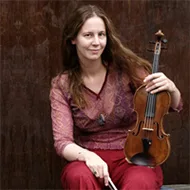
Helena Winkelman is considered one of the most interesting and versatile musical personalities in Switzerland.
Alongside her award-winning work as a soloist and chamber musician, she has been composing since her year of study in New York (1998), and her works are now performed all over the world – including by the Arditti Quartet, Steamboat Switzerland, the Ensemble Phoenix and the Münchener Kammerorchester.
Her output now spans every genre, from solo pieces and chamber music to choral and orchestral works. Her publisher is the Swiss publishing house Editions BIM.
She has been invited to the Young Artists in Concert festival in Davos (2001–2005), the Open Chamber Music Festival of the IMS in England (1996–2013), the Bastad Festival in Sweden and the Musikfestival in Ernen (Composer in Residence), and has performed with Thomas Demenga, Hansheinz Schneeberger, Werner Bärtschi, Xenia Jankovich, Christoph Richter, Dana Ciocarlie, Erich Höbarth, Lucas Niggli and other well-known soloists.
You come from a musical family and received your first violin lessons at the age of 5. How do you remember those beginnings?
Interestingly, my first object of musical desire was not the violin. When I was three years old, I was determined to play the trumpet – I especially loved the bright sound of the high baroque trumpets that I heard in cantatas. My parents, however, first only gave me a recorder.
When I later told the great trumpeter Reinhold Friedrich about this early childhood frustration of mine, he laughed and said: «As a child I wanted to fly to the moon – and my parents put a ladder in the garden for me.»
So those were the modest beginnings.
Just as important as the baroque music in my parents' house (my father is a flautist and flute maker, my mother a harpsichordist), however, was the influence of my grandparents. My maternal grandfather was an architect, an enthusiastic amateur violinist and (together with my grandmother) a devoted fan of the great Russian violinist David Oistrakh. They followed him all over Europe, and even when he was in a care home past the age of eighty, Grandfather would begin to weep whenever I told him about Oistrakh. Those must have been the happiest moments of his life.
Only recently did I learn that my paternal grandfather, who died young, also played the violin. He was a Dutch journalist and war correspondent.
When you studied the violin in New York, that also marked the start of your career as a composer. How did you come to composing?
I always knew that alongside the violin there would be something else that would give me more ways to be creative. At first it was comics and caricatures, then poetry – but these were only detours, because for quite a long time I simply did not yet have the music-theoretical foundations that composing requires.
I had, however, been improvising since earliest childhood, as I was fortunate to have Edwin Villiger as my violin teacher, who taught according to the Kodály method, in which improvisation is a natural part of the curriculum. But writing music down was endlessly laborious for me.
After my studies in Lucerne and then my year in New York, this changed, because at last I had the necessary music-theoretical knowledge.
New York was especially important, as this city has a young spirit, where everyone is searching for the new and the exciting, and failure is no disgrace. You simply get up again and carry on. I felt far less burdened there by the great compositional role models of old Europe, and so I could really begin composing there.
I remember that the year before, while I was still playing in the Mahler Youth Orchestra, I asked our conductor Claudio Abbado whether I should study in Vienna or in New York.
He gave me no direct advice, but simply told me the following: «The Vienna Philharmonic once asked me for a recommendation for an open harp position. I recommended the best harpist I knew. They replied with the following objection: she is a woman, and she is black.»
Perhaps it is better in Vienna in this respect today – but back then it was clear to me that I wanted to study in New York. I spent a great deal of time in the jazz clubs there, and even today my music is influenced by them in its rhythm and harmony.
I still remember a wonderful incident in the subway. I was sitting there with my violin when a young African American sat down next to me. He asked: "What have you got here?" Me: "My violin." He: "You study music?" Me: "Yes." He laughed and said: "That's great. You got to give it all you got." This brief exchange still motivates me today. I give music everything I have.
You have received many commissions. Do you get a free hand, or are the clients' wishes voiced in advance?
The most common request concerns a specific duration. Or there is a need for a particular instrumentation.
Sometimes I also ask a performer what their fantasies are and what kind of piece they would like. Mostly, though, I simply observe my clients until I know what they do especially well, what their character traits are and where their strengths of expression and technique lie. Dante already said at one point in his main work, the Divine Comedy, that when he wanted to convey something to people, he cut the garment to suit the cloth. That is, he adapted both style and content to the recipient of his speech. That this is also my attitude when composing is not a restriction for me; it is a freedom – it gives my imagination a direction. And when I write for performers whom I greatly admire, the inventing comes so easily that I can hardly keep up with writing it down.
That is why I had enormous difficulty composing during the lockdown. Everyone said that we composers had it easy because we could simply carry on working. But at least in my case it was impossible. I missed the encounter with the genius of my musicians far too much.
Your works are now performed all over the world. Which of your own compositions is your personal favourite, and why?
Probably Canto 33, the large vocal work based on the final canto of Paradise in Dante's Divine Comedy.
In it I have tried, with 18 solo voices and three instruments, to set to music the end of Dante's great journey through Hell, Purgatory and Paradise, and to reach into realms where language no longer suffices (as Dante himself laments several times in this canto). I wrote the first part of this one-hour work while I was still studying – very inspired and with a fair measure of naivety regarding the magnitude of the task. The parts of "Canto 33" written back then have great force – yet I could not finish the last third of the text.
At the time I thought that this part of Christian mysticism and medieval philosophy was simply too unfamiliar to me to be able to set it to music. But probably I simply still lacked life experience.
Dante only reached Paradise after passing through Hell and Purgatory – not because he had to earn Paradise, but because he was meant to receive the WHOLE experience. And as the great explorer he was, this was probably also his greatest personal wish.
It took seven years, from 2007, when I performed the first part for my diploma with young singers of the Musikakademie Basel, until I could complete Canto 33. And those years were in many respects both Hell and Purgatory to me, and I learned a great deal about what it means to have to go through the very bottom as a human being.
These experiences strengthened my conviction, which I had formed early on, that living and composing are inextricably intertwined. When I am writing, everything that happens to me during this time informs the piece – where it wants to go, what it should say. And in turn, the piece also determines what happens in my life during this time. These are astonishing synchronicities.
That is why the concept of chance is very alien to me, and when someone tells me that everything happens without reference or connection, I cannot comprehend it, based on my own experiences.
This applied in particular to another of my major works: «Das Allmachtsrohr» (The Omnipotence Pipe), a music theatre piece with texts by Adolf Wölfli, which I wrote for Steamboat Switzerland and a small ensemble of actors.
How does a composition come about for you?
Usually there is a non-musical theme at the beginning. Once I have become clear about it, I very often go for a walk with a small notebook and write down all the motifs that come to mind. Without self-criticism – like a child.
At home I then sit down at the piano and begin to harmonise these motifs. Then I look at these little personalities and consider what their strengths are. Some bring a call to set off, others are suited to slow, long developments, some are troublemakers, others great consolers. Depending on their characteristics, I know where they can fulfil their function within the dramatic structure of a composition, and I place them there. Sometimes they even determine the dramatic structure.
The instrumentation mostly comes about by itself. I never have to think about it for long. My many years of orchestral experience almost always tells me how I can combine the instruments. Only when I have to write for wind bands do I lack experience and need to seek advice.
What, in your view, distinguishes a good work?
The relationships between the elements used. To me, the first movement of a Haydn string quartet is endlessly more complex (and by that I mean richer) than a piece by Ferneyhough. One can of course say that the number of elements used and their nature determine the complexity of a music. But when these can no longer be brought into relation with one another, the result in sound and development is a dreary grey. How often in my own work have I observed: if I want complex relationships, I must reduce the elements and use simpler building blocks. Often this means that the surface does not even look so complex.
As a non-musical parallel, one could take this: the relationships within a family are endlessly richer and more prone to drama than the anonymous coexistence of the collective of a big city. And for that reason they are far more interesting for a reflection on human nature in art and psychology.
Another factor of a great composition is, for me, that the expressive means used correspond to the core of the message and can make that core directly and sensually understandable to the listener. But this presupposes that such a core exists at all.
It fully matches our Zeitgeist that we think more about form than about content. It is – to put it somewhat provocatively – a catwalk mentality. We describe the leg length of a beauty queen, the circumference of her bust to the exact centimetre – yet we no longer ask what constitutes the mystery, the inexpressible charisma of this woman. How differently the atmospheres of a Marlene Dietrich and a Marilyn Monroe feel!? Perhaps only a brilliant director or poet can portray that. I once received a good lesson when – then still a little younger – I spent a night on London buses because I had no money for a hotel. I sat with a middle-aged man from some Caribbean island. We talked. I said that I was a musician. He replied: Every music needs a message. What is your message? Then he began to sing. Just like that, on the bus. He was blind drunk – but he sang with a magnificent voice.
And his question was a good one. At a music academy one is hardly ever asked it. There the focus is mainly on objective quantities, because an academy is committed to scholarly thinking. But really that is a sad reduction of music's actual sphere of influence.
When I visited the Roerich Museum in New York in 2018, I saw that he drew religion, music and science as three circles in one representation. For me these partly overlap: some aspects of music can be grasped scientifically, others are religiously motivated – but some aspects belong to music alone.
You have also performed concerts in care homes, prisons, schools for the blind and rehabilitation centres. What was that like for you? Can you tell us about it?
Those were very important experiences. At that time I was one of the musicians of the organisation Pro Musicis, which was founded more than 50 years ago in Paris by a Franciscan priest named Père Merlet. He was an organist and one day felt called to bring young musicians at the beginning of their careers into contact with people who normally could never hear classical music. So we were each time allowed to play a concert in an important hall such as Carnegie's Weill Recital Hall or the Salle Cortot – but always in combination with two concerts in social institutions.
I remember a concert at the Centre Phénix in New York. It was a detox facility for drug addicts. We played for around 150 people, heavily guarded. Alongside a Brahms and a Beethoven sonata, we also played a new work of mine for violin and piano. It was called «Vom Berg gefallen» (Fallen from the Mountain) and was dedicated to a colleague who had had a mountaineering accident. I asked our listeners – without naming the title – what they thought the piece was about. And they actually worked it out. The people there were certainly among the most sensitive and attentive listeners I have ever played for.
I have always also very much enjoyed making music for people with physical and intellectual disabilities. At a concert in a prison in Marseille I was somewhat worried – but that also went well, and I had a good exchange with the social worker there, a great humanitarian who meets the inmates every day without condemning them.
What are your next goals and projects?
At the moment I am working on a solo piece for a Korean haegeum player. It is an instrument very similar to the Chinese erhu. I like the sound and the wide expressive range of this instrument. In an earlier work for the Asian Art Ensemble in Berlin, I already devoted myself to this wonderful ancient musical culture.
In March 2022 I will write a piece for a larger ensemble that brings jazz musicians together with specialists in early music: MINIMAL MINIMA. After that comes my trumpet concerto ICAROS.
What passions do you have besides music?
I would probably have studied philosophy or psychology if I had not become a musician. Perhaps in a way I have done so after all – but not along an academic path. East Asian cultures have interested me from the very beginning. I first encountered Tibetan Buddhism at the age of thirteen; then Zazen came along, and I practised Aikido for a while, but then switched to Qigong because of the risk of injury. All of this in order to better understand one of the foundations of our art – movement: Why can some great conductors slow down the perceived flow of time with a single gesture? Why is the rhythmic pulsation of some great performers so compelling?
I also asked myself how it is possible to truly serve the work as a performer, and how a space can arise between the performers and the listeners in which a real encounter can take place.
These are all questions that cannot be answered within the field of music alone.
In 2008 I came into contact with the medicine teachings of the Lakota (a Native American people), and for five years I studied with a teacher in England. I then extended this study with a diploma in hypnosis, as I was interested in the Western approach when it comes to the borderlands of consciousness.
I wanted to know more about the origins of music, I asked myself how the greatest intensity of a performance can be achieved, and I tried to understand where its magical quality comes from, for which a drum and a little whistle are already enough.
When Native Americans pick up a drum, they know that they can bring a reality into being with it, and therefore they account for what their inner state is while they play. They return to the point where sound truly recreates the world.
By contrast, a famous violinist colleague from the same country, when asked what he thought about while playing, answered: how much he earns from the concert, what he will eat afterwards…
A big difference, isn't it?
Pursuing such ideas in peace is not altogether easy, because so much today has become loud and commercial. Always searching for the even harder kick – and not wanting to feel how empty everything has become – this is a game in which classical music cannot and must not take part.
I do think, however, that in the development of new classical music, much has not gone ideally, and that there is quite a reason why it so often has to seek out its audience today.
But we have the chance to rediscover it in every moment, to reinvent it, and I personally still believe that audiences recognise when someone on stage is giving something valuable.
I also see that many young colleagues genuinely care about this. That gives me hope.
Interview by Florian Schär | Classicpoint.net | 15.03.2021
More interviews
All interviews →


