

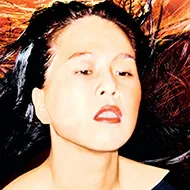
«Why actually? Why am I a musician, why do I make music?»

Hanni Liang was born in Bielefeld in 1993 and comes from a family of non-musicians. She received her first piano lessons at the age of eight and, after rapid progress, was admitted as a junior student to the piano class of Prof. Barbara Szczepanska. Hanni completed her Bachelor's degree in music and an additional qualification in media management at the Robert Schumann Musikhochschule as well as at the Hochschule für Musik, Theater und Medien Hannover, where she was significantly influenced by Bernd Goetzke. Since 2016 she has studied with Prof. Matthias Kirschnereit. Concerts have taken her, among other places, to Russia, Austria, China, Spain, Italy and Poland, where she performed at the Chopin International Festival in Warsaw, the Mariinsky Theatre, the Trans-Siberian Art Festival, the Forbidden City Concert Hall and the Tianjin Piano Festival.
In 2010 she was named a Young Steinway Artist and received the Steinway Förderpreis. She has also received scholarships from, among others, the Dörken Stiftung, the Gesellschaft Westfälischer Kulturarbeit, C. Bechstein and the Richard Wagner Stiftung. Since 2017 she has been a scholarship holder of the Studienstiftung des Deutschen Volkes.
Since 2013 she has been a successful TONALi musician and therefore has excellent qualities in music education and communication. TONALi became formative for her further career development and had a significant influence on her current artistic personality as well as on her musical commitment to inspiring more young listeners to enjoy classical music and to provide cultural education. In this context, the non-profit project TONALiSTEN was also established, whose management Hanni Liang has taken over.
Her close collaboration with the renowned German composer Manfred Trojahn developed through the world premiere of his work „Leise Gondeln“ not only into a close friendship, but also into a recording of his „Six Préludes“ in 2015 and the world premiere of his melodramas at the Klavier-Festival Ruhr.
She has also received further musical influences from Maria João Pires, Homero Francesch, John Perry, Jacques Rouvier and Michel Beroff.
How did you come to music as a child?
It was really more by chance. A friend at primary school suddenly wanted to learn the piano, and I wanted to as well. As is so often the case with children. In the end I got "stuck" and couldn't get away from the instrument. My parents are both non-musicians, so there have been many books on the piano at home ever since. My mother immediately bought a book entitled „Piano for Dummies“.
As an artist, you develop new concert formats yourself. You want to rethink and expand the concept of the "concert" in a new way in order to draw attention to social issues. Could you tell us more about this?
After my debut at the Elbphilharmonie with the Deutsche Kammerphilharmonie Bremen, the question that mainly arose for me was: Why actually? Why am I a musician, why do I make music? And ultimately, connected to this, what can music/the concert be at all, and what does it mean to engage with art in these times? So my search for the why led to the answer I carry within me today: to use music and my concerts to foster a more humane coexistence. Asking questions, challenging ourselves to engage with positions that perhaps are not part of our everyday lives, and finding out through dialogue what unites us in our diversity and holds us together as a society.
In the so-called concert format, I question traditional roles such as "artist" or "audience", or the separation between hall and stage. In doing so, however, I always start from the music, because it is and remains the nucleus from which bridges and contextualisations into the here and now are built.
Alongside your solo career, you also curate socio-artistic projects, which are mostly based on a co-creative approach and give expression to a social theme. Could you tell us about one example?
Last November, together with project developer Kian Jazdi, I gave a co-creative concert performance at the Konzerthaus Berlin. Eight young people from the Marzahn district took part, with whom we worked regularly over three months. In conversation we jointly defined the theme of the performance, which is the search for home and the question of what connects Berlin, before moving on to developing artistic means to express this theme. It is also always about what the group brings with it. Here we had some who enjoy writing texts, some who express themselves through movement, and one who wanted to design the costumes. And so the initially blank sheet is gradually painted together and brought to the stage together. It is a great process of negotiation and, of course, always a balancing act between how much one intervenes oneself, because one has one's own, perhaps different, artistic ideas, or holds back and trusts the group. It is also about how one can create spaces on stage in which every single person can be "experts of themselves". I always learn an incredible amount in the process.
Since October 2022 you have been a lecturer in concert design at the Hochschule für Musik und Theater München, and together with your students you explore the future of the classical concert artistically. What have you developed so far?
Different projects emerge every semester. For example, in cooperation with the Pinakothek der Moderne we staged a performance on broken instruments. It was about the question of beauty in what is broken, about perfection and what everything can be music.
For this we launched a call throughout Munich to lend us broken instruments. And so we were brought the most varied instruments: broken accordions, hammered dulcimers, saxophones, a harp… I remember the very first session, in which the students immediately picked up the instrument they study, but quickly realised that it made no sense at all. Because you cannot play a violin without strings, at least not the way we know it. It was therefore a very exciting and inspiring, experimental search for sounds and a breaking open of norms and expectations in instrumental playing.
Another project was in cooperation with the Münchner Philharmoniker, which I carried out with my colleagues Moritz Eggert and Ali Nikrang. It dealt with AI and music and ultimately with the question of what it means to be human. What it means to feel raindrops on the skin, to make mistakes and to be between life and death. In the process, musical collaborations between AI and humans emerged, as well as an artistic exploration in which the audience was also involved.
For VOICES you have compiled a collection of works by women composers who have personally influenced you or who are known for their fight for women's rights and equality. What motivated you to do this?
The trigger was discovering the music of the composer and suffragette Ethel Smyth. I was very inspired by her and her fight for women's rights, and I was determined to bring her wonderful piano music back to life. For me it was also about building a bridge to the present, which is why my research began with contemporary women composers who raise their voices and campaign in their own way, and ultimately with the question of what all of this has to do with me personally.
Thus the only non-British composer is the Chinese-American composer Chen Yi. Through her work I reflect on my origins and the ambivalence I feel as a citizen born and raised in Germany with Chinese roots.
Together with TONALi you founded the TONALiSTEN collective. What exactly is it?
TONALi is a cultural initiative in Hamburg that has shaped my artistic development very strongly. It is an academy, a research centre and a hub for classical music that is connected to social participation. TONALiSTEN are all the musicians who see themselves as part of it, and it is thus the collective that emerges from it. It is a place of open exchange with consistently inspiring impulses, processes and encounters, from which exciting projects arise.
Do you have other projects that are close to your heart?
I very fondly remember the performance „Watermark“, which I gave in 2023 at the Elbphilharmonie. I asked the question of ownership, starting from Caroline Shaw's piano concerto: who owns the stage, or, playing with the word, who owns the water? I wanted to create a shared moment of mindfulness for this ever-dwindling essence of life, and walked through the hall with a light bowl of water, humming the first note of the piece. Joining in: the audience, who tuned into the note. Arriving on stage, I played the first chord into the humming of all the people in the hall. It was a very special moment.
Another project I am looking forward to is now at this year's Edinburgh International Festival. There I am bringing a new concert format to the stage. It is called „DREAMS“ and combines Debussy's piano piece „Rêverie“ with improvisations. The listeners are invited to share their dreams by sketching or writing them down. This process is projected throughout the room and influences Debussy's music, as it transforms into an improvisation on the shared dream and returns to Debussy once the dream has "disappeared". I am really looking forward to it, as it is the first time that improvisation will take a significant part in a concert. So far I have only done it in small sections or as an encore, and I can hardly wait.
What are your passions besides music?
I have many passions: reading, cooking, going out to eat, strolling in cafés, meeting friends. Recently I started learning the erhu in China. The Chinese "fiddle" with two strings. I simply love music… I am also the mother of two young children, and so I connect all my passions with my family. We spend a lot of time together reading, dancing, playing games, making music, cooking and also simply lazing around together.
Interview by Florian Schär | Classicpoint.net | 1 March 2025
© Photo: Esther Haase