

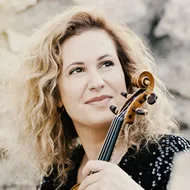
Gwendolyn Masin is one of the leading concert violinists and innovators of classical music today. She performs internationally as a soloist and together with other musicians, artists and orchestras. Her live recordings and tours include concerts with the National Symphony Orchestra of Ireland, the RTÉ Concert Orchestra of Ireland, the Hungarian National Philharmonic, the Hungarian Chamber Orchestra, the Savannah Philharmonic Orchestra, the Georgia Philharmonic Orchestra and the Berner Symphonieorchester. Her international career has taken her across Europe, to the USA, to Asia, South Africa and the Middle East.
As a commissioner of contemporary music, you have premiered many works. How do you choose the composers?
I have performed as a solo violinist since childhood. My first public concert in a large hall took place in Budapest at the Liszt Academy when I was six years old. On that occasion I met a composer in person for the first time. My mother, who is a Hungarian violist, introduced me to her friends Marta and György Kurtág. Their remarkable personalities impressed me. György excitedly told my mother about his current composition, and I loved the energy and passion with which he spoke. Later, my parents showed me pieces by him and even played some of them for me. I sensed in them the same playfulness, cheekiness and curiosity that Kurtág embodies.
Years later, when I was in my late teens, a thought dawned on me while I was feeling lonely in a hotel room on a tour in Mexico. While I was practising somewhat aimlessly, I remembered Kurtág and wondered whether composers who work in solitude also feel this sense of isolation. And then it became clear to me that performing music is a conversation with a composer and his or her ideas, which are expressed through the music.
Since then, when I meet composers with whom I would like to work, I seek out conversation with them and take enough time for an exchange of thoughts and opinions. The connection between the person and their music allows me a "somewhere in between", a point at which I, as a performer, come as close as possible to the music and to which I can hopefully also take the audience.
Do you set guidelines for commissioned compositions and accompany the creative process?
It varies from case to case. When the Irish composer John Buckley wrote his first violin concerto, which I had commissioned, I was heavily involved, right through to the cadenza, which we partly built on improvisations of mine. For the commissions for the GAIA Music Festival, however, I try to set a framework or a theme and the instrumentation, and to give the composer as much freedom as he or she feels they need. When Dobrinka Tabakova was Composer-in-Residence at GAIA, she first developed works around the musicians she knew would be taking part, and partly tailored her compositions to them. We performed one of her works as a duo, and that made me aware of how great the role of the dedicatees is in her works.
You are the founder and artistic director of the GAIA Music Festival. What makes this festival special?
Many things, I believe. Diversity, sustainability and equality have been important to us from the very beginning. The name of the festival already hints at this. Gaia, born out of chaos, is the primordial Greek goddess in the form of the earth.
The festival aims to create unique and very vibrant interpretations. They come from musicians who gather for ten days to develop a repertoire together. And rather than insisting so strongly on cultural outreach that it becomes an empty necessity, we have connected from the start with the residents of the village of Oberhofen as well as our other venues. We undertake joint projects, open the doors to rehearsals, talk with our audience and exchange ideas at small salon evenings. I invite artists who want to connect with others and who reflect the realities of our society.
The festival is taking place soon. What are your personal highlights of this year's edition?
There will be a great deal I am looking forward to. The revival of the stage production «The Journey», which I developed with Lukas Bärfuss. The concert with Amandine Beyer, in which Baroque and Renaissance music meets Schoenberg's «Verklärte Nacht». Works by rarely heard composers such as Bodorová, Ben-Haim and Bacewicz, but also the very well-known: Beethoven's Septet or one of Mozart's piano concertos.
In 2004 you launched the multidisciplinary series «In Search of Lost Time». Could you tell us about it?
Having started performing so young, by the age of 23 I was hungry for connection and collaboration, and for finding a way to bring the other art forms I love into my stage life.
I took up the idea of multidisciplinary performances early on. «In Search of Lost Time» is one example of this, which has since undergone several changes. Originally it combined classical music with theatre, literature, dance and lighting design in unusual spaces; later, contemporary music was added.
The series took place in Ireland and Switzerland and is now dormant in favour of other productions that have caught my interest.
You were invited by the Casino Bern to conceive and curate the series «Cocktail für die Musen» and to perform at every concert yourself. The result has been elaborate, one-of-a-kind productions combining classical music with other musical genres and art forms. How did this idea come about?
After the Casino Bern had been comprehensively renovated, its cultural management invited me to create this series. The Casino Bern wanted to reach a larger audience, one that would go beyond the existing one. I very much enjoyed running the series from 2018 to 2023. We had up to three happenings per year. At the first one, for example, I performed with my ORIGIN ensemble together with Andreas Schaerer, Kalle Kalima and Wolfgang Zwiauer. Among other things, Bach meets improvisation, jazz and newly created works. There were magical moments that still resonate and can be viewed on YouTube.
You are often a keynote speaker with the violin in hand. What do you most like to talk about?
I am an enthusiast – I can quickly become excited about topics ranging from music to other art forms, science, politics or history. Invitations to give talks have mostly come as part of lecture evenings, and in some cases I have had the opportunity to speak to people with little or no experience of classical music. This is on the one hand very exposed, as at TEDx, but on the other hand a fantastic process to engage in, and immensely fulfilling.
You have developed your own teaching method, and the book «Michaela's Music House, The Magic of the Violin» was award-winning. What are the core principles of your teaching method?
Probably actively engaging the imagination from a very early age, a thorough approach to the mechanics of playing, and the deep conviction that music students should achieve independence from their teacher as quickly as possible. The sooner a student leaves my classroom with critical thinking in order to seek out their own musical adventure, the greater my sense of achievement.
In your doctoral thesis you presented a chronicle of the contemporary history of the violin and examined the similarities and differences within violin pedagogy of the 20th century. What are your most important findings?
That is hard to summarise. The work is over 200 pages long and discusses more than 20 treatises by leading violinists, from Geminiani in 1751, through Spohr, Baillot, de Bériot and David, to Menuhin and Bron. It contains interviews with leading figures in violin playing, some of whom were my teachers: Ana Chumachenco, Zakhar Bron, Shmuel Ashkenasi, Herman Krebbers, Boris Kushnir, Nora Chastain, Maxim Vengerov. It is a treasure trove of tips on technique and movement that they passed on in their interviews.
I recommend that anyone who loves their violin and wants to know how the great teachers of the last 270 years taught download my dissertation. It is available free of charge on the website of Trinity College, where I obtained my doctorate.
What are your current projects?
I am touring as a soloist with the Hungarian Anima Musicae Chamber Orchestra, preparing programmes for the 25/26 season and working on developing a solo recital programme as well as on the further development of «The Journey» with Lukas Bärfuss. I am also quietly learning the art of conducting from some fantastic conductors.
What do you do besides music?
Many things, and gladly. But somehow everything I do eventually becomes material for what ends up on stage. I am a mother, I enjoy moving, I write and read a great deal, I am happiest when I am on the move, and I have an insatiable curiosity and a great interest in getting to know people. An enthusiast, in other words.
Interview by Florian Schär | Classicpoint.net | 01.04.2024
Photo: Balazs Borocz
More interviews
All interviews →


