

«It was the dream of my life.»
«It was the dream of my life.»
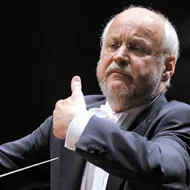
As first violinist of the Alban Berg Quartett, Günter Pichler enjoyed an unique career: during the almost 40 years of the quartet's existence, it performed on all the major concert platforms of the world. After the end of the Alban Berg Quartett in 2008, Günter Pichler intensified his conducting activities, which he has been pursuing regularly and successfully for over 20 years.
Classicpoint.ch: You became leader of the Vienna Symphony Orchestra at the age of 18, and in your mid-20s you became concertmaster of the Vienna Philharmonic under Karajan. You could have fully concentrated on a solo career. Why did you choose to play in a quartet?
My instinct told me that quartet playing was the right thing for me.
Were there moments when you regretted choosing quartet playing?
I never regretted that decision; it turned out to be the dream of my life.
In 38 years with the Alban Berg Quartett you have presumably performed in almost every major hall dozens of times and given thousands of concerts. Are there some concerts that are particularly memorable to you?
The most exciting concerts, and of course the most thrilling ones, were those of which we knew they would decisively influence our career. First of all, that was our debut in autumn 1971 at the Vienna Konzerthaus, then the first concerts in the great concert halls of Europe and overseas, for example the Berlin Philharmonie, the Zurich Tonhalle, the Concertgebouw Amsterdam, the Frankfurt Alte Oper, the Cologne Philharmonie, the Herkules Saal in Munich, the Théâtre des Champs-Élysées in Paris, the Santa Cecilia in Rome, the Queen Elizabeth Hall in London, the Suntory Hall in Tokyo, the Teatro Colón in Buenos Aires and, most especially, the Carnegie Hall in New York. Our debut there was recorded and later released on EMI; it was the catalyst for our decision to record almost exclusively live.
The world premieres performed in the presence of the composers are also unforgettable (for example by Berio, Schnittke, Haubenstock-Ramati, Urbanner, Rihm), as are concerts for which the composers expressly thanked us for the performance (such as Lutosławski or Boulez).
Concerts that were recorded live also hold a special place in my memory, particularly the live recording of the Beethoven cycle at the Vienna Konzerthaus.
When you play together in the same line-up for so long, a complicated network of social relationships develops. How would you describe the individual characters and their roles within the social fabric of the quartet? Was there someone who took the lead in rehearsals, or someone who could occasionally defuse a brewing argument with a witty remark?
A quartet can only function on a democratic basis. But democracy also has its rules. It is certainly helpful to have a primus inter pares, which in our case – I believe – was the case; it is necessary that the characters complement one another, and we were lucky in that respect too... And above all, humour must not be lacking.
Three years before the dissolution, when Thomas Kakuska (violist) died, was the end of the quartet already a topic?
Naturally, the end of the quartet was already a topic at that time. But Thomas did not want, under any circumstances, for the quartet to stop playing on his account.
Valentin Erben is said to have been the trigger for the dissolution of the Alban Berg Quartett. How did the other three members react when Valentin Erben announced his intention to reorient himself?
I believe that when Valentin informed us of his decision, we were all quite surprised. In the end, though, everyone agreed. Of course I don't know exactly what my colleagues thought. Personally, I had actually forgotten that there has to be an end at some point, and as the eldest member of the quartet and after 50 years of "professional life", the timing of the dissolution was ultimately very natural for me.
How did you experience the very last concert of the ABQ?
Preparations for the quartet's final tours began two years before the end, so we had plenty of time to get ready for the end. However, as we did not know how emotional the last concert would feel, we decided not to play it in Vienna. It was to take place at one of our favourite venues, far from home yet among friends: in Buenos Aires, at the indescribably beautiful Teatro Colón. But then, at the last moment and out of the blue, came a request from the director of the new cultural centre in Beijing. He justified his invitation with the following words: You are stopping – we are starting, so please do come. And so we played our last concert in a country where there was no chamber music culture at all, yet evidently we did something important for chamber music in China. For in July this year, the president of China's central conservatory in Beijing rang me and told me the following: "Since you gave your concerts with us three years ago, our school has had over 60 string quartets. Please come, we would like to introduce you to the best five, because we urgently need contact with your tradition." Returning once more to the last concert: despite all the preparations, it was a very moving feeling to be on stage as the Alban Berg Quartett for the last time and to play the final notes ... for me it happened as if in a trance.
What advice do you give to today's young quartet ensembles? In your view, what is most important for achieving success?
A burning love of music, the unconditional will to seek truth, humility before the work, believing in oneself and considering everything possible, regarding every concert as the most important of one's life, being utterly reliable, working unceasingly and knowing oneself.
After the end of the ABQ you intensified your conducting activities and teach as a professor at the universities in Vienna, Cologne and Madrid. Do you still play chamber music?
After months of deliberation, and already before the quartet's end, I had decided – although many good friends had invited me to make music with them – to no longer perform publicly as a violinist.
Interview by Florian Schär | Classicpoint.ch | 03.01.2012
Photo: n.a.