

«That project was fantastic.»
«That project was fantastic.»
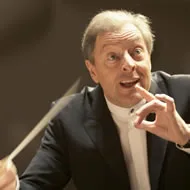
Howard Griffiths is General Music Director of the Brandenburgisches Staatsorchester and artistic director of the Orpheum Stiftung. From 1996 to 2006 he was artistic director and chief conductor of the Zürcher Kammerorchester. Howard Griffiths has lived in Switzerland since 1981.
You are currently General Music Director of the Brandenburgisches Staatsorchester in Frankfurt, but you live in Switzerland. Do you commute back and forth all the time?
Mainly I am in Switzerland, and only about 12 weeks a year in Frankfurt. As a rule I stay for rehearsals and concerts for 3 to 5 days before travelling back again.
As a guest conductor you are in regular contact with other orchestras. What do you particularly like about the Brandenburgisches Staatsorchester?
When I joined the Brandenburgisches Staatsorchester, its playing style was traditionally German. My conviction that pieces should be played in the tradition of the composer was new to the orchestra. Meanwhile the orchestra has adapted very well. Of course I also like that, compared with the ZKO, I now have a large orchestra with a big line-up at my disposal and can therefore play a very different repertoire.
You are repeatedly enthused by extraordinary projects, such as the "Symphony of a Thousand" by Gustav Mahler, which you performed with the Basler Sinfonieorchester and over a thousand participants. Was that your idea?
No, someone approached me. But the project was fantastic. Bringing together many choirs in one concert was very special.
You also successfully realise crossover projects. Which of these projects are most memorable for you?
I don't much like the term "crossover". It quickly sounds cheap, as if one only wanted to attract new audiences. For me these are more "stylistic encounters", which I enjoy, such as the Istanbul Symphony by Fazil Say, which we premiered in Dortmund and in which the normal symphony orchestra line-up is expanded with Turkish instruments.
I also regularly create programmes in which I juxtapose pieces by composers who lived at the same time but in completely different cultures.
Or silent film scores, such as the live accompaniment of a Charlie Chaplin film in the Circus Knie tent: that was a highlight.
I have also done projects in jazz or in Gypsy music. What matters to me is simply that it must be done well.
Your wife is Turkish, you speak Turkish fluently, and you lived there for several years. How widespread is classical music in Turkey?
You may be surprised, but classical music is indeed very widespread in Turkey. There are certainly over 30 classical orchestras. In Istanbul alone there are two large symphony orchestras and 4–5 chamber orchestras. On average, the audience is even somewhat younger than with us.
You have been artistic director of the Orpheum Stiftung for over 10 years. What distinguishes this foundation?
When the foundation was established 20 years ago, there was still no way for talented young soloists to appear as soloists with a large, established orchestra. Today that is different. The Orpheum Stiftung has achieved a pioneering feat in this area. The artists also receive comprehensive support for their project.
Who decides which talents are considered?
It is always like a mosaic made up of many individual pieces. We receive over 200 applications every year. One receives recommendations, hears and reads about artists, until one makes up one's mind – this one or that one we take. Conductors of course also suggest artists. In the end I make the decision. In these 20 years, however, very few have disappointed us. We can be proud that we have had a good nose. Most of the artists are now very well known and still thank us for the support long afterwards.
You are also committed to introducing children and young people to classical music. What projects have you already realised?
My latest project is a children's book: Die Hexe und der Maestro, an orchestral fairy tale. The book is meant to contain as much information about an orchestra as possible. It is for children aged 5–10 and can be enjoyed without music or with the enclosed CD recording. A few weeks ago we had the premiere. Right after the concert we sold over 200 books. It was a great success. In Zurich we will give another performance with the Musikkollegium Winterthur on Whit Sunday in May 2013.
In general, children's concerts seem very important to me. I also do orchestral projects in which young people are allowed to play in a professional orchestra.
In addition, we carry out a series of education projects, each involving 300 children. In this way Carmina Burana, Holst's The Planets or a children's opera based on the Pied Piper of Hamelin are brought to performance.
Interview by Florian Schär | Classicpoint.ch | 03.09.2012