

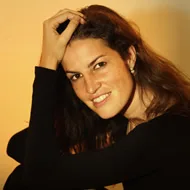
«Leadership types acquire charisma through hard work.»
Graziella Contratto represents a younger generation of conductors who combine concert and operatic repertoire with a special sensitivity for exciting programme choices, innovative connections and open communication. Literature, architecture, dance and film are sources for her concepts.
Classicpoint.ch: You give workshops for managers and leaders. Participants are allowed to conduct an orchestra under your guidance. You show the parallels between the leadership qualities of a conductor and those of a manager and offer suggestions for optimisation. Where are the parallels, and what are the most common insights from such workshops?
Perhaps somewhat poetically, and perhaps not very well suited to the economic context, I would argue that the most important thing is beauty: as soon as conducting executives shed everything artificial, conditioned, cool or superior, they become beautiful, and the musicians allow themselves to be led. This happens without the slightest verbal communication, purely through healthy charisma and the associated sense of flow, which manifests itself in the sound. Other parallels include clarity of message, professional competence, a sense of balance between collective and individuality among those being led, and vision and implementation without detours through vanity.
Do you also learn from the business participants in your workshops for your work as a conductor?
Absolutely – concepts such as 'authoritative' or transactional/transformational, 'flow' or the specific problems of personnel management can be transferred almost identically to my work. (If I may add: at the moment, however, I learn the most from our two-year-old daughter about what 'leading' means. In some educational decisions I ask myself: does this no serve me, the upbringing or the child? Feel free to transfer that to orchestral direction or corporate management.) Arnold Schoenberg, himself an inspired teacher, wrote in the introduction to his 'Harmonielehre': 'I have learned this book from my pupils.'
Can charisma and leadership skill actually be learned?
A certain degree of basic charisma is certainly innate or natural. But: certain leadership types acquire, through very intensive study, a kind of 'professional' charisma, which in recent decades has integrated remarkably well into the classical field – many conductors with a musicological or historical background are respected by orchestras, even though they no longer correspond to the mythical cliché of the magician on the podium.
How do you deal with a classical diva in the orchestra?
Divas can be found everywhere. In any case, I find it a challenge to integrate these strong personalities, who not infrequently suffer from a kind of post-adolescent attention syndrome, into the interpretation through a particularly strong, visionary concept. The best players should serve the team, not undertake hybrid solo ventures.
How do you deal with obvious power struggles and group formation within an orchestra?
An orchestral body contains groups that have grown historically, for example the string groups or the woodwinds and brass. Each group has two faces: one is humble (ideally) and devotes itself passionately to realising the compositional template; the other insists on trade union rights, wants a say, and engages in outward-facing communication. To keep all these important differences under control, one needs a conducting personality who can empathetically identify with the various positions musically, communicatively, stylistically and in trade-union matters, without losing themselves in the process. Despite everything, a conductor is and remains a leadership figure originating in the 19th century.
You have become the first woman to serve as chief conductor of a state orchestra in France. Have you already felt rejection while working as a woman with a top orchestra?
Let's wait a few more years, and this question will become entirely redundant! I can only say that it was a matter of give and take: the better I conducted, the less problematic the relationship was. Sometimes, for some irrational reasons, there is love at first sight – or the opposite. If they are honest, my male colleagues will tell you the same thing…
What options are there for winning over an orchestra when one is rejected as a female conductor?
Study, learn, reflect: the emotional and intellectual insights must flow into the body and take on a form of their own. One should master the score so well that the orchestra – whether stylistically in agreement or not – can no longer resist the elegance or the evidence of the interpretation.
You are very active in many fields. Are there projects that are especially close to your heart that you have not yet been able to realise?
A Wagner ship on Lake Lucerne – wait a few more years, and it will happen. No more will be revealed for now.
You are artistic director of the Davos Festival – young artists in concert. What is the concept of this festival, and how does it differ from other festivals?
For nearly 26 years, the Davos Festival has been dedicated to promoting international young musical talent, especially at chamber music level. We do not invite big names; instead we try to offer young talents performance opportunities in the beautiful triangle of landscape, audience and poetry. For a few years now we have become very bold in new music, dance theatre and special outreach ideas (lying-down concert on the Schatzalp! Hotel operas! Cage in the club), and a few weeks ago we were honoured to receive the Johana Dürmüller-Bol Prize – which of course encourages us to continue along the path we have taken.
You have worked with many great artistic personalities. Which of them have impressed and inspired you particularly?
Carlos Kleiber, whom I unfortunately never had the chance to hear live, but who constantly accompanies me as a conducting muse. Ben Heppner, who in 1998 sang Tristan as if it were Mozart. Lisa Larsson, who demonstrates a remarkable stylistic assurance as a soprano from the Baroque to the contemporary. The young Mirella Weingarten, with whom I was able to co-produce numerous projects in her direction or choreography. Martin Helmchen, to whom I owe an incredible Schubert at the Davos Festival. And my husband, the violinist Frédéric Angleraux, for his music and his cooking…..
Interview by Florian Schär | Classicpoint.ch | 21.02.2011
More interviews
All interviews →


