

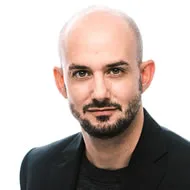
« For me, Handel was the Andrew Lloyd Webber of baroque opera in London. »
Franco Fagioli was born in San Miguel de Tucumán in north-western Argentina. He received piano lessons at the Musikinstitut von Tucumán and then studied singing, first in his home city and later at the Instituto Superior de Arte, the training centre of the Teatro Colón in Buenos Aires. The breakthrough came for the already impressively mature young performer when he won the 10th »Neue Stimmen« International Singing Competition of the Bertelsmann Foundation in October 2003. In July 2015, Fagioli became the first countertenor ever to be signed by Deutsche Grammophon.
Classicpoint.net: You were born in Argentina. What place does Argentina have in your life today?
That's right, I was born in San Miguel de Tucumán. Tucumán is a province in the north-west, with beautiful subtropical weather. It is 1,200 km from Buenos Aires. In my life today, Argentina has the place of being the country where I was born. My closest family lives there, so it is always somehow present, even though it is far away. Argentina is my past and my present. That is where all the people live who have known me since the beginning, and that is priceless. Of course, you come to Europe and make new friends, but they don't know you from the very beginning.
When did you first hear a countertenor, and what did it trigger in you?
The first time was by chance, when I was a pianist in a choir and we were rehearsing Pergolesi's Stabat Mater. To learn the piece better, I went to a music shop to buy the CD. There was only one version. I didn't pay attention to who was singing the piece. I went home and put the CD in my CD player to listen to it. The first voice was a soprano, but there was this second voice, which I at first thought was a woman's voice. When I looked more closely at the CD cover to check exactly whom I was listening to, I was shocked to see that it was a man. For me, though, it was also a confirmation. Before I knew that countertenor is a voice category of its own, I was already singing in my head voice, but really more for fun. I thought I was imitating women's voices. I didn't know that there was music written for the countertenor voice. It was a confirmation that this existed and became an option for me to pursue seriously. At that time I was more a pianist than a singer, but it led to my decision to become a countertenor.
Castrati were once great stars. Senesino, Caffarelli or Giovanni Carestini – would you have liked to live back then as one of these castrati?
Well, no, I would not have liked to be castrated like those poor men. A question back to you and to humanity: was castration really a necessity? Today we sing without being castrated. Perhaps there is no answer to this question, though. We cannot say that the castrati were better, that they could do something that countertenors cannot do today. We will never know how these stars sounded. Of course, there is that very old recording of the Capella Sistina castrato, which gives us an idea of how a castrato voice sounded. But this recording also makes it audible that the way of singing was completely different back then. Whether that is beautiful or not is a matter of taste.
I would not have liked to be castrated, but I would very much have liked to hear the castrati live once. I would have liked to learn from them, because they were very well trained at that time, not only as singers but as musicians in general. They played instruments, knew harmony, counterpoint, all the rules of music and of composition. It was the golden age of musical performance for singers.
Argentina is a country with pronounced machismo. How did your social environment react when you began to study as a countertenor?
I was lucky that my parents supported me completely. Although my mother was initially worried about me, because she did not know that men could sing so high. She was afraid that I would ruin my voice. As a child I was a singer in a choir, a soprano of course, and my mother loved it. But as a mother, you naturally expect that this will change, that your child will have a beautiful tenor or baritone voice. She wanted to protect my voice. "Oh no, don't sing like that, don't sing so high, you're endangering the health of your voice!" And I told her: "No no, it's okay, there is a countertenor voice category, and that is what I do," and then it was fine for her. It was somewhat different with my friends. Once we were walking around in town, and I sang now and then. My male friends then always told me to stop. They told our female friends to move their mouths, so that people would get the impression of a choir and not think that they were walking around with a madman. That was funny.
I must also say that the reception among the people of Tucumán was very positive when I started to sing. I remember my first concert with the provincial symphony orchestra. I was 19 or 20 years old and sang the alto solo part of Handel's Dixit Dominus. The audience liked it very much. It was probably the first time that a countertenor had performed there, but I never had any problems.
Do you still encounter a lot of prejudice today?
That is a good question. Somehow there is much more prejudice in the music world than among ordinary people. People receive what you give them; they like it or not, that's all. Like any other art form. But theatre or concert promoters, people who work with music, have far more prejudices than the actual audience. What happens to me very often, for example: I am a countertenor, but one characteristic of my voice is that its register is very similar to that of a mezzo-soprano. Now and then I can also play so-called "trouser roles" that are normally sung by mezzo-sopranos. Ariodante by Handel, for example, is such a role. It was written for castrati but is nowadays usually sung by a mezzo-soprano because it is so high. But I can also sing these roles, such as Sesto in La Clemenza di Tito. I was able to sing this role on stage as a countertenor, because Sesto was also written for a castrato. But these prejudices can change, as I have already said. Fashions change, and of course, if you only ever hear recordings in which Sesto is sung by a mezzo-soprano, you will always choose a mezzo-soprano for the role, even though you know the role was composed for a castrato. If they choose me for the role, of course I am not a woman and of course it won't be the same, but it is a different version, a different way of singing this role. Sometimes the theatres accept that, and sometimes they don't.
But I have already grown used to it: with my voice I can take on both lower and higher parts. But only male roles, and I don't mean to say that I would sing Carmen or Cenerentola. It does make me happy, though, that there are theatres that have given me roles normally played by women. For example, Arsace in Rossini's Semiramide, the aforementioned Sesto in La Clemenza di Tito, or Idamante in Idomeneo, or Ariodante by Handel. Prejudice is, as the word itself says, a PRE-judgement. Please, listen to it first, and if you then don't like it, that's okay. One is free to like what one wishes. But one should first have the experience.
Your teachers had no experience at all with high male singing. How did you develop your voice technically?
Yes, that is true. I had two teachers: my first teacher was a soprano and my second a baritone. They had no experience with countertenors, but I thought that was great. Why do I say that? Well, they taught me what they knew about singing. The soprano taught me Italian singing technique, the bel canto technique. My baritone teacher at the Teatro Colón in Buenos Aires was the first to tell me that I should try the aria of Arsace from Semiramide, that my voice was well suited to it. So I developed my voice with the Italian singing technique. That means that it is based on the early days of opera, based on bel canto; bel canto not only as the music of the 19th century, but bel canto as a kind of singing ideal, rooted in the Italian tradition of singing. During the 19th century, bel canto was a fashionable term, a way of referring to music out of a nostalgic feeling for the Italian singing of the past. What I mean by nostalgia: look at how many "trouser roles" there are in bel canto opera houses. These roles are a reminiscence of what the castrato was. There were no more castrati, castration had been forbidden, but composers wrote the roles in this way again, because it was in fashion once more. The audience liked this kind of opera, but since there were no more castrati, these roles were taken over by women, which is very interesting. That is what I learned.
You have made a name for yourself as one of the best Handel singers of our time. What is your personal relationship to Handel?
My personal relationship to Handel is "Hello, my master, here I am to learn." Each time I turn to him in the score, I try to find out what he wants to convey to me through the notes, through the music. Of course, I try to interpret the character in the opera. Handel is always present; he was a great genius, even though he wrote for castrati or other special singers. You always see his heart in the music, and that is what makes him so great. He is not comparable to the other composers who wrote for castrati, for example Porpora, Vinci, Manna, Cafaro, all these Neapolitan composers who wrote very personalised music that related very strongly to the voice of the person for whom the piece was written. So, for example, a singer would go to the composer: "Oh, Maestro Porpora, I am very good at singing these scales or these arpeggios, please write them into the aria," and then it was done that way. Handel went further than that. He was able to create a style that was based on Neapolitan opera but was much more universal. Handel thought not only of the person for whom he wrote the piece, but also of all the other voices that would sing his music. That is what is great about him for me. He knew how to combine his genius with universality, and of course also with business; he was a great businessman. He ran a theatre, so he had to sell his operas. For me, Handel was the Andrew Lloyd Webber of baroque opera in London. Today we go to musicals in London or New York; back then it was Handel in London. He created a style that was accessible to both the audience and the singers.
Where are the sonic differences between a countertenor and a mezzo-soprano?
That question is not so easy to answer. We cannot really speak of sonic differences in the narrowest sense, because sometimes you hear a recording and cannot tell whether it is a countertenor or a mezzo-soprano. It happens to me regularly that people hear me and don't know that I am a man. So it is less about the sound. Of course, a mezzo-soprano is a woman and a countertenor is a man; it will never be the same, but both have something rich that they can contribute to the artistic scene. I would rather talk about the different singing schools. You can immediately hear whether a soprano is more closely related to the Italian school of singing or to the German or Russian school. It is this school that makes the greatest difference, much more than the sonic difference. Among countertenors, for example, there are the British and the Italian schools. You learn to sing and feel connected to one of these techniques. There is an interesting point: in Handel's time there were both countertenors and castrati. The castrati were all Italians, so their way of singing was coloured by the Italian school. They sang Italian operas in London. At the same time, there were also countertenors. The difference from the castrati, apart from the operation, was the singing technique. The castrati were engaged to sing Italian operas, the countertenors oratorios and English music, because they felt connected to the British school of singing technique. That is one example when we speak of sonic differences.
Are major opera houses reluctant to engage countertenors?
It is similar to the prejudices: opera houses are not reluctant per se. They are very open to creating artistic events when they stage operas, and that is wonderful. It is also nice that they always include baroque operas or even Handel operas in their seasons. I don't think they are reluctant. It is about what they need, which aesthetic direction they want to pursue, and that is fine.
Outside of music, what are your interests?
People, my family and friends, communicating with other people. But I also love tennis and running; I am a good runner.
Interview by Florian Schär | Classicpoint.net | 2.10.2018
© Image: Igor Studio / DG
More interviews
All interviews →


