

«The ability to listen to music attentively has deteriorated for many people.»
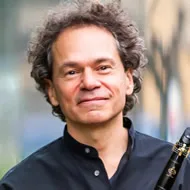
Fabio Di Càsola was born in Lugano in 1967 and won first prize at the International Music Competition Geneva (CIEM) in 1990. He is also a laureate of the Prix Suisse for contemporary music and the Prix Patek Philippe. He also received first prize in the contemporary music competition in Stresa. In 1998 he was voted "Swiss Musician of the Year" by a specialist jury and the public. From 1990 to 2010 he was principal clarinettist of the «Musikkollegium Winterthur» orchestra.
Since 1991 he has been Professor of Clarinet and Chamber Music at the Zurich University of the Arts (ZHdK), where he teaches in English, French, German and Italian.
In 2006 he founded the chamber music festival klang, of which he is artistic director. Most of his CDs have been released by Sony Classical.
Fabio Di Càsola is a member and co-founder of the «Ensemble Kandinsky» and the wind quintet «Swiss5».
How and when did you come to the clarinet?
Among the jazz recordings my father listened to at home, the clarinet was the instrument that struck me most. I was very impressed when I discovered that the clarinet sounds completely different in classical music and that the instrument is very rich in colour.
By chance, a friend of my parents had a very old clarinet in his attic that he no longer needed. I borrowed it when I was 10 years old.
You won the important 1st prize at the CIEM international music competition at just 23. How did this change your life?
When I took part in my first major international competition, I was still studying in Geneva on a master's course for soloists.
As the best clarinettists of the time were evidently taking part in this competition, I did not hold out great hopes for myself.
After winning the competition at that stage of my life, still as a student, it was important to me to find my path in this wonderful profession quickly.
One month later I became principal clarinettist of the Musikkollegium Winterthur orchestra.
You have also won competitions for contemporary music. What is your approach and your relationship to contemporary music?
Through intensive work with contemporary music I have certainly developed certain qualities, both in tone production and in fingering technique.
But I believe the most important thing about this experience was seeing classical music and its development from a different perspective.
You have now been teaching students at the Zurich University of the Arts for over 30 years. How have the students and their playing changed during this time?
It can undoubtedly be said that the general basic level of technical command of the instrument among students has improved greatly.
What, in my opinion, unfortunately has not improved (I think it has even deteriorated) is the ability to listen to music attentively and to follow what is happening in a live concert. This is probably because people hear a great deal of music throughout the day, even involuntarily, and thereby lose the habit of listening to music actively.
Do you teach differently today than you did 30 years ago?
Over these 32 years I have gathered a great deal of experience and developed a broad range of approaches to help my students solve their problems.
In this sense, I hope that over the years I will teach more purposefully during my teaching activity at the ZHdK.
You were principal clarinettist of the Musikkollegium Winterthur for 20 years and are currently a very active chamber musician, a member of several ensembles. How do you fit everything in, including teaching, alongside your solo career? Did you never want to put all your eggs in one basket?
The fact that I received an orchestra position and a professorship in Zurich only a few months after winning the first prize in Geneva enabled me to pursue my solo career, my orchestral career and my teaching in parallel.
I still consider myself very fortunate to have received this opportunity. These three professions are very closely connected and complement one another.
In this way I was able to develop musically in different directions, which probably also made me more open-minded in my profession (at least I hope so).
Had I put everything on one card, I would not have been able to develop in this way.
You have been artistic director of the klang festival since 2006. What is special about this festival?
The klang.ch festival is based on the idea of creating closeness between audience and musicians. The various venues (Schloss Meggenhorn, St. Charles Hall, Grandhotel Giessbach, Kursaal Hotel Zürichberg, etc.) are also very inspiring for the musicians.
The festival always takes place between 26 and 30 December, but also over three days in summer: in 2023, for example, from 16 to 18 June.
In planning the artistic programme, we aim to put together a varied programme with well-known pieces and works still to be discovered, in order to appeal to a broad audience. The line-ups range from solo to octet, and this summer the closing concert «Gourmet Grooves» will present Peter Schickele's classical-jazz quartet and Bohuslav Martinů's sextet «Revue de Cuisine» with humorous texts – an entertaining evening is guaranteed.
What does music personally mean to you, and how has your relationship with it changed over the years?
As a child I was rather shy and introverted. Listening to classical music in my room, alone with headphones, gave me a great deal of inner strength to make contact with the outside world.
Later, over the years and with the concert opportunities I had, I realised that I can express myself differently than with words, and that I can reach the souls of the people around me with more feeling and power. As I said, I consider myself very fortunate to have had this opportunity and I am very grateful for it.
What passions do you have besides music?
Being in contact with nature, walking in the forest, especially in the mountains, and on the way back... drinking a good espresso.
What have you not yet done that you would still like to do – musically and privately?
My special interest lies in chamber music, and I am glad that I am already very active in this area.
If I may dare to dream: I would wish for my own concert hall with ideal acoustics. There I would like to present chamber music programmes or programmes with small orchestras (and perhaps also conduct), in which the audience can immerse itself even more intensely in the sound experience.
Interview by Florian Schär | Classicpoint.net | 01.04.2023
Photo: Adrian Rosu
More interviews
All interviews →


