

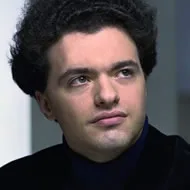
« Life brings its own surprises. »
Evgeny Kissin is one of the outstanding pianists of our time. Born in Moscow in 1971, he began playing and improvising on the piano by ear at the age of two. At six he was admitted to the Gnessin School of Music in Moscow. There he became a pupil of Anna Pavlovna Kantor, who remained his only teacher. He made his solo debut with orchestra at the age of ten, which earned him the reputation of a child prodigy. At the New Year's Concert of the Berlin Philharmonic in 1988, Kissin performed Tchaikovsky's B-flat minor Concerto under the direction of Herbert von Karajan, and with it achieved his international breakthrough.
You started playing the piano very early. What can you still remember about it?
Before I had my first piano lessons, I had been listening to music without a break since my birth. I already knew a great many different musical styles and pieces very well by the time I finally had the physical size to touch the keyboard. I began to play these melodies and pieces back by ear. The first piece I sang was a Bach fugue; I was 11 months old. My older sister was practising the Prelude and Fugue in A major from the second book of The Well-Tempered Clavier.
You studied with the same teacher, Anna Pavlovna Kantor, your whole life. Can you tell us something about your relationship with her and what you valued most about her?
She is a person of true and remarkable integrity. She sacrificed her whole life for her piano teaching. One evening, when we had organised her 85th birthday dinner, a friend asked her whether she could say how she had taught me in my childhood. Mrs Kantor said that in fact my own personality, my natural gifts and my specific qualities were the only aspects that showed over time how it was best to teach me.
How would you describe your personal relationship with the piano as an instrument?
Since my earliest childhood I have had a natural urge to play the piano. I loved playing the piano for my own enjoyment, rather than practising for lessons.
What interests you outside of music?
Poetry, reading short stories and games.
You have learned the Yiddish language. At the Verbier Festival in 2002 you recited in Yiddish in public for the first time. What does this language and your Jewish roots mean to you?
As a child I did not learn Yiddish, although I heard it quite often. When I spent summers with my maternal parents at their country house, they often spoke Yiddish. As I grew older, I wanted to learn the language properly.
A few years ago I heard a recording of Bloch's Sonata, a wonderful piece. And three years ago I took part in the concert series of Pro Musica Hebraica in Washington, organised by Charles Krauthammer and his wife Robyn. The Krauthammers began sending me various scores of Jewish music. I then chose the pieces I found most suitable. Every language is a treasure. Every heritage of a nation is a treasure. Yiddish is a very rich and expressive language. Wonderful literature was and still is written in it. I feel that this is something that should be kept alive.
You will also be playing at the Verbier Festival this year. The programme features Beethoven and Rachmaninoff. What is your relationship to these composers?
I have a complicated relationship with Beethoven's music, although I have always believed that I have a special affinity for it. But in this case my love for his music has never been transformed into an adequate ability to express it. I always play Rachmaninoff as if it were my first time.
Where do you see the challenges in your life, and what are your plans for the future?
I say quite often: life brings its own surprises. For example, only a few years ago I would never have believed that I would write prose in Yiddish and that it would also be published. Well, and now exactly that is happening.
Interview by Florian Schär | Classicpoint.net | 1 June 2017
© Photo: Sheila Rock
More interviews
All interviews →


