

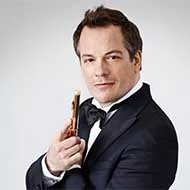
«It is a wonderful balance for me.»

Travel has been an important part of Emmanuel Pahud's life from birth. His father worked for an American company, and the family moved repeatedly during his childhood. However, this only shaped Pahud's international outlook for his future. Just six weeks after Pahud was born, his parents moved to Baghdad for a year. When he was one year old, they moved again, this time to Paris, where Emmanuel's younger brother was born. In 1972 they then moved to Madrid for two years, and in 1974 finally to Rome for four years. In their Rome apartment building lived the Swiss-French Binet family, whose four children played musical instruments. The father (François) was a flautist who studied in Zurich and Paris but no longer performed in later years. At the age of four, Pahud heard the flute for the first time. When the eldest son Philippe played Flute Concerto No. 1 (Mozart) K. 313 in G major, it was the starting signal for a remarkable chapter in Pahud's life.
Pahud attended the Conservatoire de Paris (Conservatoire National Supérieur de Musique de Paris) in France and studied with Michel Debost, Alain Marion, Pierre Artaud and Christian Larde. During his studies he won two major competitions, one in Duino in 1988 and the other in Kobe in 1989. In 1988 Emmanuel also won 2nd prize at the International Scheveningen Music Competition in Scheveningen, Netherlands. As a result of these competition successes, Pahud was appointed principal flute of the Radio-Sinfonieorchester Basel under Nello Santi. He obtained this position in 1989, while he was still studying in Paris. He left the orchestra in 1992. Pahud was also principal flute of the Munich Philharmonic under Sergiu Celibidache. Pahud completed his studies at the Conservatoire in 1990, at the age of 20, with a First Prize (Premier Prix). Over the following two years he continued his studies in style and interpretation with one of France's greatest flautists, the Swiss Aurèle Nicolet, who turned out to be his neighbour. In 1992 Nicolet prepared Pahud in an extensive ten-day audition course for both the International Music Competition of Geneva (le Concours International de Genève) in September of that year and the audition for the position of principal flute of the Berlin Philharmonic (BPO) in October. He explains that he owes both his first prize at the Concours International de Genève and his appointment as principal flute, at the age of 22, by BPO conductor Claudio Abbado to his experiences with Nicolet.
As a child you moved very often. Did this have any influence on your later life as a musician or on certain decisions?
I haven't thought about it yet, and in principle I don't see any connection. Of course, childhood experiences shape you, and travelling with the family brought me into contact with music early on. Perhaps I would have discovered music for myself sooner or later anyway. But in this way I came into contact with the flute already at the age of 5, through our neighbour in Rome. As an adult I travel a great deal now, and my childhood certainly helps a little there and has a positive influence on my perception.
You were the youngest member to become principal flute of the Berlin Philharmonic under Claudio Abbado at the age of 22. Can you tell us a little about that time?
Above all, it was an exciting time for everyone. The city was in transition after the fall of the Wall, one of the few cities in Europe that could still grow and change from within. On the other hand, in the orchestra the post-war generation had reached retirement age, and a new wave of musicians arrived, all from different corners of Europe. Claudio Abbado's task was to bring these forces together and unite us as musicians.
Do you teach very little these days?
Yes, with concert tours as a soloist, in the orchestra and in chamber music I have hardly any time for teaching. Corona has changed all of that: fewer tours, fewer trips. As a result I have also gained a little more time in Berlin. We have an orchestral academy, and there we teach two students on the flute. They are prepared by us, together with us, for competitions and performances. In addition, I have the opportunity to teach ensemble music and woodwind and brass at the Barenboim-Said Academy.
What do you enjoy most: soloist, chamber music, orchestra?
I enjoy everything, so I try to fit it all in by alternating between them. Playing in an orchestra always moves me, but in a solo concerto you are responsible for the music yourself. I think the two complement each other quite well. In the orchestra the Romantic dominates, while in chamber music it is Baroque and modern music. There are many ways to pick the best from both worlds. For me, it is definitely a wonderful balance.
Which composers and compositions do you like best?
As a child I came to music through Mozart. That kind of music quickly captivated me, and Wagner also had a very formative influence. From about the age of 30 my taste has changed somewhat and now leans more towards Ravel or Stravinsky. But Mozart and Bach are so monumental that it is a luxury for me to be allowed to engage with them.
Have you ever composed anything?
No, I have occasionally improvised on projects. But sitting at a desk to write is something I have neither the urge nor the time for.
What is your view of contemporary music?
I like working with composers of the modern era. For example, each year I receive a new flute composition that I get to study. I also receive many new works for solo or chamber music. When I speak with composers today and become familiar with their perspective and their train of thought, I also understand older compositions much better.
How much do you still practise?
I always try to practise a few hours a day. By this I mean purely practising alone, without other musicians. This is something very important to me. And fortunately, since Corona I have had more time for it.
Do you have goals or visions?
Yes, I would like to continue this complete body of music for flute. I currently have about 20 projects in mind. These are the things I am considering. On the other hand, I want to share my experience with the next generation. I am now increasingly working with music universities, where I can show a great deal. But if you devote more time to others, you have less for yourself.
Do you have passions beyond music?
Earlier I would have said travelling and experiencing other cultures, which is of course very enriching. But you can also do that through books; there are so many books about other cultures and insights. Understanding them, I believe, is very important.
Interview by Florian Schär | Classicpoint.net | 23.12.2021
More interviews
All interviews →


